Next Scottish government faces ‘really difficult’ spending choices, economists say

The next Scottish government will need to make “really difficult” spending decisions soon after taking power, including tackling its large public sector pay bill, senior economists have said,Economists with the Fraser of Allander Institute, at the University of Strathclyde, believe the manifestos published by Scotland’s political parties during the campaign failed to tell voters about the true scale of the challenge,Prof Mairi Spowage, the institute’s director, said the next government would need to have a “reckoning” after the 7 May election because the last Scottish National party administration consistently spent more money than it received from its core sources of funding,She said it had been heavily reliant on non-recurring windfalls, such as fees from the ScotWind offshore wind licensing round or one-off payments from the Treasury, to fund its higher spending,The next government would therefore face the most challenging budget since the Scottish parliament was founded in 1999, she said, and may need to cut this year’s spending to cope with the shortfall.
“The parties have engaged in a collective bout of fiscal denial with manifestos which have lots of commitments, yes, some ways to save money, but any money that is saved is then spent immediately,” she said at a recent briefing for economists.“We can’t go on as we are, never mind spend more money.”The FAI’s analysis shows that, on average, Scottish public spending has grown in real terms by 3.9% a year since 2019.Yet its income from taxes, the UK government’s annual grant and one-off sums from energy levies and so on grew by only 3.
6% a year.Scottish spending has also grown “significantly” faster than the UK’s, which has been limited to 3% a year on average over the same period, partly because the SNP government breached its policies on public sector pay, the FAI said.Last year, the Scottish government estimated it faced a £5bn gulf between its spending commitments and income by the end of this decade.SNP ministers published a revised spending strategy in January, which they said would cope with much of that overspend.The Scottish Fiscal Commission, the official watchdog, forecasts spending for day to day Scottish services will rise by only 1% a year over the next five years.
The FAI’s analysis echoes the view of the Institute for Fiscal Studies, which said on Monday none of the parties’ plans were “fiscally credible”.David Phillips, the IFS’s lead on devolved government finances, said every party displayed a “lack of realism regarding just how tough the fiscal challenges facing the next Scottish government are”.João Sousa, the FAI’s deputy director, said the last Scottish government had trimmed its spending plans in January to partly address the funding gaps but there were still a number of “unexploded traps” laying in wait for the next administration.Those include meeting the costs of public sector pay growth, future health and social care cost increases and funding Scotland’s rising social security bill, which is forecast to be £1.2bn higher than its share of UK welfare spending by 2031.
The Scottish government spends nearly half its £59bn annual budget on pay, such as council refuse workers, doctors, nurses and teachers.Two years ago, it set a public sector pay policy to cap pay rises at 9% over the next three years, with no year exceeding 3%.But its actual pay deals, using collective bargaining with public sector unions, took up 8% of that within two years.Sousa said that 9% cap would have to be breached next year if public sector pay were to keep pace with inflation.And as these wage increases were recurring costs, every future government would have to keep funding them unless there were cuts in public sector employment.
Scottish ministers say they can save £1.5bn through efficiency savings and cutting the public sector workforce, chiefly by natural wastage.Sousa said that approach lacked credibility and ministers could “only paper over things for so long.”All the major parties in this election – the SNP, Labour and the Conservatives – have promised voters they will not raise income tax, and said they aspired to cut income tax or to simplify the system once government finances allowed.Prof Graeme Roy and Prof Anton Muscatelli, of Glasgow University, and Prof Stuart McIntyre, of Strathclyde university, three of Scotland’s leading economists said the next government’s “overarching challenge will be economic and fiscal”.
Writing in the Economics Observatory journal, they said: “Slow growth in living standards, an ageing population and rising spending pressures mean that the next parliament will face difficult budgetary choices.A prolonged conflict in the Middle East may make that position even more challenging, particularly if the UK overall becomes even more constrained fiscally.”

Mercedes may have won again but Miami upgrades have shaken up the F1 grid | Giles Richards
The improved form of McLaren and Red Bull in Florida suggests the 2026 title race is likely to run and runThere is a long old way to go but after Formula One emerged from its enforced early season break with an entertaining romp around the Hard Rock Stadium in Miami, it indicated that there may yet be a decent tale to be told this season. One where Mercedes do not have it all their own way.Regulation changes dominated the buildup – of which more later because honestly paragraph two is too early to subject readers to the increasingly soul-destroying phrase “energy management” – but what really mattered in Miami was the sporting imperative of upgrades making a competitive difference.Mercedes had looked ominously strong with three straight wins in the opening three rounds before the five-week break caused by the cancellation of the Bahrain and Saudi GPs. During that time there was no little beavering across the paddock on upgrades for Miami
RFU backs Steve Borthwick to lead England for 2027 World Cup after Six Nations review
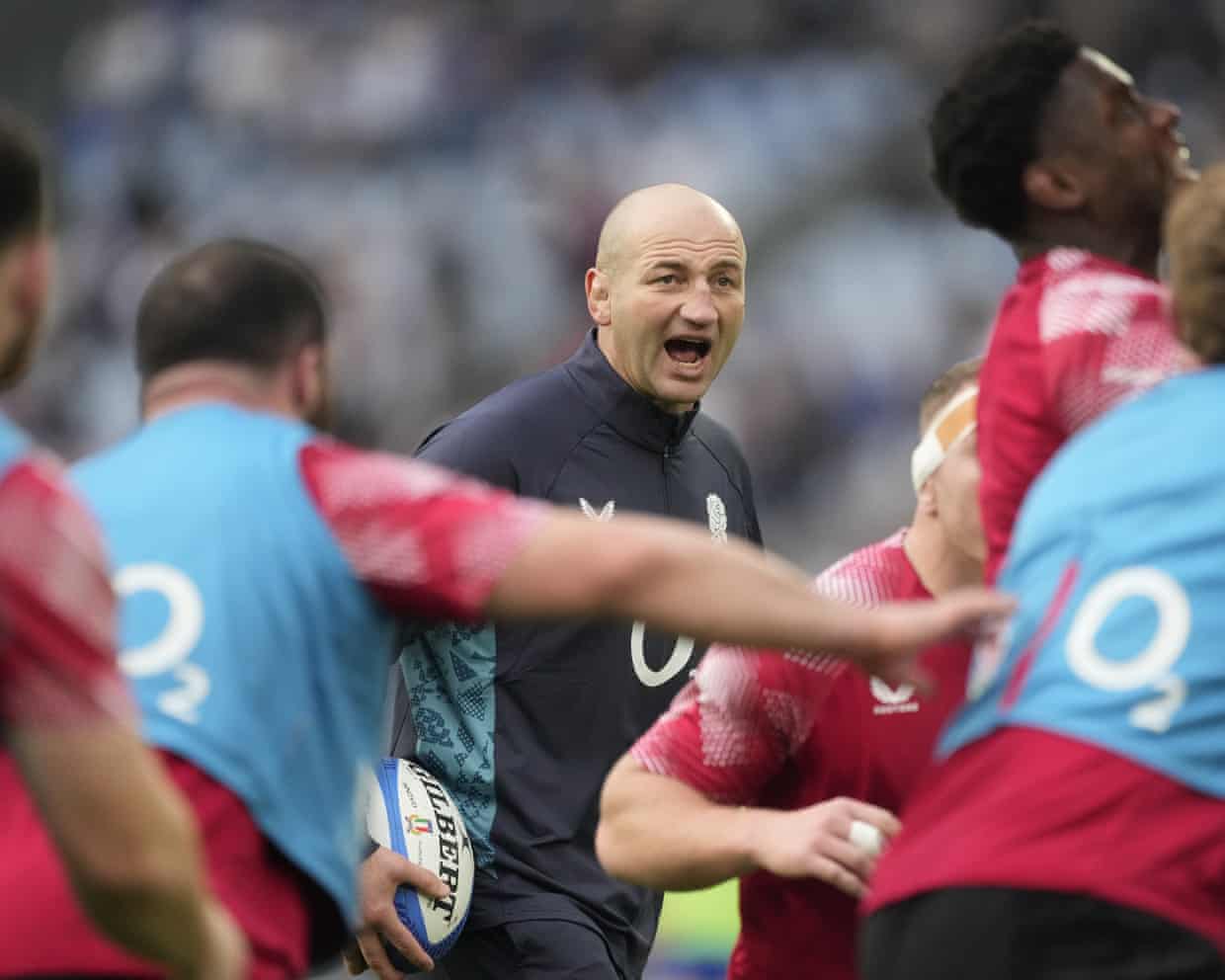
Steve Borthwick and his coaching staff will remain in charge of England’s men despite the team’s worst Five or Six Nations for 50 years. The Rugby Football Union has opted to back Borthwick and his lieutenants through to the Rugby World Cup in Australia next year having completed what it described as “a detailed and robust review” of England’s latest campaign.Despite the team having lost four championship games in the same season for the first time since 1976, the RFU has chosen to keep faith with the Borthwick regime in the belief that things can only get better. The union has decided that sacking the head coach is not the optimal solution, having previously dispensed with Eddie Jones’s services nine months before the 2023 World Cup.“This has been a thorough and honest review, and it is clear that improvement will come from addressing several areas rather than chasing one simple answer,” said the RFU’s chief executive, Bill Sweeney, in a statement

The Breakdown | Rugby needs to stop the screen-obsessed, finger-pointing, hair-trigger arguments
Game is in danger of losing its integrity by howling about referees’ decisions and unedifying actions on the field under the notional banner of player welfareIt felt like a proper occasion in Bordeaux on Sunday. The trams were so jammed en route to the ground that the kick-off had to be delayed to allow spectators extra time to find their seats. For those who dismiss the notion of club rugby rivaling football for vibrant mass interest, here was a compelling counterpoint: a heaving 42,000-capacity stadium, off-the-scale passion, top-class sport in every respect.Later on, after the game was done, there was another revealing snapshot at the airport. As Bath’s beaten players headed for their flight home they were warmly applauded down to the gate by their travelling supporters
Carlton fined $75,000 for mishandling of Elijah Hollands’ mental health episode
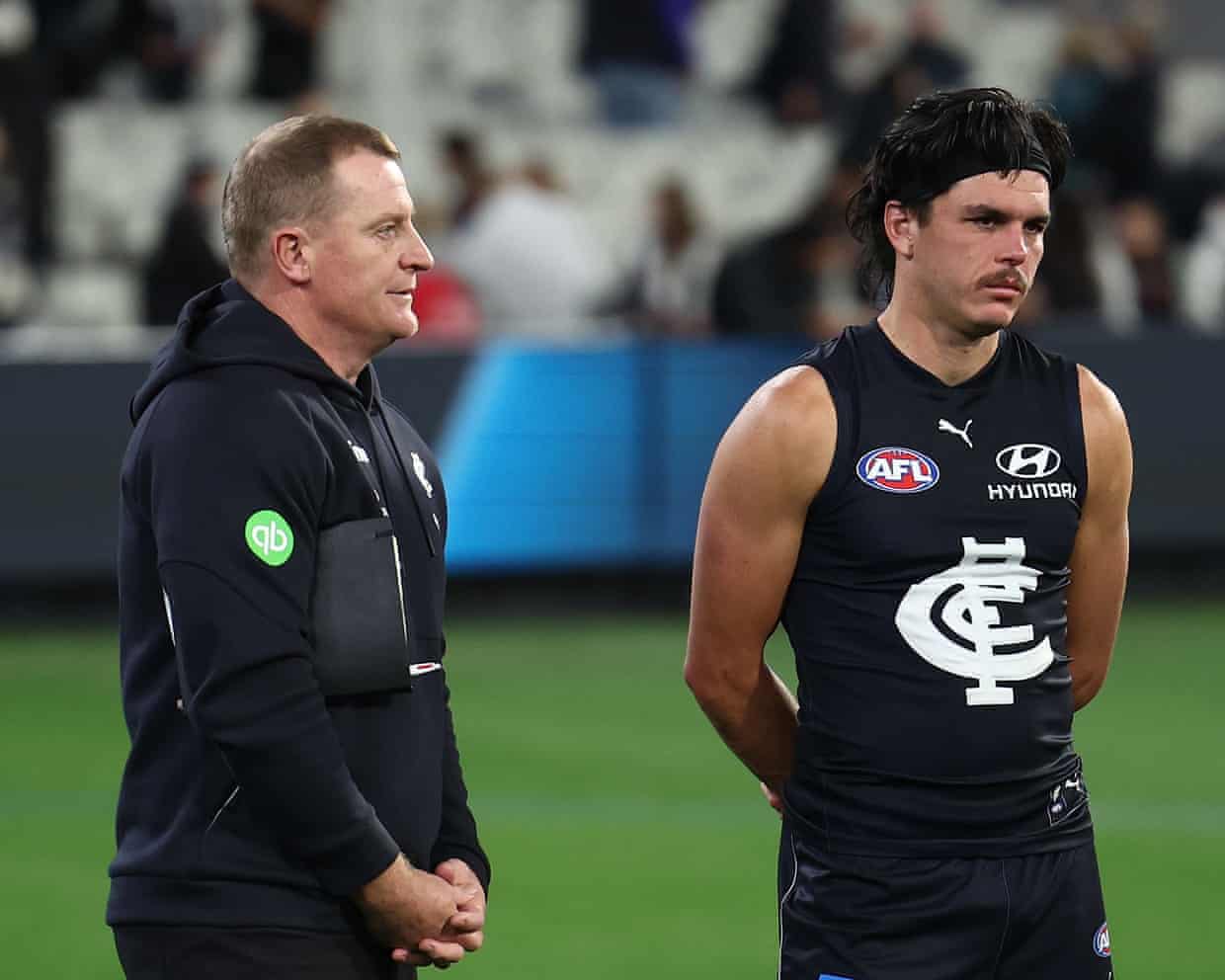
The AFL has fined Carlton $75,000 for not removing Elijah Hollands from the field while he was experiencing a mental health episode during round six against Collingwood.Hollands appeared to be acting erratically during the match at the MCG, and was admitted to hospital for treatment several days later.The AFL found Carlton should have removed Hollands from the game earlier based on visual cues, performance data and the player’s previously disclosed mental health challenges, and that the club’s failure to do so brought the game into disrepute.The AFL’s chief executive, Andrew Dillon, said the “substantial sanction” was made against the club “collectively” rather than singling out any individuals.“What transpired during the game was something we haven’t seen before and while Elijah did undergo checks, he should not have been left on the field for that period of time,” Dillon said, adding that the incident had highlighted areas of improvement for the code

‘English cricketers don’t always have that fight’: Simon Harmer on lessons from a decade in county game
The Essex and South Africa spinner has taken more Championship wickets than anyone else since arriving in 2017 – but says 18 teams can reward mediocrityFor 10 seasons, few have earned the right to comment on English cricket more than Simon Harmer. Because for 10 seasons, no one has taken more County Championship wickets than the South African off-spinner who arrived at Essex in 2017 on a six-month contract, his international career stalled and his options narrowing fast.He has since become one of the great imports of the English game: 522 first-class wickets and counting for Essex, two County Championship titles, a Bob Willis Trophy, a return to South Africa’s Test side and, perhaps most importantly, contentment. “My journey has been bumpy,” Harmer says from a sun-drenched beer garden near the Oval. “I can say now that I’m at peace with it

These are the questions I would ask the Enhanced Games … if they would let me | Sean Ingle
The plan to fly to Las Vegas to cover what the Enhanced Games claims is the “next frontier of human performance” ended with a short email sent at 7.02pm on Friday. “After careful consideration, we are unable to approve your media credential request for this year’s event,” it said. “Due to the high volume of applications and limited media capacity, we could not accommodate all requests … thank you again for your interest and understanding.”Admittedly, the rejection didn’t come entirely out of the blue

UK 30-year borrowing costs hit highest since 1998 amid oil price surge and political uncertainty – as it happened

HSBC profits fall amid $400m fraud-related charge and Iran war

Ken Eason obituary

Richard Dawkins concludes AI is conscious, even if it doesn’t know it

Sabalenka believes players will boycott grand slams to ‘fight for our rights’
London Marathon sets record after 1.8% of UK adult population applies for 2027 race