Reform council’s plan to shut eight care homes ‘a betrayal of local people’

A Reform UK-led council plan to shut eight of its residential care homes has been condemned as “a betrayal of local people”.Days before Christmas, Derbyshire county council announced that the homes would have to close after a proposed sale fell through.The closures have prompted a backlash and have echoes of the furore in Lancashire where the Reform-led council is planning to close five care homes and five day centres and move residents into the private sector.Mick Coppin, a regional organiser of the GMB union, said the Derbyshire plans put vital services and more than 200 jobs at risk.“These closures are nothing short of a betrayal of local people and staff,” Coppin said.
“Derbyshire county council did not stand before the electorate last May pledging to shut care homes.“Care home residents, their families and dedicated care workers face huge anxiety about the future – just days before Christmas.It’s time for the county’s leadership to halt these disastrous plans and work with the community to explore alternatives to closure.”Linsey Farnsworth, the Labour MP for Amber Valley, last week raised the issue at prime minister’s questions in the Commons, saying that families and staff were heartbroken and called for a rethink.Keir Starmer replied: “It is deeply concerning to hear about the closure of eight Derbyshire care homes by the Reform-led Derbyshire county council.
It will be hugely concerning to residents and their families, while we are making £3.7bn of extra funding available to councils to fund social care.”Derbyshire county council said it had been in “intensive” but unsuccessful negotiations with a provider to take over the running of the eight homes as a going concern.Joss Barnes, a Reform councillor who is the cabinet member for adult care, said he was “devastated” by the failure of the negotiations.“I know this will be extremely upsetting news for all our residents and their families, as well as our hard-working care colleagues, especially coming at this time of year in the run-up to Christmas,” he said.
“I’d like to thank everyone for their hard work, patience and persistence and I’d also like to say how incredibly sorry I am that this hasn’t worked out as we’d hoped and planned for.“We have done absolutely everything to progress the sale, but in the end it wasn’t possible.Due to commercial sensitivities, we’re not able to give any more details regarding negotiations.”He said the council would work to support residents to find new homes.The decision to sell the homes was agreed in November 2024 when the authority was Conservative-controlled.

Former EU commissioner and activists barred from US in attack on European tech regulators
The state department has barred five Europeans from the US, accusing them of leading efforts to pressure tech firms to censor or suppress American viewpoints, in the latest attack on European regulations that target hate speech and misinformation.Secretary of state Marco Rubio said the five people targeted with visa bans – who include former European Commissioner Thierry Breton – have led “organized efforts to coerce American platforms to censor, demonetize, and suppress American viewpoints they oppose.”“These radical activists and weaponized NGOs have advanced censorship crackdowns by foreign states – in each case targeting American speakers and American companies,” Rubio said in an announcement.In recent months, Trump officials have ordered US diplomats to build opposition to the European Union’s landmark Digital Services Act (DSA), which is intended to combat hateful speech, misinformation and disinformation, but which Washington says stifles free speech and imposes costs on US tech companies.Late on Tuesday night, Breton posted on social media: “Is McCarthy’s witch hunt back?”Tuesday’s move is part of a Trump administration campaign against foreign influence over online speech, using immigration law rather than platform regulations or sanctions

Elon Musk, AI and the antichrist: the biggest tech stories of 2025
Hello, and welcome to TechScape. I’m your host, Blake Montgomery, wishing you a happy and healthy end of the year. I myself have a cold.Today, we are looking back at the biggest stories in tech of 2025 – Elon Musk’s political rise, burst and fall; artificial intelligence’s subsumption of the global economy, all other technology, and even the Earth’s topography; Australia’s remarkable social media ban; the tech industry’s new Trumpian politics; and, as a treat, a glimpse of the apocalypse offered by one of Silicon Valley’s savviest and strangest billionaires.At the close of 2024, I wrote that Elon Musk’s support of Donald Trump had made him the world’s most powerful unelected man

Activist group says it has scraped 86m music files from Spotify
An activist group has claimed to have scraped millions of tracks from Spotify and is preparing to release them online.Observers said the apparent leak could boost AI companies looking for material to develop their technology.A group called Anna’s Archive said it had scraped 86m music files from Spotify and 256m rows of metadata such as artist and album names. Spotify, which hosts more than 100m tracks, confirmed that the leak did not represent its entire inventory.The Stockholm-based company, which has more than 700 million users worldwide, said it had “identified and disabled the nefarious user accounts that engaged in unlawful scraping”

Chinese robotaxis due in London next year as Lyft and Uber reveal tie-ups
Chinese robotaxis are due to be on the streets of London next year after the US ride-hailing companies Lyft and Uber announced tie-ups with Beijing-based Baidu to deploy its self-driving technology.Lyft is the third firm to announce plans to introduce self-driving taxis to the UK capital next year, after Uber and Waymo, the main operator of robotaxis in the US.Its ride-hailing services are the major rival to Uber’s in the US and Canada, and this year Lyft expanded into Europe after acquiring the Freenow app in the summer.While Uber had signed a deal to work with Baidu in the summer in other global markets, it had not until now said that the Chinese tech company’s Apollo Go cars were planned for London. It had previously announced its services would be operated with self-driving technology from the UK-US firm Wayve
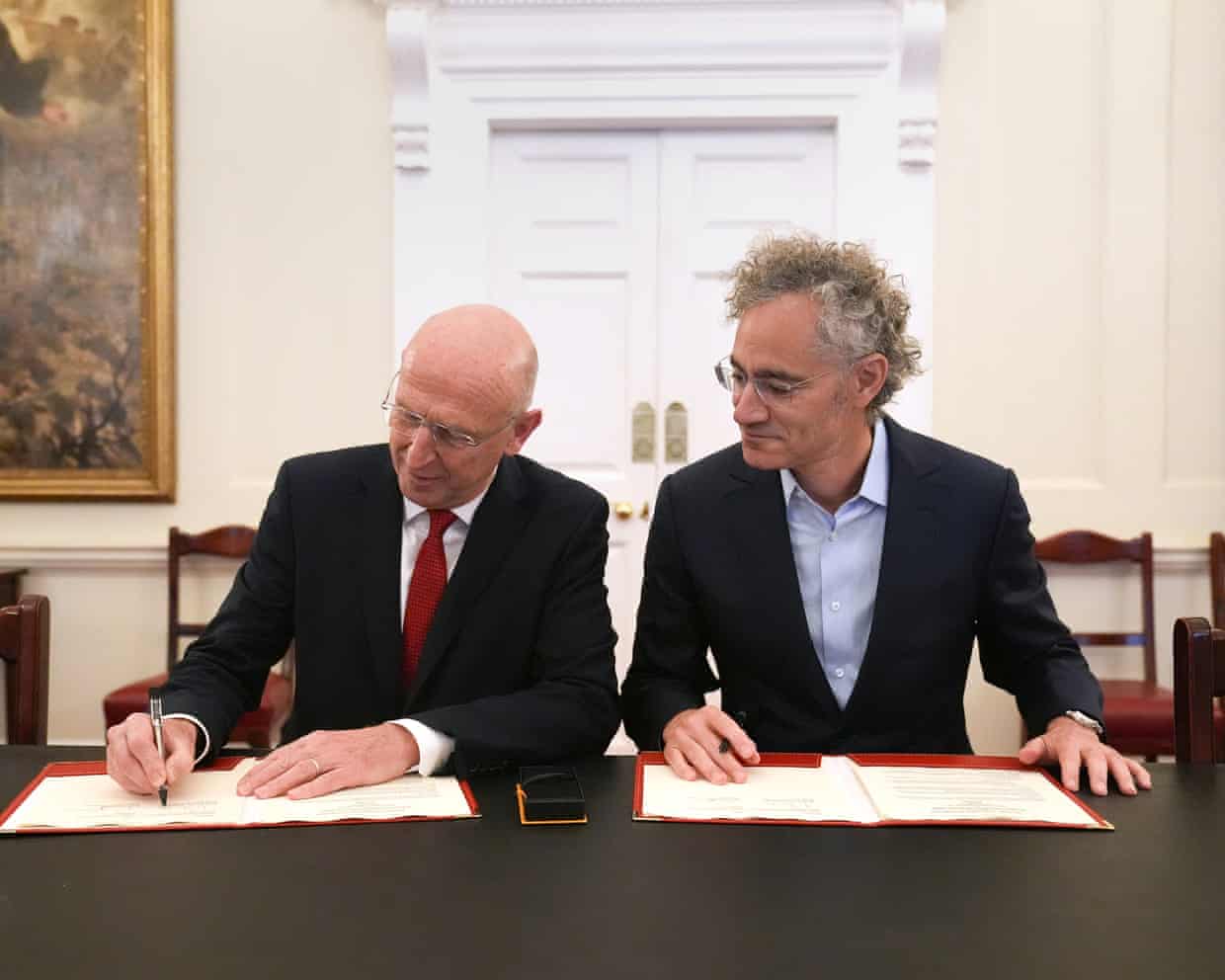
MPs question UK Palantir contracts after investigation reveals security concerns
UK MPs have raised concerns about the government’s contracts with Palantir after an investigation published in Switzerland highlighted allegations about the suitability and security of its products.The investigation by the Zurich-based research collective WAV and the Swiss online magazine Republik details Palantir’s efforts, over the course of seven years, to sell its products to Swiss federal agencies.Palantir is a US company that provides software to integrate and analyse data scattered across different systems, such as in the health service. It also provides artificial intelligence-enabled military targeting systems.The investigation cites an expert report, internal to the Swiss army, that assessed Palantir’s status as a US company meant there was a possibility sensitive data shared with it could be accessed by the US government and intelligence services

Extremists are using AI voice cloning to supercharge propaganda. Experts say it’s helping them grow
While the artificial intelligence boom is upending sections of the music industry, voice generating bots are also becoming a boon to another unlikely corner of the internet: extremist movements that are using them to recreate the voices and speeches of major figures in their milieu, and experts say it is helping them grow.“The adoption of AI-enabled translation by terrorists and extremists marks a significant evolution in digital propaganda strategies,” said Lucas Webber, a senior threat intelligence analyst at Tech Against Terrorism and a research fellow at the Soufan Center. Webber specializes in monitoring the online tools of terrorist groups and extremists around the world.“Earlier methods relied on human translators or rudimentary machine translation, often limited by language fidelity and stylistic nuance,” he said. “Now, with the rise of advanced generative AI tools, these groups are able to produce seamless, contextually accurate translations that preserve tone, emotion, and ideological intensity across multiple languages

No more kitchen martyrs – a guide to sharing the load at Christmas

A meat-free Christmas: Chantelle Nicholson’s French mushroom pie, caramelised pear pud and more

10 of the best Australian sparkling wines for every budget

Cosmopolitan Christmas: Stosie Madi’s French-African-Lebanese Christmas lunch – recipes

From a showstopping pavlova to a £7 sherry: what top chefs bring to Christmas dinner

A fresh take on wine pairings for Christmas dessert