Baked cheesy smoked haddock and lemon icebox pudding: Henry Harris’ alternative Easter lunch
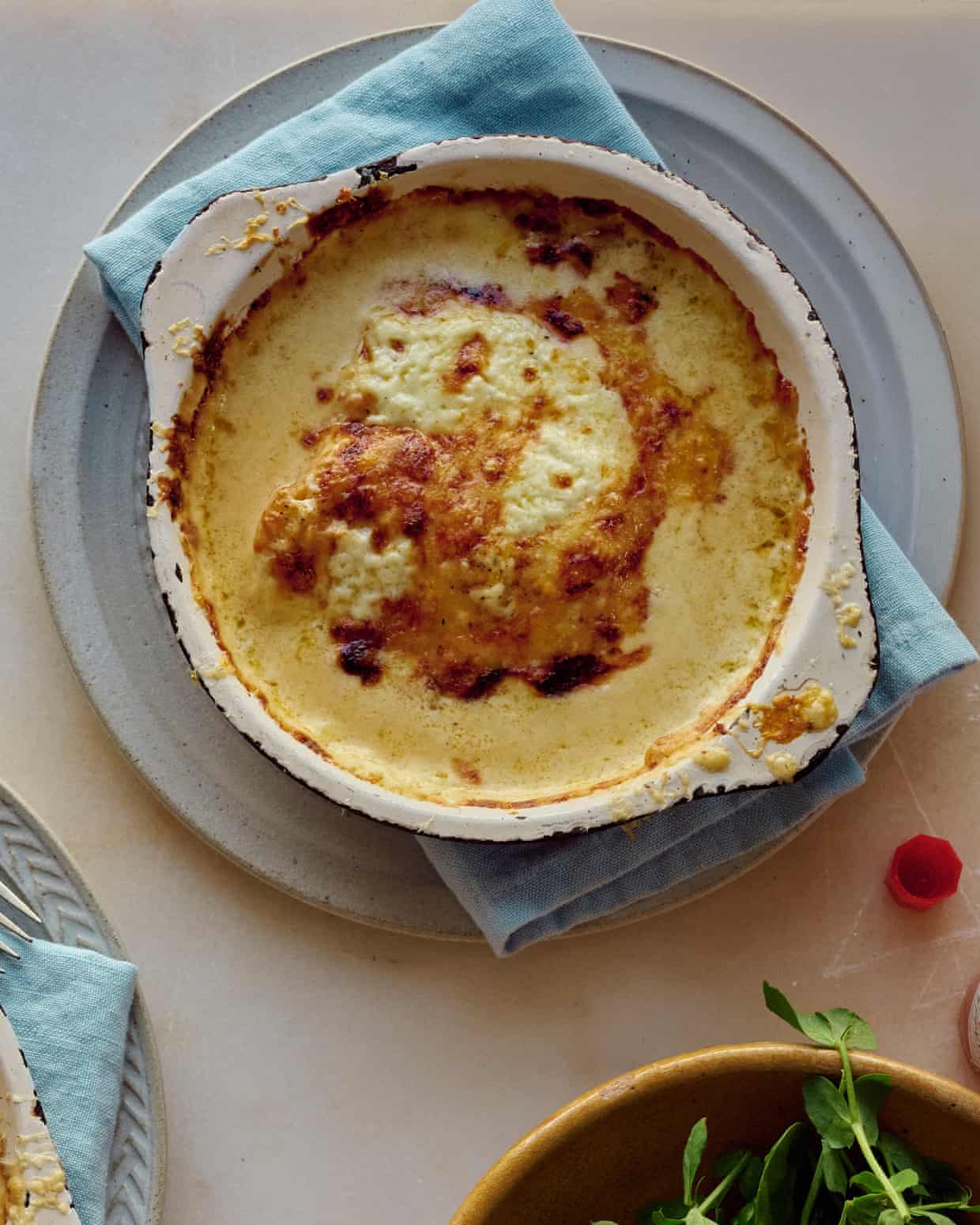
Sometimes all you want is a hot, bubbling dish and a spoon, and for me today’s cheesy haddock is that dish – a 15-minute supper to be enjoyed in front of the telly with a salad or a large bowl of hot buttered peas.Add a lemony, biscuity iced dessert, and you have a light, very easy and enjoyable supper that’s almost the perfect close to a long Easter weekend.Choose your smoked haddock carefully: you want large, thick fillets of undyed fish.Stating the obvious, here, but a good fishmonger will have this; a supermarket never.The creme fraiche must be a French, naturally soured cream, too, becausethe cheaper English versions coagulate when heat is applied, resulting in an unpleasant, watery gunk.
If you want to give this a little extra jazz, slice two leeks into rounds, cook them in butter for about 20 minutes until completely soft and all the liquid has evaporated, and add some sliced cooked waxy potatoes to heat through for the last few minutes.Spread this mixture across the base of the two dishes before adding the fish and building up as below.Prep 10 minCook 15 minServes 22 180g sustainably sourced skinless smoked haddock fillets 150-200g creme fraicheBlack pepper Tabasco sauce, to tasteParmesan, for gratingComté or gruyère, for grating Buttered peas, or green salad, to serveHeat the grill to high.Put each haddock fillet in an individual heatproof dish, spoon over the creme fraiche and spread it out loosely but evenly to cover the fish.Season generously with black pepper and a dash of Tabasco, then grate over a good amount of parmesan – there’s no point in trying to give a precise amount, so just give it a good, generous grating to taste.
Next, grate over a light covering of comté, then put both dishes in the oven on a shelf that’s about two-thirds of the way down from the grill.Close the door and leave to cook for eight to 10 minutes, until the cream is bubbling and the cheeses have started to colour in places.Check that the fish is cooked through – if it isn’t, just cook for a little longer.Put two napkins on two plates and carefully lift the dishes from the oven and on to the plates.Take to the table (or sofa) and serve with buttered peas or a green salad.
The Guardian aims to publish recipes for sustainable fish.Check ratings in your region: UK; Australia; US.My mum often serves this at lunch or dinner parties, because you can make it days in advance, and so remove a level of stress or more complications on the day itself.She usually serves it with a raspberry coulis spiked with a dash of brandy or eau-de-vie, and who am I to disagree?Prep 10 minCook 40 minFreeze 3 hr+Serves 6-8Neutral oil, for greasing150g gingernut biscuits 50g unsalted butter, melted2 large eggs, separated70g caster sugar 120ml lemon juice 285ml double cream Finely grated zest of 2 lemonsGrease a 900g (2lb) loaf tin, then line it with a double layer of clingfilm, ensuring there is plenty of overhang.Put the biscuits in a plastic bag, then use a rolling pin to bash them to crumbs.
Transfer to a bowl and stir in the melted butter,Press half the biscuit mixture evenly into the base of the lined loaf tin, and save the rest for later,Put the egg yolks in a warmed bowl (fill it with boiling water, leave it to stand for a minute or two, then tip out and dry the bowl),Add the sugar, whisk until pale, light and airy, then beat the lemon juice into the sabayon,In a second cold bowl, whisk the cream and lemon zest to soft peaks, then fold the cream into the sabayon.
In a third bowl, whisk the egg whites until they’re properly stiff, fold a spoonful of the egg whites into the sabayon mixture, to loosen it a little, then fold in the rest,Pour the egg and cream mixture into the loaf tin, then put the tin uncovered in the freezer and leave for an hour to set a little,Remove, cover the top evenly with the reserved biscuit mixture, then fold over the excess clingfilm to enclose,Wrap the whole tin in a stout double layer of foil, then return to the freezer until frozen,When you are serving the main course, transfer the tin from the freezer to the fridge, so it has time to temper and soften (Mum says if you are planning a long cheese course after the main course, wait until you have cleared the mains before doing this).
To serve, turn out the pudding on to a board and slice it with a knife that you have run under the hot tap.These recipes are edited extracts from The Racine Effect: Classic French Recipes from a Lifetime in the Kitchen, by Henry Harris, published by Quadrille at £40.To order a copy for £36, go to guardianbookshop.com

Medicines watchdog to investigate UK peptide clinics over health claims
The medicines regulator is investigating whether UK clinics are breaking the law by making claims about the benefits of unregulated, experimental peptide therapies, the Guardian can reveal.Interest in experimental peptides has boomed in recent years. The substances are delivered by injection and are touted by sellers, influencers and even some medics as aiding everything from anti-ageing to recovery from injury.There is little scientific evidence to support such health and wellness claims in humans. Where studies have been carried out, most are in animals or cells

‘Young people want to come together’: experts respond to mass teen meet-ups in Clapham
It started with a flyer sent around on Snapchat. Teenagers were invited to gather at a south London basketball court to celebrate the start of the Easter holidays. They were told to bring their own weed and laughing gas because it was going to be a late one.What followed in the hours after was chaos. Hundreds of young people came to the “link-up” last Saturday, and then gathered on Clapham High Street

Dorothy Logie obituary
My sister, Dorothy Logie, who has died aged 83 of Alzheimer’s, was a Scottish GP whose commitment to global health extended to HIV/Aids care and advocacy in Africa.Dorothy was born in Aberdeen, the daughter of Adeline (nee Donald), a housewife, and William Caie, group secretary of Aberdeen General Hospitals who helped establish the NHS in Aberdeen, inspiring Dorothy to study medicine. She left St Margaret’s school aged 17, qualified as MBChB from Aberdeen University in 1966, and married Sandy Logie, a fellow doctor, two weeks later.She and Sandy travelled the following year to the Gambia to join the Medical Research Council; Sandy was a medical officer and Dorothy researched maternal malaria. When she became pregnant with their first child, she returned to Aberdeen, but the visit sparked a lifelong love of Africa

How we won a refund from a cash-grabbing care home firm | Letters
As witness to the cash-grabbing nature of these businesses (The great care home cash grab: how private equity turned vulnerable elderly people into human ATMs, 28 March), I would like to draw your attention to a specific practice: that of trying to deny grieving families the balance of fees owed to them when a resident dies in the home with full weeks already paid for.I had already heard of this from someone else, so I was on the alert when the same thing happened to us. We were told that it was not their “policy to refund” when, policy or not, a careful reading of the contract showed that the money was owed. We appealed, and were successful.I imagine that many families in the grip of bereavement simply accept this “policy”, shrug their shoulders and say goodbye to the money owed to them

Calling us Auntie or Uncle is no insult | Letters
Re Lola Okolosie’s article (Is calling a woman ‘auntie’ ageist harassment – or a mark of respect? It’s a trickier question than you think, 31 March), I was interested to read uncle/auntie described as honorifics. Growing up (I’m 60-plus years old, Scottish), I think it operated as a familiar term. I was taught to call close friends of my parents Aunt Jane or Uncle John. Otherwise Mister/Miss.Clearly, there is an honorific element – if I am (as a child) calling you Aunt, you are close to my parents, but it was not related to age – I would never have dreamed of calling anyone Aunt/Uncle on an age basis

Young people ‘more likely to leave for health reasons when in low-paid, insecure jobs’
Young people in the UK are more likely to leave their job for health reasons and become economically inactive when they work in insecure, low-paid sectors, a study has found.Research carried out for the Trades Union Congress by the consultancy Timewise charts a connection between the jobs young people are most likely to do – in hospitality, retail and care, for example – and the proportion of people leaving because of ill health.“The occupations that young people are concentrated in are associated with high numbers of people moving into long-term sickness and worklessness,” the analysis said.The authors said that these sectors were also among those most likely to offer precarious or low-paid jobs.More than 40% of staff in accommodation and food services are in insecure working arrangements, for example

Starmer’s cost of living adviser urges him to extend fuel duty cut in light of Iran war

Labour challenges Farage over cost of private jet trip to Maldives

Starmer must call energy summit akin to 2008 crisis response, Labour MP says

Drip-feed of Reform UK controversies puts party’s policy drive in shade

UK politics Q&A, as it happened: Andrew Sparrow answers your questions on Starmer, Reform and more

Reform donor Nick Candy sells Chelsea mansion for reported £275m