Ittai Gradel obituary

With a doctorate in Roman religion and a university chair, Ittai Gradel, who has died of cancer aged 61, might have confined his achievements to a successful scholarly career.However, in 2008, bored with routine bureaucracy, he left his post at Reading University, and returned to his native Denmark to deal in antiquities.His disillusionment with academia was reinforced when, a few years later, he discovered that large-scale thefts had been taking place from the British Museum’s collections.At first reluctant to believe the accumulating evidence, Gradel contacted the museum in 2021 only when it became impossible to deny – and was told nothing was missing.Ill and increasingly impatient, he took his cause to the museum’s trustees, and at last the police were called.
In 2023 the director and deputy director resigned, and a senior curator was dismissed.Investigation of the loss or damage of 2,000 pieces of ancient goldwork, gems and glassware continues.On leaving Reading, Gradel had at first joined an antiquarian book dealership in Copenhagen.But he soon changed his focus to Graeco-Roman engraved gems, finding them both interesting – they evoked the private experiences of people in antiquity, he said, yet could still be worn as personal jewellery centuries later – and profitable.With hindsight, he thought a purchase he made at the very start, trading freelance from home, consisted of pieces stolen from the British Museum.
By 2010 there were signs that might have halted a less trusting mind.An English vendor, claiming to be an old man who had inherited gems from his grandfather, kept finding more to sell.When Gradel tried to meet him (having failed to prove his existence any other way), he received a message supposedly from the man’s son who told Gradel that he had just died.In 2016 someone with the same name as the allegedly deceased vendor listed a Roman cameo on eBay that Gradel knew from a 1926 British Museum catalogue: the listing disappeared within hours, and when asked about it, the vendor said the gem had belonged to his sister and was not his to sell.Only in 2020, however, did Gradel finally accept that something was up.
He saw a piece for sale online that had featured in the same 1926 catalogue, and found that the buyer had acquired it from the same vendor who had first provoked Gradel’s suspicions 10 years before.Hackles raised, Gradel searched his records and found a PayPal receipt naming a Peter Higgs, similar to the name he had been given on earlier sales - Paul Higgs or Higgins.A fellow dealer told him that this was the name of a British Museum curator.When tipped off, the museum saw no reason to investigate.A few months later, it promoted Higgs to acting head of the department of Greece and Rome.
Gradel now began a campaign of emails and letters hoping to stir the museum into action.It repeated its claims of nothing untoward, until October 2022, when a trustee forwarded one of the messages to the new museum chair, the former politician George Osborne.“I have taken your comments very seriously,” Osborne told Gradel.The following July, Higgs was sacked.In August the museum’s director, Hartwig Fischer, resigned, and Jonathan Williams, the deputy director, voluntarily stood down and in due course also left the museum, which has brought a civil case against Higgs.
He denies any wrongdoing.Poor record-keeping had facilitated the thefts, and the British Museum soon announced a five-year plan to document online its entire collection of a nominal eight million objects, a formidable challenge.To date, of 1,500 missing or stolen pieces, 650 have been returned, and more are expected to follow.The saga was covered by the BBC in 2024, in a Radio 4 series Thief at the Museum and a BBC Two film, both presented by Katie Razzall and featuring extensive interviews with Gradel.In the same year, Apollo magazine made Gradel its personality of the year.
Gradel was born in Haifa, Israel, to a British father and Danish mother.They settled in Nyborg, Denmark, when he was aged two.After leaving school he moved to London, where, between part-time working for the London Underground and a fish-and-chip shop, Gradel spent all his spare hours in the British Museum, later claiming to have seen practically every displayed object.He returned to Denmark to study classical archaeology at Aarhus University, receiving a gold medal for his thesis on Roman emperor worship.In 1995 he obtained a DPhil at Oxford University, publishing his research as a much-admired monograph, Emperor Worship and Roman Religion (2002).
After a year as a visiting fellow at Brasenose College, Oxford, and a stint teaching at the University of Copenhagen, in 2005 he took up the post of associate professor of history and archaeology of the Roman empire at the University of Reading.Colleagues there remember him variously as hilarious, eccentric and exasperating.Though he never regretted leaving academia, he retained the dogged determination of a research historian.On one occasion Sotheby’s marketed on his behalf a Roman gem in an 18th-century gold setting, with an estimate of £100,000-£150,000: his description of the lot included 5,000 words of notes and sources.When the gem failed to find a buyer, Gradel told friends he would bequeath it to a museum.
His last publication, co-authored with Arne Pedersen, was The Lost Novel of King Solomon and the Demons (2025), a monograph inspired by the discovery of an antique ring engraved with the message: “Solomon says: Watch out!”Shortly before his death, the British Museum presented Gradel with a medal, and a message from the current director, Nicholas Cullinan, recognising his expertise and “passionate determination that wrongs should be righted”.Gradel is survived by his wife, Hanne Lavér Hansen, who was studying classical philology at Aarhus University when they met, and by his older brother, Kim.Ittai Gradel, classical scholar and antiquities dealer, born 29 January 1965; died 28 April 2026
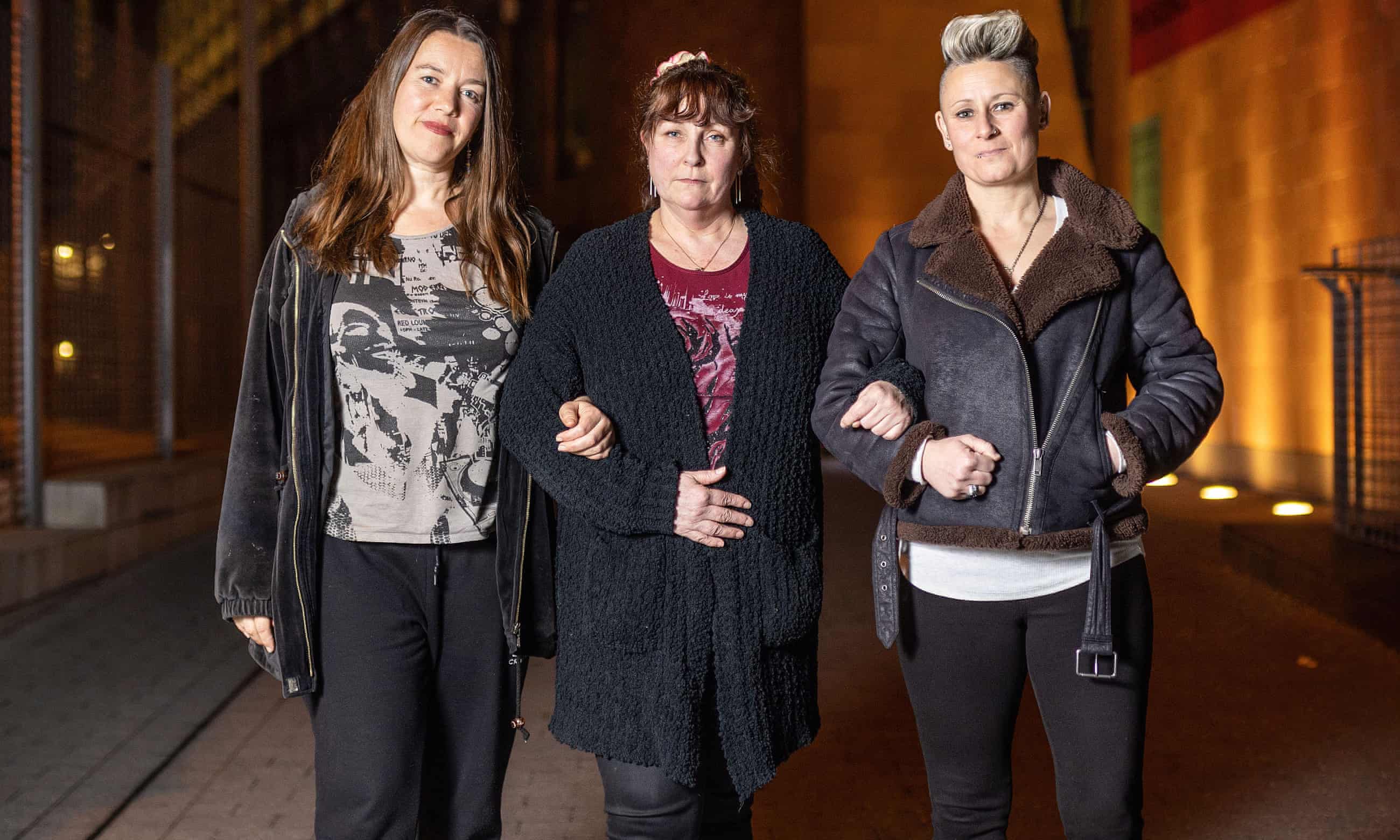
‘We have the same monster’: three women brought down their rapist – this is what happened next
In 2023, the Guardian profiled a group of women who had formed an unshakeable bond after they saw their attacker convicted and decided to waive their anonymity. That interview has now led to a documentaryThe three women refer to each other as “the girls”, even though they are in their 40s and 50s, long past girlhood. They have a WhatsApp group called Sister Solidarity, even though they are biologically unrelated.The unshakeable bond between Laura Hughes and Lauren Preston, both 45, and Mary Sharp, 58, came about for the saddest reason – all three were raped and abused by Martin Butler, a manipulative drug dealer on their estate in London who groomed and coerced them decades ago.Butler is now serving a lengthy sentence for the rape and buggery of Sharp in 1988

Did breakthrough in US fentanyl crisis start in China?
As Donald Trump travels to Beijing this week, fentanyl – and China’s role in its supply chain – remains an enduring point of acrimony in bilateral relations.At a UN meeting in March, the US again accused China of failing to stop its chemical industry selling the precursors required to make the potent synthetic opioid, while China suggested the US was shifting the blame for its domestic drug problem.Yet there are growing signs that the US fentanyl crisis has turned a corner – and some experts believe that interventions made in China have played a key role.“There was a supply shock: the purity of fentanyl fell,” said Keith Humphreys, a professor at Stanford University. “The question is why was there a supply shock

Getting children to eat their vegetables starts in the womb, researchers suggest
Rather than bribery, or hiding carrots under ketchup, the key may be to expose foetuses to healthy flavoursIt is an age-old battle with small children that most parents will recognise: please, please, eat your vegetables.Some will read them books with titles such as The Boy Who Loved Broccoli. Others have been known to smother veg in tomato ketchup, or mix avocado and fruit with Greek yoghurt and call it icecream. Or resort to plain bribery.Now, a study suggests there may be a more effective approach – but mothers need to start early

Older people risk mental decline if they do long hours of caring, UK study shows
The stresses and strains of caring for someone for 50 hours or more a week leads to “accelerated cognitive decline” in middle-aged and older people, research shows.However, providing care for only five to nine hours a week has the opposite effect, boosting brain health so much that the benefits last until older age.Carers UK called the findings “extremely worrying” and said they highlight how long hours spent providing care raises the risk of social isolation and burnout.Dr Baowen Xue, an academic at University College London and the lead author of the paper, said: “Our study shows that the caring responsibilities many people take on in later life can be a double-edged sword.“On the one hand, lighter caring responsibilities can be good for you by providing mental stimulation from interacting with loved ones or others you’re helping and a sense of purpose and usefulness

Capacity of lifts not kept up with UK obesity levels, study shows
Lifts are no longer big enough to fit the UK’s larger citizens, according to researchers.A study of maximum capacity in elevators in the UK and mainland Europe found lifts have not kept up with increasing obesity levels, raising concerns about safety and equity.The research, presented at the European Congress on Obesity in Istanbul, Turkey, used photos of weight limits for 112 lifts manufactured between 1972 and 2024 in the UK, France, Germany, Italy, Spain, Austria and Finland.Prof Nick Finer, the president and chair of the International Prader-Willi Syndrome Organisation and lead author of the study, compared the average maximum weight allowance (total weight allowance divided by maximum passenger limits) with the average adult weight in the year the lift was manufactured.The research found that despite adults’ continued growing weight, total lift limits have not increased since about 2004

More than 6,000 children treated at obesity clinics in England, figures show
More than 6,000 children living with obesity, including hundreds as young as four, have required treatment at specialist NHS weight-loss clinics, new figures reveal.NHS England data, published for the first time, underlines the scale of the growing childhood obesity crisis.Since the first Complications from Excess Weight clinic (CEW) opened in 2021, the NHS has treated 6,497 children and teenagers. Of these, 423 were four years old, 1,088 were aged between five and eight, 1,791 were aged nine to 12 and 3,137 were aged between 13 and 17. The age of a further 58 is unknown

‘I’m unique’: Dyson Daniels on his NBA niche, missing three-pointers… and investing tips

The Spin | ‘We have a hoot on the field’: Oswestry CC boasts 10 mother-daughter pairs

How will the liberal Masai Ujiri handle leading the ultraconservative Dallas Mavericks?

World’s No 1 disabled golfer Kipp Popert: ‘The best need to play for a living. The sport has stopped’

Racing need not fear Green party ‘conversation’ but must continue efforts on horse welfare

From the Pocket: Voss coached the way he played and his brutal football failed Carlton