Apple seeks to appeal against £1.5bn ruling it overcharged UK customers

Apple is seeking to overturn a landmark £1,5bn court ruling on behalf of millions of UK customers, which found the company overcharged them for years in its App Store,The iPhone maker has applied to the court of appeal to challenge a verdict that campaigners heralded as the start of a “tidal shift against big tech”,It is one of a cluster of cases heading towards trial in 2026 as consumers realise the mounting cost of paying up to 30% commission – what campaigners call the “Apple tax” – on apps and in-app purchases, which more people rely on for activities from fitness to dating,The appeal, if allowed, involves one of several class action suits against Apple and Google in which consumers, small businesses and entrepreneurs are demanding over £6bn in combined compensation.
The class action cases use an opt-out system that means millions of people can be represented at once in claims of breaches of competition law.“It’s definitely a tipping point,” said Dr Rachael Kent, an academic at King’s College London who won the £1.5bn case against Apple on behalf of 36 million UK consumers.“People are pushing back against the harms from digital worlds, which they have to be living in and through every day and the financial implications of that,” she said.Kent added that the win in October still felt “a bit pinch me”.
If Apple’s appeal fails, every person in the UK who made App Store purchases between 2015 and 2024 could be entitled to a payout,In the suite of class action cases, Apple and Google are accused of overcharging British consumers and developers in their app stores and, in the case of Apple, of “trapping” and overcharging customers with its iCloud data storage service,Instead of up to 30%, Apple should be charging commission of 17,5% when selling apps and 10% on in-app purchases, while app developers should pay 10%, the competition appeal tribunal found in Kent’s case,Another of the cases is being brought by Barry Rodger, a law professor at the University of Strathclyde, on behalf of more than 2,000 app developers who he argues are collectively entitled to up to £1bn in compensation.
“Small and medium-sized app developer businesses have suffered as the result of excessive profiteering by the App Store and Google Play,” he said.His case alleges Google Play has charged “excessive, arbitrary and discriminatory commissions” against developers, with the makers of dating and games apps particularly affected.His suit is expected to reach trial at the competitions appeal tribunal in October 2026, and will be jointly managed with a claim for about £1bn on behalf of 19 million Google Play customers, who are alleged to have been overcharged.That case is being brought by the consumer activist Liz Coll and accuses Google of “excluding competition and/or charging an unlawfully high level of commission on digital purchases”, breaching competition law.Coll said: “These types of large collective proceedings are new in the UK, but I’m really excited about the potential of the Kent decision to not only make people aware they were paying too much for apps through opaque commission but also that there is now a clear route to getting that put right.
Where we need consumers to get really active now is in claiming back the money they’re owed.”A Google spokesperson said: “Android provides more choice than any other platform and our fees are the lowest of any major app platform.We’ll defend these cases vigorously.”Google argues that the class action cases seek to upend a system that has lowered prices and increased choice and that, if successful, would make downloading and using apps on Android phones more complicated and less safe.And in the largest of all the claims, November saw the consumer campaign group Which? announce a £3bn claim against Apple over its iCloud services, claiming it is “trapping” customers with Apple devices into using it.
Apple called the Which? claims unfounded and said no customers are required to use iCloud.The company said it strongly disagrees with the ruling in Kent’s case over the App Store, and the tribunal took a flawed view of the “thriving and competitive app economy”, with other platforms providing “vigorous competition”.It said most apps are subject to a 15% commission, and the App Store helps drive the UK’s digital economy, facilitating billings and sales of over $55bn (£41bn) in the UK in 2024.Kent said that people are “waking up to the harms of digital life and how it can be detrimental mentally, physically and financially”.“There is a tidal shift that is happening against big tech,” she said.
“Consumers are looking at all of the tools that they have to use every day.Covid really accelerated our reliance on technology and many of us went from using five apps in a week to perhaps 10 apps in a day to manage food shopping, food delivery, retail, fitness and diet tracking, keeping in close communication with friends and family, much more social media, increased screen time.“A big part of the last six years working the case has been about educating people that this is actually happening.That’s what tech giants and marketeers like Apple are so brilliant at.It’s creating an ecosystem where we are foreclosed into decision making and we don’t even realise that this is actually how it’s happening.
”

Abuse survivors need safe housing above all | Letters
The government’s new violence against women and girls strategy sets out welcome ambitions to strengthen protection and tackle misogyny, but the real test will be in delivery (UK government strategy to protect women and girls from violence ‘seriously underfunded’, 18 December). Housing remains one of the most critical yet underfunded parts of the national response to abuse. Without a secure home, survivors cannot rebuild their lives, access work or engage with support services.Every week, too many women and families seeking help are turned away because there simply isn’t enough safe, suitable housing available. A survivor can’t start again if they have nowhere to go
Blood test could predict who is most at risk from common inherited heart condition
Scientists are developing a simple blood test to predict who is most at risk from the world’s most common inherited heart condition.Millions of people worldwide have hypertrophic cardiomyopathy (HCM), a disease of the heart muscle where the wall of the heart becomes thickened. It is caused by a change in one or more genes and mostly passed on through families.Some feel fine most of the time and have few or no symptoms. But others can suffer complications, such as heart failure and abnormal heart rhythms, which can lead to a cardiac arrest

Inside the US’s psychedelic church boom, where taking drugs is legal
The Church of Gaia in Spokane, Washington, has all the makings of a traditional place of worship: regular gatherings, communal songs and member donations – except they also serve ayahuasca, a psychedelic substance that can induce nausea and, at times, projectile vomiting.“This is a purely spiritual practice,” said Connor Mize, the ceremonial leader of the Church of Gaia. “It’s not a thing you do just for fun.”Psychedelics are classified as schedule 1 substances and banned throughout most of the US. But a small number of churches have won the right to use them as sacraments: since the 2000s, four organizations have secured legal protections for psychedelic use after protracted battles with the Drug Enforcement Administration (DEA)

Key figures in creation of Milton Keynes criticise England’s new towns plan
Senior planners involved in building the country’s postwar new towns have raised concerns about the government’s new towns programme, criticising a lack of ambition and insufficient commitment to social housing.Lee Shostak, former director of planning at Milton Keynes Development Corporation (MKDC) in the 1970s and later chair of the Town and Country Planning Association (TCPA), said the current plan for the new towns may not help people who need homes the most.He said that while Milton Keynes was designed specifically to ease the housing burden in London with a large stock of council housing, there was a real risk these new towns would do little to alleviate council house waiting lists in big cities.“There’s talk about 40% of the homes as affordable housing, most of which will not be social housing and there’s no indication whatsoever those homes will be available for people moving from London or other urban areas,” said Shostak.“So the very basic, simple premise that kickstarted the original new towns programme isn’t being followed through today
Motor neurone disease patients in England die waiting for home adaptations, campaigners say
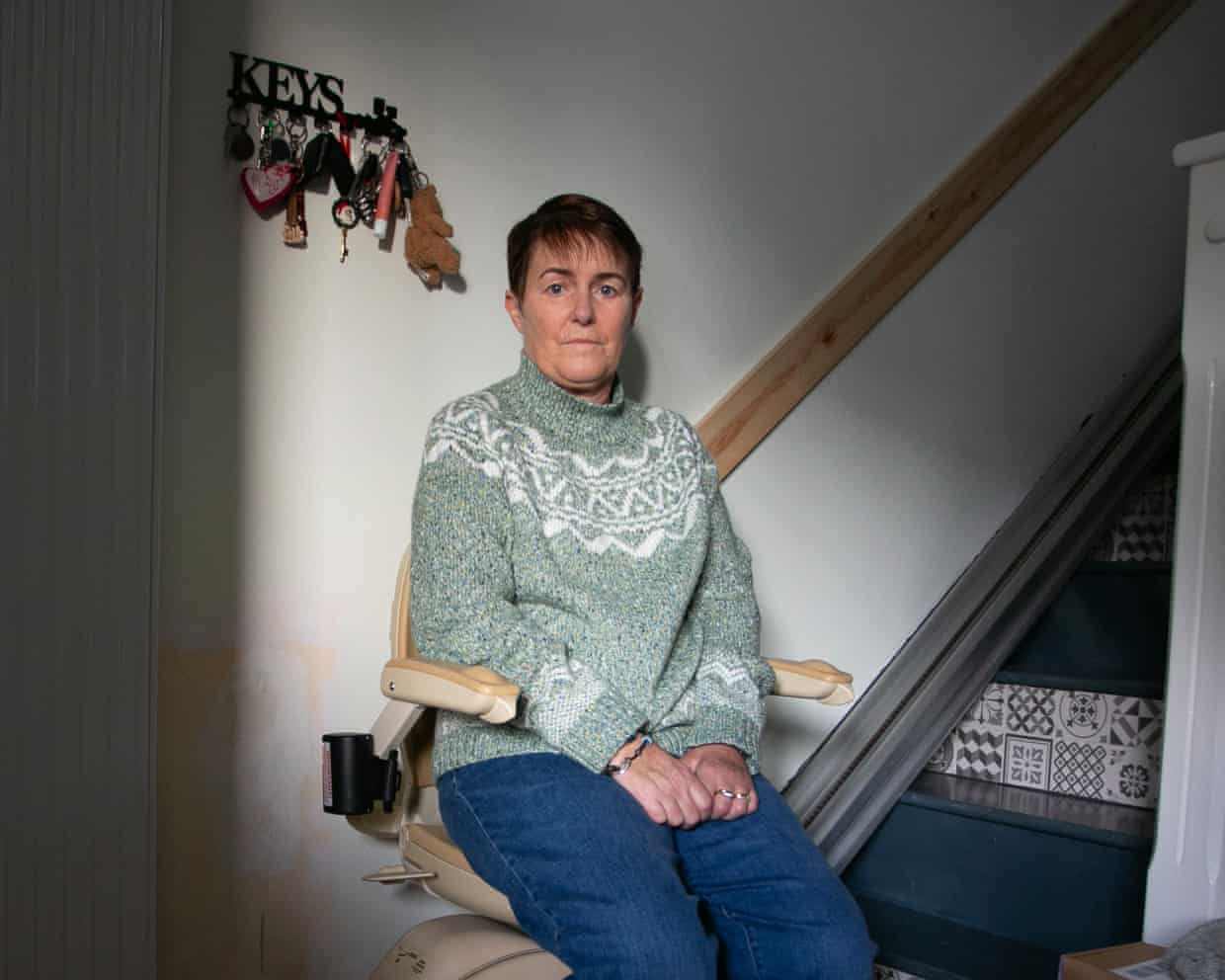
People with motor neurone disease (MND) are dying waiting for grants to make their homes fit to live in due to a huge backlogs in applications, campaigners have said.The MND Association has found it takes an average of 375 days for people in England to get essential home adaptations through the government’s disabled facilities grant (DFG) due to growing delays in the system.But a third of people with MND die within a year of diagnosis, and about half die within two years, meaning they are spending the last months of their lives fighting for support, with many dying in unsafe and unsuitable homes.The charity’s chief executive, Tanya Curry, said: “For someone whose condition may progress dramatically in a matter of months, waiting a year or more for vital adaptations is equivalent to being denied them altogether.”Nicole Foster, 56, was diagnosed with MND in May and has spent her entire life’s savings, as well as money fundraised on her behalf, replacing her bathroom with an accessible one after she was told she faced a two to three-year year wait for DFG funding

Guardian readers’ Christmas appeal donations surpass £500,000
Generous Guardian readers have so far raised more than £500,000 for the Hope appeal supporting inspirational grassroots charities that bring together divided communities, promote tolerance, and tackle racism and hatred.The 2025 Guardian appeal is raising funds for five charities: Citizens UK, the Linking Network, Locality, Hope Unlimited Charitable Trust, and Who Is Your Neighbour?Our partner charities deliver practical projects designed to foster empathy, build trust and promote positive change on the issues that matter for local communities, from affordable housing to youth clubs, arts projects to food kitchens.The appeal launched earlier this month as a constructive blast of hope and optimism against an increasingly unsettling backdrop of extremist violence and harassment, anti-migrant rhetoric, and the re-emergence of “1970s-style racism”.Our coverage includes Lucy Knight’s moving account of SaSh, a Jewish-Muslim charity food kitchen project supported by Hope Unlimited that tackles hatred and hunger with joy and irrepressible determination.As one donor told us: “The story about SaSh was beautiful and gives me hope

US capitalism casts millions of citizens aside, yet Badenoch and Farage still laud it | Phillip Inman

No longer ‘unloved’: retailers investing more in physical stores, UK data shows

From shrimp Jesus to erotic tractors: how viral AI slop took over the internet

More than 20% of videos shown to new YouTube users are ‘AI slop’, study finds

PDC world championship: James Hurrell stuns Stephen Bunting in thriller

Tommy Freeman hat-trick topples Bath and sends Northampton to Prem summit