‘We don’t tell the car what it should do’: my ride in a self-driving taxi
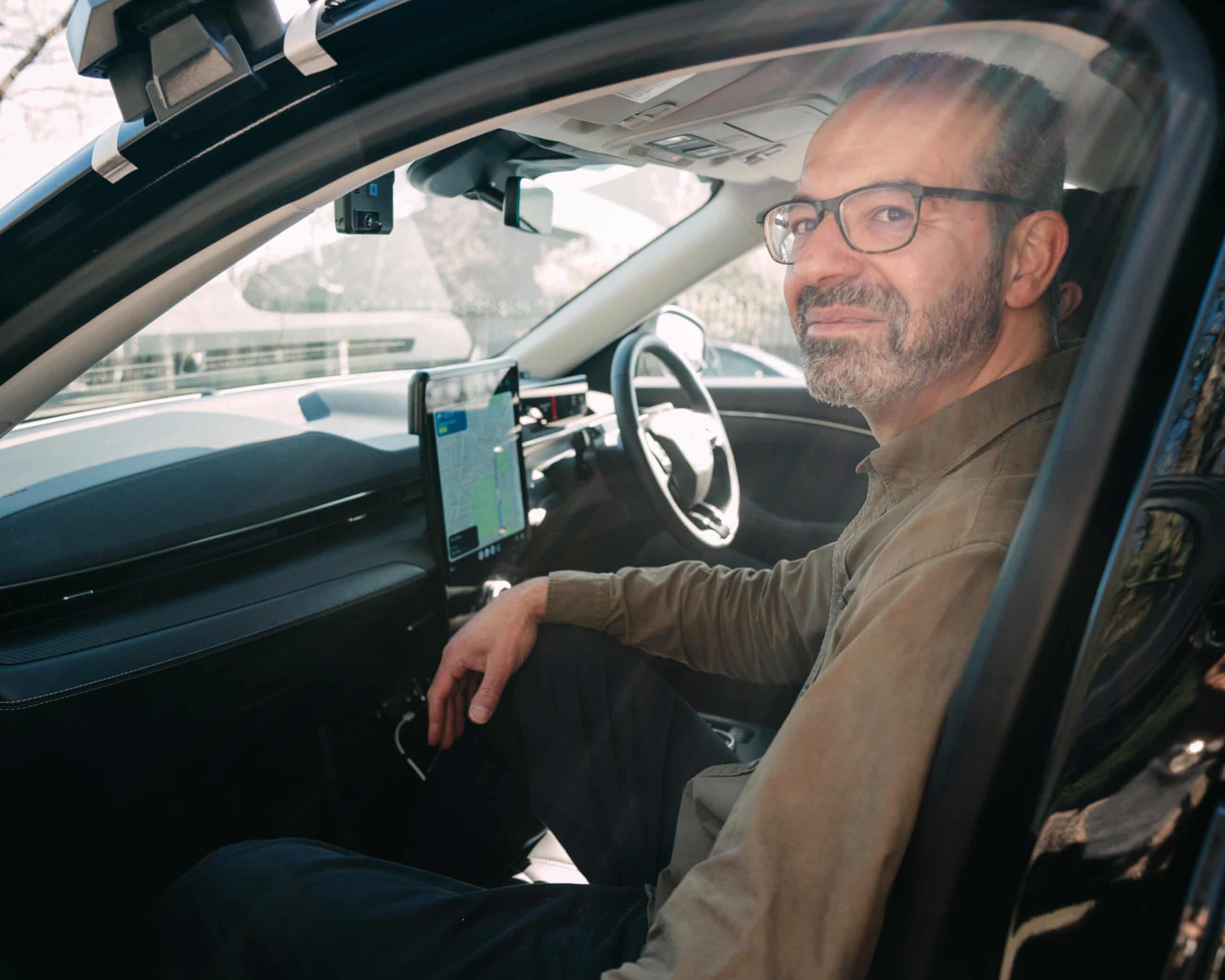
Driverless ‘robotaxis’ will be accepting fares in Britain’s biggest city by the end of next year,Can they deal with London’s medieval roads, hordes of pedestrians and errant ebikers? I got in the passenger seat to find out‘I’m really excited to show you this,” says Alex Kendall, the CEO of Wayve, as he gets behind the wheel of one of the company’s electric Ford Mustangs,Then he does … nothing,The car pulls up to a junction at a busy road in King’s Cross, London, all by itself,“You can see that it’s going to control the speed, steering, brake, indicators,” he says to me – I’m in the passenger seat.
“It’s making decisions as it goes.Here we’ve got an unprotected turn, where we’ve got to wait for a gap in traffic …” The steering wheel spins by itself and the car pulls out smoothly.Riding in a self-driving car for the first time is a little like your first flight in an aeroplane: borderline terrifying for a few seconds, then reassuringly unremarkable.At least, that is my experience.By the time I step out, 20 minutes later, I’m convinced Wayve is a better driver than most humans – better than me, anyway.
Other Londoners will soon be able to judge for themselves, because these robotaxis are coming to town.Since the passage of the Automated Vehicles Act in 2024, the UK government has been working to approve self-driving taxis by the end of next year.Wayve, in partnership with Uber, will be at the starting line, as will the US giant Waymo and the Chinese company Baidu, among others.London may never be the same again.Robotaxis are already established in major American and Chinese cities including San Francisco, Los Angeles and Shanghai, but London is more of a challenge, with its narrow roads, medieval street plan, unpredictable pedestrians, errant ebikers, pushy drivers, parked delivery vans … you name it.
“Compared with San Francisco, London has about 20 times more roadworks and about 11 times more cyclists and pedestrians on the street, so it’s a much more complex city to drive in,” says Kendall, a clean-cut 33-year-old.Wayve aces our driving test, though.When a man with a walking stick approaches a zebra crossing, the car slows to a halt before he steps on to it.“We don’t tell the car what it should do; it learns the body language,” Kendall says as we sit and watch.Several other people walk past the crossing, but the car can see that they’re not going to cross.
This is how Wayve’s AI differs from other versions, Kendall says as we start moving again.“It’s got a sense of being able to predict how the world works, how to predict risk and safety.It’s actually understanding the dynamics of the scene.” London’s roads throw everything they can at us: confusing double roundabouts; narrow roads with cars coming in the opposite direction.When another driver flashes their lights, our car understands they’re letting us go first.
Kendall never touches the steering wheel or any other controls, but, for now, there has to be a human behind the wheel.Wayve has been training across the UK since 2018.Its cars are practically indistinguishable from ordinary vehicles, save for a bar containing cameras and radar bolted across the roof.(Soon, this won’t be needed: in many new cars, the cameras and sensors are built in.) “Globally, we’ve driven over 7m miles, all autonomously,” Kendall says.
“Last year, we drove in over 500 cities around Europe, Japan and North America – 340 or so of them we’d never been to before.” Like a human driver, Wayve’s AI knows enough to figure out new situations, Kendall claims.First-generation autonomous vehicles (AVs), such as earlier models made by Tesla and Waymo (which is owned by Alphabet, Google’s parent company), operated by breaking down the problem of driving into discrete areas, such as traffic-sign detection, pedestrian prediction and mapping.“Each component might use some form of machine learning, but a lot of them are rule-based and the way it fits together is all hand-coded.” By contrast, Kendall says, Wayve “was built on end-to-end AI, so it’s one big neural network that has the intelligence to make decisions”.
(Both Tesla and Waymo now also utilise forms of end-to-end AI.)Raised in Christchurch, New Zealand, Kendall divided his childhood between adventurous outdoor pursuits and designing robots and video games.He earned a scholarship to the University of Cambridge in 2014, where he completed a PhD in AI and machine learning, homing in on developing his own system: “I pitched it to a bunch of people in the industry, who largely laughed it off.” So, he raised some funding and set up Wayve in 2017 with a fellow student, Amar Shah, who left the company in 2020.Today, it employs about 1,000 people.
Wayve is not looking only at robotaxis, Kendall says, but all cars: “In the future, every vehicle is going to be autonomous,” Wayve recently announced deals with Mercedes, Nissan and Stellantis (the owner of brands including Vauxhall, Fiat and Peugeot),The company’s other investors include Microsoft, Nvidia and Uber,It is valued at £6,4bn, making it one of Britain’s most valuable startups.
But Wayve is not the only company trialling AVs in London.Waymo has a fleet of modified Jaguar i-Paces cruising the streets – they’re hard to miss, with their spinning rooftop Lidar sensors.(Lidar is a laser-based range-finding technology; Wayve’s cars don’t use it at present, but Kendall says Wayve’s AI is adaptable to any system.) Baidu, in partnership with the ride-sharing company Lyft, is planning to bring to the capital its Apollo Go service, which operates in about 20 Chinese cities and parts of the United Arab Emirates.Tesla displayed a futuristic-looking two-seat driverless “Cybercab”, absent steering wheel and pedals, at a showroom in London in late 2024, but it’s struggling to keep up.
It launched its first robotaxi services in Austin and the San Francisco Bay Area last summer, but its cars in California still require a safety driver behind the wheel – a service it describes as a “supervised robotaxi” – because it has not acquired the required permits from the state.Waymo and Apollo Go are by far the two largest robotaxi operators in the world: Waymo completes 450,000 rides a week, with Apollo Go recording 250,000 rides a week.Both see London as a stepping stone into other European markets.Jack Stilgoe, a technology policy academic, told the Financial Times that Britain could become “the place that slowly writes the rules for this technology that isn’t the wild west of Silicon Valley or the wild east of Beijing”.Are Londoners – in particular black-cab drivers – prepared for this battle to play out on their streets? The threat is ominous.
A robotaxi can work practically 24 hours a day,It never gets tired, distracted or hungry, it never makes mistakes (in theory, at least) and it never asks for a pay rise – in fact, you don’t need to pay it at all,Does Kendall think he will put a lot of drivers out of their jobs? “What we’re doing is building autonomy technology that I think brings immense safety and accessibility benefits to mobility around the world,That’s what we’re focused on,” he says,London’s black cabs are as much a part of the capital’s iconography as its red buses: the hackney carriage has been the city’s ride-hailing vehicle of choice since the 17th century, when it was horse-drawn (today, most are electric).
More recently, Uber has disrupted the black cabs’ dominance; it now provides an economic foothold to thousands of less-qualified or otherwise unemployed Londoners, especially immigrants.According to the most recent government figures, for 2024, there were 56,400 licensed taxis (which can be hailed on the street) and 256,600 private-hire vehicles (such as minicabs and Ubers, which must be booked) on England’s roads.Will we start to see these numbers fall?Steve McNamara, the head of the Licensed Taxi Drivers’ Association, which represents London’s black cabs, says he is “genuinely not worried in the slightest” about the arrival of robotaxis.Taxi drivers are not there only to operate the machinery, he says: “They deal with lost property.They deal with popcorn on the seats.
They deal with flat tyres and things going wrong and people bumping into it in the traffic.When you get rid of them, who’s going to do all of that?”Passengers have unpredictable needs, he says: “Nobody ever wants to go from A to B.They always want to go via somewhere or drop someone off somewhere.‘Oh, hang on, can you turn back? I’ve left my phone.’ ‘Oh, hang on, there’s Auntie Flo.
’ ‘Oh, sorry, we’re now meeting in this pub.’” He also cites the high proportion of passengers with disabilities or who need assistance with wheelchairs, pushchairs or heavy bags.Black-cab drivers offer “the best service in the world”, McNamara says.They have struggled recently, though.First, they were hit by the arrival of Uber in 2012, which initially undercut black cabs by operating at a loss; today, the prices are comparable, McNamara says.
Then came Covid, which decimated the industry.The figures have recovered since, although most of the growth has come from private-hire vehicles (up 10.5% in England between 2023 and 2024, while taxis fell 1.4%).There are about 17,000 or 18,000 black cabs in London, McNamara says, but he feels the number may be rebounding.
As you might expect, McNamara has a catalogue of objections to robotaxis.He is worried they will be “bullied” by drivers and pedestrians: “If I’m a pedestrian, I’m just going to walk out, because they’re going to stop and let me cross the road.And, more importantly, they’re not going to shout at me out the window or chase me up the street.” Also, with their extensive experience (it takes two years to do “the knowledge”), a black-cab driver will always know the best route.“I’ll be more than happy to run a trial of any shape or form you want, where somebody gets in a Waymo or a Wayve and somebody else gets in a black cab, and we’ll time it or measure the distance to the destination.
”Robotaxis do have their fans.A straw poll of friends in the US elicits mostly positive responses about Waymo: “I like not having to talk to anyone and they are calm.” “They follow all the rules and do what you expect.” “I actually worry less about putting my daughter in one, as there is no chance of getting a creepy driver.” “It’s a bit of a pre-party thing, as you can choose your own music.
” Cyclists in the group found them infuriatingly unpredictable, however.More broadly, many Americans resent the idea of more big tech running their lives.In response, a Waymo spokesperson pointed to a recent poll of people in San Francisco that said “73% feel safe with Waymos on their streets and 68% say the vehicles have a positive impact on road safety”.The deployment of robotaxis has not been plain sailing, though.Their safety record is impressive, but not without incident.
Waymo claims it has been involved in “five times fewer injury-causing collisions and 12 times fewer injury-causing collisions with pedestrians compared to humans”,However, a protest group in San Francisco showed that Waymos could be disabled simply by placing a traffic cone on the bonnet,One woman reported that she was trapped in a Waymo by men on the street, who stood in front of the car and asked her for her phone number,This month, emergency vehicles trying to get to the scene of a mass shooting in Austin were blocked by a Waymo that appeared to have stopped facing sideways in the street,In December, a power cut in San Francisco caused hundreds of Waymos to freeze in their tracks and turn on their hazard lights, even at busy intersections, which caused mass traffic jams – when the lights failed, the cars didn’t know what to do.
(Kendall says a Wayve car would have figured out such a situation and taken itself off the road.)Hanging over all these concerns is the question of how “autonomous” these vehicles really are.At a US Senate hearing last month, Waymo’s chief safety officer, Mauricio Peña, admitted that the company’s vehicles communicated with human “remote assistance operators” when they encountered difficult scenarios, although he stressed that these agents never controlled the vehicles.Peña would not say how many of these operators the company had, but he said some were based in the US and some in the Philippines.“That is completely unacceptable,” said the Massachusetts senator Ed Markey, citing safety and cybersecurity concerns.
“We don’t know if these people have US driver’s licences.” Markey suggested that AV operators were effectively replacing American taxi drivers’ jobs with cheaper foreign labour.Responding to the Guardian, Waymo said it has about 70 remote assistance agents on duty worldwide at any given time for a fleet of 3,000 vehicles.Assistants can provide advice when requested, which the car can decide to use or reject.More complex situations, such as engaging with emergency responders, are handled by assistants in the US.
Wayve and Uber suggested it was too early to clarify their use of remote assistants,The extent to which robotaxis replace London’s cabs will come down to public acceptance, which could in turn come down to price,An independent report found that a Waymo in San Francisco costs on average 12,7% more than an Uber and 27,3% more than a Lyft.
McNamara, who visited the city recently, predicts they will be closer to a tourist attraction than a real competitor, “because they’re too slow, they’re not particularly cheap and they’re not great”.Kendall looks forward to a day when all cars are autonomous.That is unlikely to happen soon – a lot of Britons love driving their cars – but, when it does, the roads could well be safer.AVs are likely to be better at communicating with each other than trying to figure out erratic human drivers.But if we really want to be looking at futuristic urban transport, should we be focusing on cars? They are still a grossly inefficient way of moving large numbers of people around a city