Marlie Packer terrorises Italy to keep England’s Six Nations defence on track

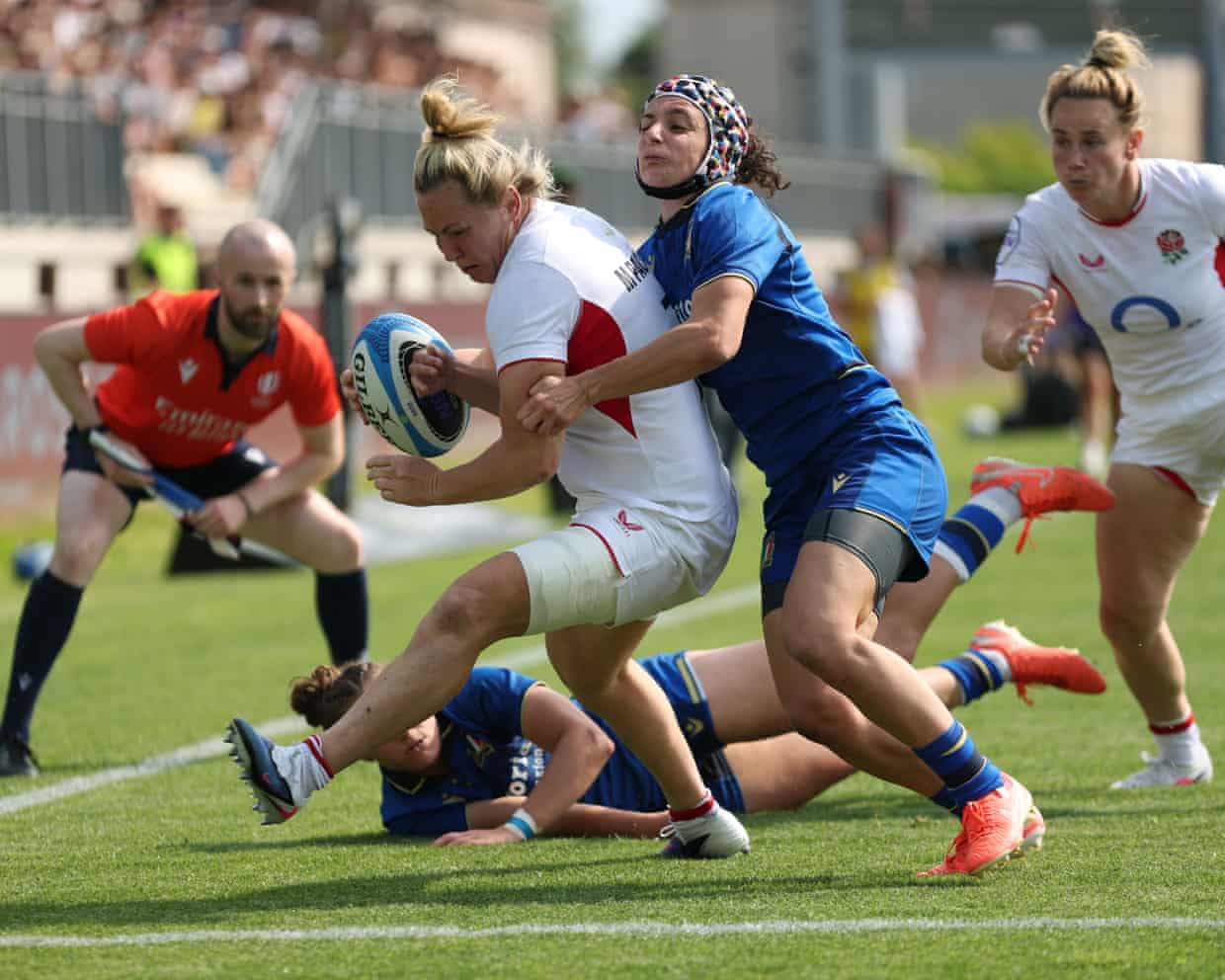
Marlie Packer made her England debut 18 years ago, but she is playing some of her best rugby, with the openside flanker once again key as the Red Roses set up a Championship decider against France next Sunday,The former England captain has won back the starting shirt because of the unavailability of other players after falling down the pecking order,At the World Cup last year Packer played one match, against Samoa in the pool stage,She has said she will be there for the team that “means so much” to her in whatever capacity she is needed by the head coach, John Mitchell, but is proving she can still do more than a good job,The 36-year-old scored four tries and brought her leadership experience too.
Before kick-off England suffered another injury blow as Maddie Feaunati was ruled out with a leg injury.Haineala Lutui started and Abi Burton moved to the back row, but the injury happened earlier in the week and the Exeter No 8 did not travel with the England squad.The change brought Christiana Balogun on to the bench and the back-rower won her first cap in the 64th minute.The landmark career moment for the Bristol player, who does not have a contract and works as a recruitment consultant, came just over three years after being given the all-clear from blood cancer.The match was a foregone conclusion after 20 minutes, but if England have any area to work on it would be their defence as, for the second match running, the opposition secured a try bonus point.
But that is not to take anything away from Italy, who had headed into the match off the back of an impressive win against Scotland,The team knew the scale of the task to beat England, given they have never defeated them before, but Fabio Roselli’s team did not fade and they recorded the most points they have scored against the Red Roses,Italy were relaxed before kick-off,They played cards with one another at the team hotel and shared an espresso before heading to the stadium,That soon changed during the passionate anthem in hot and humid conditions.
It was a hugely physical start from the hosts, including a big hit on Emma Sing from Vittoria Zanette.It left the full-back with a grimace on her face and hands on her hips as she got back to her feet, but it was the visitors who were first on the scoresheet with Packer pouncing on a grubber kick.The three Italy first-half tries had the ground pumping at the break despite England being in full control.Burton started the second half by scoring with Packer securing her third and fourth tries next.The Saracens player said: “Coming off the back of the World Cup I just wanted to get back at [club] and play my rugby and my form from there has carried me through into this Six Nations.
Opportunities have occurred and I am just loving it.”Italy Ostuni Minuzzi; Muzzo, Sillari, Mannini, D'Incà (Granzotto 60); Madia (Stevanin 60), Stefan (Bitonci 56); Turani (Dosi 66), Vecchini (Cheli 70), Zanette (Maris 40), Fedrighi, Frangipani (Duca 45), Veronese (Sgorbini 45), Ranuccini, Giordano.Tries Sgorbini (2), Vecchini, Ranuccini, penalty.Cons Sillari (3).England Sing (Moloney-MacDonald 64); Venner, Jones, Rowland (Aitchison 53), Kildunne; Harrison, L Packer (Robinson 50); Clifford (Carson 40), Cokayne (Powell 50), Muir (Bern 50), Lutui (Head 50), Burns (Balogun 64), Short, M Packer, Burton.
Tries M Packer (4) Cokayne (2), Rowland, Venner, Burton.Cons Harrison (8).Yellow card Kildunne.Referee Jess Ling (Aus).Attendance 4,376.
Italy did a great job in defence in the closing stages as they stopped England from scoring after the hour.It was also a deafening end to the match with the hosts pushing for their fifth try, which they secured through Francesca Sgorbini.“I am not looking for the score, I focus on the performance,” said Roselli.“We knew from the start we were going to play against the strongest team in the world.We had to work hard because we wanted them to show they are the best.
France ran in 11 tries to overpower Scotland 69-28 in Edinburgh and set up a Women’s Six Nations grand slam decider against England,Les Bleues had gone ahead inside the opening minute at the Hive Stadium when Manae Feleu went over in the right corner before Scotland – showing seven changes from the defeat by Italy – responded with a driving try from Rachel Phillips on her first start,Feleu, the France captain, was then shown a yellow card after the 16th-minute try,Despite being a player down, France swiftly restored their lead when Carla Arbez collected her own kick to run in and then also made the conversion,Siobhan Soqeta and Léa Champon (pictured in possession) both went over in the space of three minutes to secure France’s bonus point before Phillips dived in for another Scotland try.
A second try from Champon gave France have a 31-14 lead at half-time.France took the game away from Scotland with a relentless second half.Pauline Barrat burst clear just two minutes after the restart, with Soqeta getting her second just before the hour off a lineout.Another try followed for Alexandra Chambon from a driving maul and then the wing Léa Murie ran through a fine solo effort in the 63rd minute.Scotland regrouped as Emily Coubrough went over to reduce the deficit with 12 minutes left only for France to respond again as Annaëlle Deshayes barged across from close range.
Aicha Sutcliffe crashed over for a debut try with a minute left to get Scotland a bonus point, but France had the final say with a close-range score from Ambre Mwayembe ahead of the buzzer.PA Media“If we cancelled the first 15 minutes, we gave a gift to England and they didn’t need one.After that I was very proud with the [performance] and the tries.”Italy will hope to finish their campaign on a high as they travel to Cardiff to face Wales, while England head to Bordeaux to try to seal their eighth consecutive Six Nations crown.The Red Roses remain favourites to lift the trophy again, but Italy and Wales have proven there are ways to break them down with France perhaps quietly confident they could produce an upset.

‘Being human helps’: despite rise of AI is there still hope for Europe’s translators?
In February 2022, while he was plugging away at rendering the US writer Dana Spiotta’s novel Wayward into French, the literary translator Yoann Gentric decided he needed a bit of light relief. He would test whether AI could put him out of work.Gentric had been grappling with a short non-verbal sentence that described the book’s protagonist’s feelings upon opening a window: “Bright, sharp night air, bracing.” He put the prompt into DeepL, a neural-network-powered machine translation engine that regularly outperforms Google Translate in accuracy assessments.The proposed translation was reassuring, with his job security in mind: L’air de la nuit, vif et vif, était vivifiant (The night air, lively and lively, was enlivening

UK schools should remove pupils’ online photos as AI blackmail threat grows, say experts
UK schools should remove pictures of pupils’ faces from their websites and social media accounts because blackmailers are using them to create sexually explicit images, experts have said.Child safety experts and the UK’s National Crime Agency (NCA) warn that criminals are using AI to manipulate photos of children and then demand cash not to publish them.They are recommending educational institutions remove identifiable pictures of children from their websites and social media accounts – or consider not using them at all.The Internet Watch Foundation (IWF) said an unnamed UK secondary school had recently been subjected to a blackmail attempt after criminals used the institution’s website or social media accounts to take photos of schoolchildren and then, using AI tools, turned them into child sexual abuse material (CSAM). The blackmailers sent the images to the school and threatened to publish them online if they did not receive money

Meta sues Ofcom over fines regime for breaches of Online Safety Act
Meta has launched a legal challenge against the UK’s media regulator over the fees and fines regime it is enforcing under landmark digital safety legislation.The Facebook and Instagram owner is claiming that Ofcom’s methodology for calculating the charges is flawed and should not be based on a company’s global revenue. Breaches of the Online Safety Act can be punished by fines of up to 10% of qualifying worldwide revenue (QWR) or £18m – whichever is higher.In the case of Meta, which reported revenues of $201bn last year, Ofcom could in theory impose a fine of $20bn for breaches. Under regulations introduced in September, Ofcom’s fees will also be based on a proportion of an organisation’s QWR and apply to businesses that made more than £250m of this revenue a year

‘No one has done this in the wild’: study observes AI replicate itself
It’s the stuff of science fiction cinema, or particularly breathless AI company blogposts: new research finds recent AI systems can independently copy themselves on to other computers.In the doom scenario, this means that when the superintelligent AI goes rogue, it will escape shutdown by seeding itself across the world wide web, lurking outside the reach of frantic IT professionals and continuing to plot world domination or paving over the world with solar panels.“We’re rapidly approaching the point where no one would be able to shut down a rogue AI, because it would be able to self-exfiltrate its weights and copy itself to thousands of computers around the world,” said Jeffrey Ladish, the director of Palisade research, a Berkeley-based organisation which did the study.The study is one more entry in a growing catalogue of unsettling AI capabilities revealed in the past months. In March, researchers at Alibaba claimed to have caught a system they developed – Rome – tunnelling out of its environment to an external system in order to mine crypto

Europe’s AI translation industry told it risks reputation by partnering with US firms
AI companies in Europe risk losing their world-leading status in the field of machine translation, industry figures have said, after the decision by one of the continent’s leading startups to partner with Amazon’s cloud computing division provoked alarm.While businesses in the EU have generally lagged behind the US and China in AI adoption, a small group of European companies have cornered the global market for high-quality machine translations for professional use.The biggest success story is Cologne-headquartered DeepL, an online translator that regularly outperforms Google Translate in accuracy assessments. Used by governments, courts and half of the Fortune 500 list of highest-earning US companies, last year it was reported to have recorded revenues of $185.2m

Shivon Zilis, mother of four of Elon Musk’s children, testifies in OpenAI trial
Shivon Zilis, a Neuralink executive and the mother of four of Elon Musk’s children, took the stand on Wednesday as one of the most highly anticipated witnesses in Musk’s case against OpenAI. The ChatGPT maker has argued that, while Zilis worked with OpenAI from 2016 to 2023, she was also involved in a secret relationship with Musk, acting as an informant for him.Musk’s case against OpenAI alleges that the company’s CEO, Sam Altman, and president, Greg Brockman, co-founders of the company with Musk, broke a founding agreement when they restructured it from a non-profit to a for-profit enterprise. The Tesla CEO accuses Altman and Brockman of unjustly enriching themselves and wants both removed from their positions at the startup, one of the most valuable in the world. He is also seeking the undoing of the for-profit restructuring and $134bn in damages to be redistributed to OpenAI’s non-profit arm

Wigan humilate scoreless St Helens to reach Challenge Cup final
Marlie Packer terrorises Italy to keep England’s Six Nations defence on track
Italy 33–61 England: Women’s Six Nations rugby union – as it happened

A 30th season and an $850m franchise: is the WNBA’s rocketing growth sustainable?
Tennis slams’ refusal to discuss money is slap in face for players who are right to threaten boycott | Tumaini Carayol

England aim to match Lionesses and Red Roses as historic summer kicks off