Alex Samara: how a 30-year-old Englishman became an WNBA head coach

As an aspiring basketball coach in his teens and early 20s, Alex Sarama was often met with snickers when he talked about the game he loved,For the British-born Sarama, who on 28 October was named the head coach of the WNBA’s newest expansion team, the Portland Fire, people doubted him before he even put two sentences together,“There was a lot of skepticism,” he tells the Guardian,“A lot of coaches heard the accent and they’d say straight away this Alex guy can’t coach!”Sarama, however, would not be dissuaded,“So, it’s been great!” he says with a laugh.
“It’s given me a real chip on my shoulder to go the extra mile to make sure I’m meticulous knowing my stuff.Because at the end of the day, the players don’t care.The players just respect you if you’re competent, if you make them better.”All joking aside, it’s true.It’s not every day that you see a British basketball coach make it in the US.
But that’s exactly what Sarama has achieved.While his homeland has never been known as a hotbed for basketball, he’s made a name for himself.Growing up, though, Sarama played soccer and tennis.While basketball is a religion to many in the United States, It was never nearly as important in the UK.Still, as he got older, the game drew Sarama in.
“I think the fact that basketball wasn’t as popular made me even more determined,” he says.“Even when all my friends were playing other sports.”Indeed, where there’s a will there’s a way.“I think because basketball in the UK is less developed, it actually awarded me more unique opportunities to accelerate my coaching career,” the 30-year-old says, reflecting on his journey.“When I was 15, I knew I was never going to be good enough to be a professional player.
But I thought that coaching would be the best way to have a career at the highest level.”In need of an outlet, Sarama was in his mid-teens when he started his own basketball club, the Guildford Goldhawks.In just a few years, he grew it to be one of the bigger youth teams in the United Kingdom.“We actually won the national championship for the under-14 girls team,” he says.“That was my first experience coaching girls basketball.
”In his early 20s, Sarama continued his education at the University of Nottingham, studying history.He also coached – some of the players were nearly twice his age.He garnered important experience.“If I was in [a bigger basketball market like] Serbia, Spain or Lithuania, I would never have had those chances to coach,” he says.“To lead.
”From there, he managed to make the leap to the highest level of basketball: the NBA.He worked in the league’s international office, starting in London, before moving to Madrid and Antwerp.When he came to America, he worked in player development with the G-league’s Rip City Remix and then got a job with the Cleveland Cavaliers.“The resources are very different in the UK,” Sarama says.“The universities – it’s not professionalized like it is in the US.
For a lot of universities, it’s more for participation, rather than elite performance.”The new head coach for the Fire, though, says that Britain does have a lot of potential when it comes to hoops.He goes as far as to call the country a “sleeping giant” when it comes to basketball.“I think it has so much potential with the players,” he says, “and some really good coaches who mean well.We just need as a country to prioritize a lot more coaching education and development.
”Sarama says he does maintain hope for the sport to grow there, however.“I think there’s no reason why England couldn’t be a great basketball country,” he says.“It’s going to require a lot of intentional work to get things moving in the right direction.One day I would love to be a part of that and really initiate some positive transformations.”As for his job with the Fire, he certainly has his work cut out.
Building an expansion team is not for the weak of heart.Sarama, the author of the book, Transforming Basketball, is going to have to help build a franchise from square-one in a league that is both growing and changing faster than anyone can predict.To do so, he will employ some unique methods.“We’re going to have every coach doing player development,” Sarama says, “with a shared methodology and a shared framework of the principles of play and the individual development plans we have for each athlete.So, a strength coach is not just going to do weight room and warmup.
They’re going to be in the whole practice, doing actual basketball activities.”Sarama says he’s keeping three things in mind in his new job – courage, confidence and humility.He believes he is working in the most exciting time in WNBA history.“I feel very privileged to be coming in during this moment in time,” he says.“Just the chance with an expansion team – this is so unique.
I could coach the rest of my life and never have this situation,A lot of times in an organization, you have to unlearn previous processes,”Sarama says he’s going to be instituting a lot of new “standard operating procedures”,“We’re going to have absolutely everything documented in the organization,” he says,“That includes checklists in every area from how we go about building the culture to how we build an offense, how we run film sessions, how we give feedback to the players, what we do during a timeout.
There’s going to be a checklist to everything.”One thing that he will assuredly keep track of is his team’s rivalry with the squad a few hours north of Portland – the Seattle Storm, who are one of the successful teams in league history, with four championships to their name.“It’s the game I’m most looking forward to, I can say that,” Sarama says.“That will be a very hyped game, which I’m eagerly looking forward to … I watch a lot of basketball – leagues all over the world.And I really want to try to bring the best ideas I’ve been fortunate enough to learn in all these different places to the Fire.
”

Former EU commissioner and activists barred from US in attack on European tech regulators
The state department has barred five Europeans from the US, accusing them of leading efforts to pressure tech firms to censor or suppress American viewpoints, in the latest attack on European regulations that target hate speech and misinformation.Secretary of state Marco Rubio said the five people targeted with visa bans – who include former European Commissioner Thierry Breton – have led “organized efforts to coerce American platforms to censor, demonetize, and suppress American viewpoints they oppose.”“These radical activists and weaponized NGOs have advanced censorship crackdowns by foreign states – in each case targeting American speakers and American companies,” Rubio said in an announcement.In recent months, Trump officials have ordered US diplomats to build opposition to the European Union’s landmark Digital Services Act (DSA), which is intended to combat hateful speech, misinformation and disinformation, but which Washington says stifles free speech and imposes costs on US tech companies.Late on Tuesday night, Breton posted on social media: “Is McCarthy’s witch hunt back?”Tuesday’s move is part of a Trump administration campaign against foreign influence over online speech, using immigration law rather than platform regulations or sanctions

Elon Musk, AI and the antichrist: the biggest tech stories of 2025
Hello, and welcome to TechScape. I’m your host, Blake Montgomery, wishing you a happy and healthy end of the year. I myself have a cold.Today, we are looking back at the biggest stories in tech of 2025 – Elon Musk’s political rise, burst and fall; artificial intelligence’s subsumption of the global economy, all other technology, and even the Earth’s topography; Australia’s remarkable social media ban; the tech industry’s new Trumpian politics; and, as a treat, a glimpse of the apocalypse offered by one of Silicon Valley’s savviest and strangest billionaires.At the close of 2024, I wrote that Elon Musk’s support of Donald Trump had made him the world’s most powerful unelected man

Activist group says it has scraped 86m music files from Spotify
An activist group has claimed to have scraped millions of tracks from Spotify and is preparing to release them online.Observers said the apparent leak could boost AI companies looking for material to develop their technology.A group called Anna’s Archive said it had scraped 86m music files from Spotify and 256m rows of metadata such as artist and album names. Spotify, which hosts more than 100m tracks, confirmed that the leak did not represent its entire inventory.The Stockholm-based company, which has more than 700 million users worldwide, said it had “identified and disabled the nefarious user accounts that engaged in unlawful scraping”

Chinese robotaxis due in London next year as Lyft and Uber reveal tie-ups
Chinese robotaxis are due to be on the streets of London next year after the US ride-hailing companies Lyft and Uber announced tie-ups with Beijing-based Baidu to deploy its self-driving technology.Lyft is the third firm to announce plans to introduce self-driving taxis to the UK capital next year, after Uber and Waymo, the main operator of robotaxis in the US.Its ride-hailing services are the major rival to Uber’s in the US and Canada, and this year Lyft expanded into Europe after acquiring the Freenow app in the summer.While Uber had signed a deal to work with Baidu in the summer in other global markets, it had not until now said that the Chinese tech company’s Apollo Go cars were planned for London. It had previously announced its services would be operated with self-driving technology from the UK-US firm Wayve
MPs question UK Palantir contracts after investigation reveals security concerns
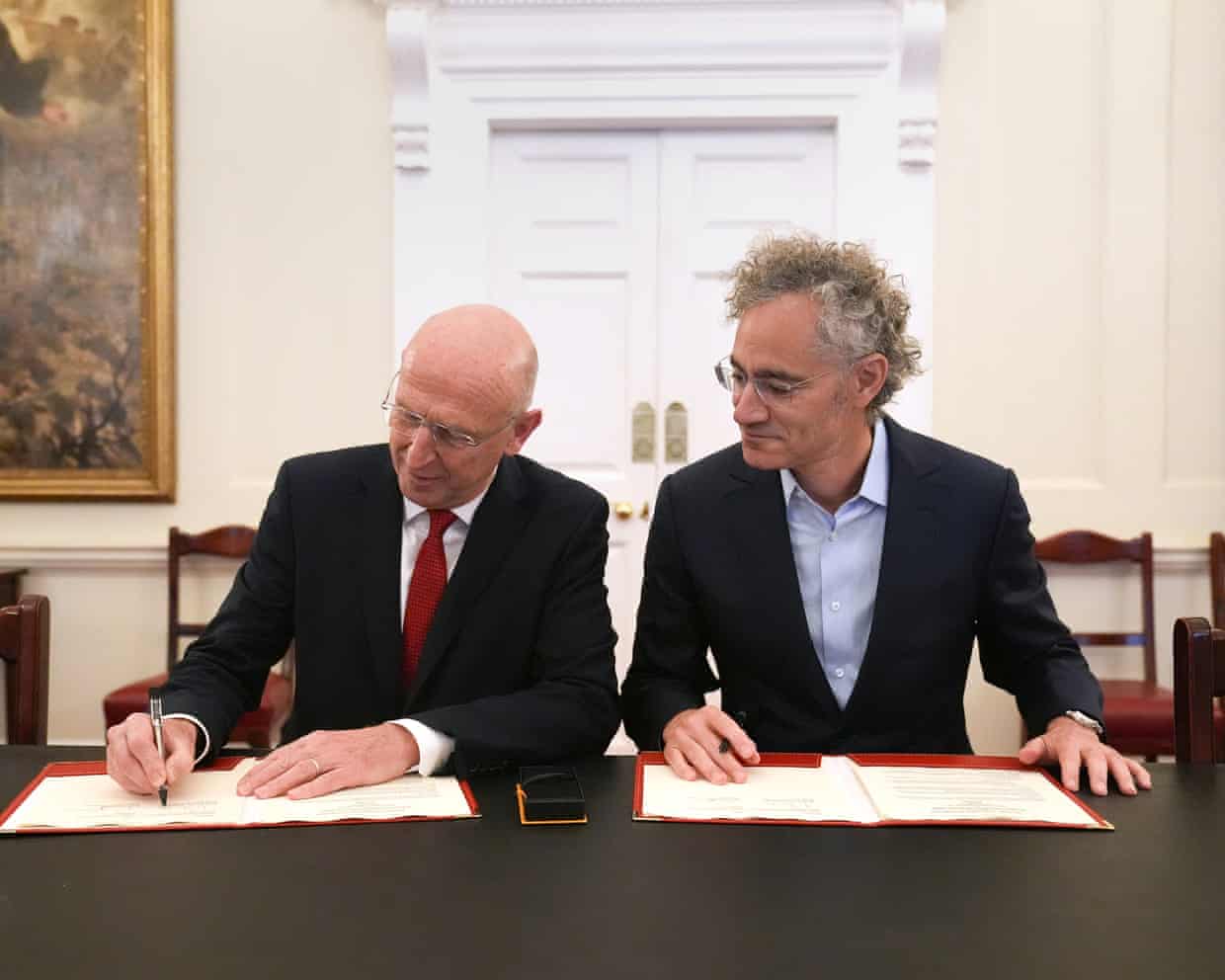
UK MPs have raised concerns about the government’s contracts with Palantir after an investigation published in Switzerland highlighted allegations about the suitability and security of its products.The investigation by the Zurich-based research collective WAV and the Swiss online magazine Republik details Palantir’s efforts, over the course of seven years, to sell its products to Swiss federal agencies.Palantir is a US company that provides software to integrate and analyse data scattered across different systems, such as in the health service. It also provides artificial intelligence-enabled military targeting systems.The investigation cites an expert report, internal to the Swiss army, that assessed Palantir’s status as a US company meant there was a possibility sensitive data shared with it could be accessed by the US government and intelligence services

Extremists are using AI voice cloning to supercharge propaganda. Experts say it’s helping them grow
While the artificial intelligence boom is upending sections of the music industry, voice generating bots are also becoming a boon to another unlikely corner of the internet: extremist movements that are using them to recreate the voices and speeches of major figures in their milieu, and experts say it is helping them grow.“The adoption of AI-enabled translation by terrorists and extremists marks a significant evolution in digital propaganda strategies,” said Lucas Webber, a senior threat intelligence analyst at Tech Against Terrorism and a research fellow at the Soufan Center. Webber specializes in monitoring the online tools of terrorist groups and extremists around the world.“Earlier methods relied on human translators or rudimentary machine translation, often limited by language fidelity and stylistic nuance,” he said. “Now, with the rise of advanced generative AI tools, these groups are able to produce seamless, contextually accurate translations that preserve tone, emotion, and ideological intensity across multiple languages

Stokes calls for ‘empathy’ for England players and pledges support for Duckett

Five big Boxing Day Ashes Tests: Botham, Pietersen and Warne

Trump loomed over sport like never before in 2025. Next year he will take even more
Alex Samara: how a 30-year-old Englishman became an WNBA head coach

Scott Boland reveals uncomfortable truth about standing up to England during Ashes

Wounded England must salvage more than pride in MCG Boxing Day Ashes Test