‘Deeply illogical’: this man’s life work could end homelessness – and Trump is doing all he can to stop it

Now in his fourth decade of spreading the word across most of the world’s continents about “Housing First”, an approach to helping homeless people that has convinced governments and non-profits alike to see housing as a human right, Sam Tsemberis experienced a first.He was censored by the US government.In the 1990s, Tsemberis began developing a simple idea: people living on the street want, and should have, safe housing with no strings attached.When you add accessible mental health and addiction services and caring, consistent case management, most stay housed.His research would bear out the idea, showing that Housing First results in at least 85% of people staying housed 12 or 24 months later, depending on the study.
These are higher rates than any other approach that’s been studied.The idea was and still is not easy to implement because it depends on all the components being present: the apartments, the services and the committed case workers.It also requires believing that unhoused people “deserve” a place to live – a belief abhorrent to the Trump administration and most Maga conservatives.On the phone from his apartment in Santa Monica in October, Tsemberis told me he had had an “eye-opening experience” earlier that week.He was preparing the kind of talk he’s given hundreds of times, this time on Zoom, about the relationship between homelessness and health, for several dozen doctors and lawyers hosted by the National Center for Medical-Legal Partnership.
The center asked Tsemberis to send in his slides before the event.The Health Resources and Services Administration (HRSA) – a federal agency funding the event – wanted to see them, an event organizer told him.When Tsemberis got them back, there were red lines throughout.Among other things, a federal official had deleted sections referencing the idea that racially discriminatory government policy is one cause of homelessness, as well as the terms “harm reduction” and “trauma-informed”, and mentions of Tsemberis being the founder of Housing First.What’s more, the term “Housing First” was deleted throughout.
The event organizer made a decision: in order to avoid making these changes, she would no longer use federal funds to cover the event’s cost.Tsemberis was shocked by the experience.“It’s a big country,” he said to me.“The fact they had someone who had the time to go through my slides like that was terrifying.It was a real wake-up call.
”The incident was indicative of the Trump administration’s attempts to do away with Tsemberis’s life work in the US.Instead, the federal government is pushing a longstanding approach sometimes called “Treatment First”, because it is based on the notion that homeless people have to resolve addictions, mental illness and other issues before obtaining housing.That approach historically has seen vastly inferior results, with people staying in housing for at least a year at less than half the rates of Housing First.Donald Trump codified the new policy in an executive order this summer titled “Ending Crime and Disorder on America’s Streets”.The order called out Housing First by name, accusing it of “deprioritiz[ing] accountability”.
The president asserted that no federal dollars would back Tsemberis’s ideas.The turnabout comes after more than a decade of federal support and four decades of research that have woven Housing First thinking into programs for unhoused people in every state in the country.Results during that time include the housing and urban development department (HUD) partnering with the Veterans Administration, using Housing First to reduce the number of homeless veterans in the US from 73,000 in 2009 to 36,000 in 2020.In Milwaukee, Wisconsin, the approach helped reduce the homeless population by 42% from 2015 to 2024, going from 1,521 to 885 people.Meanwhile, HUD issued a proposal in November that would reduce funding for permanent housing subsidies by two-thirds, at least $2.
5bn in cuts that could jeopardize housing for 170,000 people.A federal judge stalled the proposal after two lawsuits were filed against HUD: one, from 20 states plus DC, mentions Housing First 50 times, calling the administration’s change in policy “blatantly arbitrary and capricious” and asserting that HUD has “made no effort whatsoever to explain their utter abandonment of Housing First policies”.Trump’s disdain for Housing First didn’t appear from nowhere.Project 2025 called for an end to Housing First policies, as have conservative commentators since the first Trump administration.“Finally, the failed era of Housing First is over,” crowed a November column for the Hill by Devon Kurtz of the Cicero Institute, a rightwing thinktank founded by the Palantir founder Joe Lonsdale.
Kurtz dismissively and inaccurately described the approach as “giv[ing homeless people] keys to a subsidized apartment and expect[ing] nothing else of them other than to stay inside”.The editorial applauded such measures as Utah’s plans to build a 1,300-bed facility with dedicated space for involuntary treatment.These critiques exhibit certain ideological strains: first, as Project 2025 puts it, that “Housing First is a far-left idea premised on the belief that homelessness is primarily circumstantial rather than behavioral”.In other words, the reasons people are living on the streets lie with the people themselves – and have nothing to do with structural issues such as a lack of affordable housing or livable wages.Also, that homeless people are dangerous – they are in fact more likely to be victims of violent crime than perpetrators – and must be removed from city streets and put into institutional settings.
Another thread running through conservative critiques: how can Housing First be effective if there’s still homelessness?In early November, a young social worker from Barcelona bounded up to Tsemberis at a conference,She had just spent six months applying Housing First methods in her work, and she wanted a photo with the man who developed them,We were at the first-ever European Housing First conference organized by Tsemberis (and colleagues in Germany and the US),Held in Berlin, the event drew social workers, government officials, program administrators and formerly unhoused people from more than 20 countries,I’ve known Tsemberis for two decades, after discovering his work in the early 2000s while reporting on homelessness in Las Vegas, and I joined him in Berlin to report on the reception of his ideas there.
The cellphone scene was repeated many times over, as if Tsemberis – 6ft tall, thin, with a short, graying beard, and a psychologist by training – was a marquee actor or rock star,He seemed to enjoy both the attention and the enthusiasm of the hundreds in attendance, whose experience applying or researching his methods ranged from several weeks to more than a decade,Neither his 76 years or his recent knee surgery slowed him down in any way,But he couldn’t help but note the difference between being “under attack” in the US and drawing a pan-European audience in Berlin,“You know, it’s funny,” he told me.
“Thirty-five years ago, when I started this, I was an outlaw, an outlier [in the US].I was not welcomed at traditional meetings in the system.Then I built all this data, persisted, and [Housing First] became mainstream.Now, it’s full circle.“I’m a hero in Europe – and back to being an outlaw [in the US].
”The conference included leaders of France’s 15-year Housing First program and England’s 11 years of projects.Both have seen similar success rates as elsewhere worldwide, with participants still in housing between 12 and 36 months after starting the program 80% or greater.They and other panelists and attenders spoke at length about challenges in implementing Housing First: a shortage of affordable housing in Ireland, difficulties in coordinating mental health and addiction services in Denmark, and in England, uncertain funding.In France and other countries, several participants worried about increasing numbers of people becoming homeless.But in stark contrast to what’s happening at top levels in the US, belief in the approach was clear.
Stefan Ripka, a member of the housing taskforce at the European Union’s executive branch, told the audience his agency’s position was that “access to affordable housing should not be seen as a privilege, but a fundamental right” – the underlying principle of Housing First.“The European Commission remains committed to Housing First, through policy, financing and data,” Ripka added.The two-day event also included nuts and bolts-type sessions.In one, a young man from Salzburg asked Lynne Cahill, an Irish researcher: “How long is the service period?” Cahill answered: “You’re just with them,” referring to an open-ended relationship between case workers and homeless people.Another audience member added: “It’s like a family – it doesn’t go away.
”The exchange centered another core Housing First idea: case workers build a caring relationship with the homeless person seeking help, and that person decides when to end the relationship and leave the program, not the other way around.Sitting next to me, Tsemberis applauded and said softly: “Beautiful.”“We have to get people to understand, it’s not just keys to a house,” he added.Back in the US, there is a palpable malaise among programs working with unhoused people.A director of a non-profit organization with a multimillion-dollar budget, that has seen hundreds of formerly homeless people stay in housing after 24 months at rates above 90% using Housing First, said he did not want to attach his name to anything critical of the Trump administration.
Although a small portion of his organization’s budget comes from HUD, he was concerned about Trump’s work to undermine Housing First in general.His program also uses federal funding for mental – health services; he was concerned about that funding being targeted as well.The director cited the “unpredictable nature [of the administration] and what they could do to us”.“It’s sad we’re in this place,” he said.“It’s all ideology on their part and they’re not thinking things through.
”Tsemberis has seen this fear stifle non-profits across the country.“Organizations are trying to figure out how to stay off the radar,” he said, comparing the federal government’s approach to Housing First to its attempt to stamp out “illegal DEI practices” in the nation’s universities.The fear extends to HUD, which funds rental assistance, and to other federal agencies that fund services crucial to the Housing First model, Tsemberis said.In January, for example, the Trump administration announced it was cutting nearly $2bn in mental health and addiction services across the nation – only to reverse the decision the following day.“The attitude is, don’t draw attention in a way they can cut your funding,” Tsemberis said.
Tsemberis finds himself spending much of his time trying to respond to the administration’s moves.This spring’s US Housing First conference, Housing First in Challenging Times: Staying True, Moving Forward, will focus on using the model while in the federal government’s crosshairs.The far-reaching consequences of Trump’s executive order on homelessness are still unfolding, several experts told the Guardian.“I find it really disheartening … to be in the place we’re in,” said Ann Oliva, CEO of the National Alliance to End Homelessness.Oliva has been working on homelessness for 30 years, including a decade at HUD; her policy and research organization is a plaintiff in one of the two lawsuits filed against the federal agency over funding for housing.
Oliva allowed that since Housing First’s mainstream acceptance in the US starting in the 2000s, issues have arisen.For instance, applicants for HUD funds are incentivized to attest to using the model even if they cut corners on, say, mental – health services.“There are programs purporting to be Housing First, but don’t have fidelity” to the model, she said.But the current administration is not proposing improvements.Instead it is pushing a complete turnaround based on the notion that homeless people don’t “deserve” permanent housing without treating mental health and addiction issues first.
“We’re regressing to models used in the 80s and 90s that didn’t work, and didn’t produce permanent housing,” Oliva said.Deborah Padgett, professor at NYU’s Silver school of social work, has known Tsemberis since the 80s.“I thought [Housing First] was a crazy idea back in the day,” she allows.“But then it became evidence-based – and now it’s under attack.” The researcher described several decades of Housing First studies in the US, Canada, Sweden, Italy and Switzerland that produced what she called “eerily similar results” to Tsemberis’s: about 85% of people staying in housing.
Padgett said conservative attacks stem from the fact that Housing First “touches a nerve in American society: the extent to which we want to help people, but also want them to help themselves”,The backlash against Housing First has not reached European shores, said Tomás Eoin O’Sullivan, editor of the European Journal of Homelessness,For the most part, he said, “the punitive mentality that exists in the US doesn’t exist here”,Nicholas Pleace, who wrote the European manual on Housing First – now translated into 12 languages – said that non-profits and others pushing the model in Europe have been successful at underlining its cost-effectiveness, since chronically homeless people tend to cost societies a great deal when they are on the streets due to their intensive use of emergency healthcare services and frequent contact with the criminal justice system,The conservative argument underpinning the Trump administration’s actions – there’s still homelessness, so Housing First must be a failure – is “deeply illogical”, he said.
“It’s like saying, ‘Why should we have doctors if people still get sick?’”Tsemberis and multiple experts interviewed for this story said that the right’s argument ignores a host of structural factors,Homelessness continues to increase, the experts assert, due to a shortage of affordable housing, cuts in social services and an underfunding of Housing First approaches in general at all levels of government,Other factors include the fentanyl epidemic and increasing economic inequality,If the US continues to pursue policies as laid out in Trump’s executive order, Pleace said, “it’ll be like going back to Elizabethan poor laws”,He was referring to 17th-century English laws that allowed authorities to lock up or fine able-bodied people who refused to work.
“There’s incredible human and financial costs, as well as costs to society, when you cut back what’s actually helping,” he said.“It gets into deep questions about what kind of society you want to be.”

Elon Musk posted about race almost every day in January
Elon Musk’s longtime fixation on a white racial majority is intensifying. The richest man in the world posted about how the white race was under threat, made allusions to race science or promoted anti-immigrant conspiracy content on 26 out of 31 days in January, according to the Guardian’s analysis of his social media output. The posts, made on his platform X, reflect a renewed embrace of what extremism experts describe as white supremacist material.“Whites are a rapidly dying minority,” Musk said on 22 January, a short time before taking the stage at the World Economic Forum in Davos, while reposting an Irish anti-immigrant influencer’s video about demographic change.Musk’s posts included him repeatedly claiming white people face systemic discrimination, endorsing the conspiracy that there is an ongoing genocide against white people in countries around the world and promoting a claim that white people would be “slaughtered” by non-whites if they become a demographic minority

The big AI job swap: why white-collar workers are ditching their careers
As AI job losses rise in the professional sector, many are switching to more traditional trades. But how do they feel about accepting lower pay – and, in some cases, giving up their vocation?California-based Jacqueline Bowman had been dead set on becoming a writer since she was a child. At 14 she got her first internship at her local newspaper, and later she studied journalism at university. Though she hadn’t been able to make a full-time living from her favourite pastime – fiction writing – post-university, she consistently got writing work (mostly content marketing, some journalism) and went freelance full-time when she was 26. Sure, content marketing wasn’t exactly the dream, but she was writing every day, and it was paying the bills – she was happy enough

Is it possible to develop AI without the US?
Hello, and welcome to TechScape. Today in tech, we’re discussing the Persian Gulf countries making a play for sovereignty over their own artificial intelligence in response to an unstable United States. That, and US tech giants’ plans to spend more than $600bn this year alone.I spent most of last week in Doha at the Web Summit Qatar, the Gulf’s new version of the popular annual tech conference. One theme stood out among the speeches I watched and the conversations I had: sovereignty

Apple and Google pledge not to discriminate against third-party apps in UK deal
Apple and Google have committed to avoid discriminating against apps that compete with their own products under an agreement with the UK’s competition watchdog, as they avoided legally binding measures for their mobile platforms.The US tech companies have vowed to be more transparent about vetting third-party apps before letting them on their app stores and not discriminate against third-party apps in app search rankings.They have also agreed not to use data from third-party apps unfairly, such as using information about app updates to tweak their own offerings.Apple has also committed to giving app developers an easier means of requesting use of its features such as the digital wallet, and live translation for AirPod users.The commitments have been secured as part of a new regulatory regime overseen by the Competition and Markets Authority, (CMA), which has the power to impose changes on how Apple and Google operate their mobile platforms after deciding last year that they had “substantial, entrenched” market power

Beats Powerbeats Fit review: Apple’s compact workout earbuds revamped
Apple’s revamped compact workout Beats earbuds stick to a winning formula, while slimming down and improving comfort.The Guardian’s journalism is independent. We will earn a commission if you buy something through an affiliate link. Learn more.The new Powerbeats Fit are the direct successors to 2022’s popular Beats Fit Pro, costing £200 (€230/$200/A$330)

Files cast light on Jeffrey Epstein’s ties to cryptocurrency
Millions of files related to Jeffrey Epstein have brought to light his ties to the highest echelons of the cryptocurrency industry.Documents published last week by the US Department of Justice reveal Epstein bankrolled the “principal home and funding source” for bitcoin, the world’s largest cryptocurrency, during its nascent stages; he also invested $3m in Coinbase in 2014, the largest cryptocurrency exchange in the US, and cut a check that same year to Blockstream, a prominent bitcoin-focused technology firm. Both crypto startups accepted Epstein’s investments in 2014 – six years after his 2008 conviction in Florida for soliciting prostitution from a minor.Despite murmurings among crypto communities online about the need for a sector-level reckoning around the Epstein files’ revelations, most industry players predict few consequences for crypto companies or the sector writ large. Some see Epstein as a “skeptical investor” who pulled out of his crypto investments prematurely; others go so far as to claim Epstein was attempting to “undermine bitcoin”

Bank bosses get huge pay rises in sign top City salaries back to pre-crash highs

Shares in trucking and logistics firms plunge after AI freight tool launch

Tony Blair’s oil lobbying is a misleading rehash of fossil fuel industry spin

UK economy grows by only 0.1% amid falling business investment
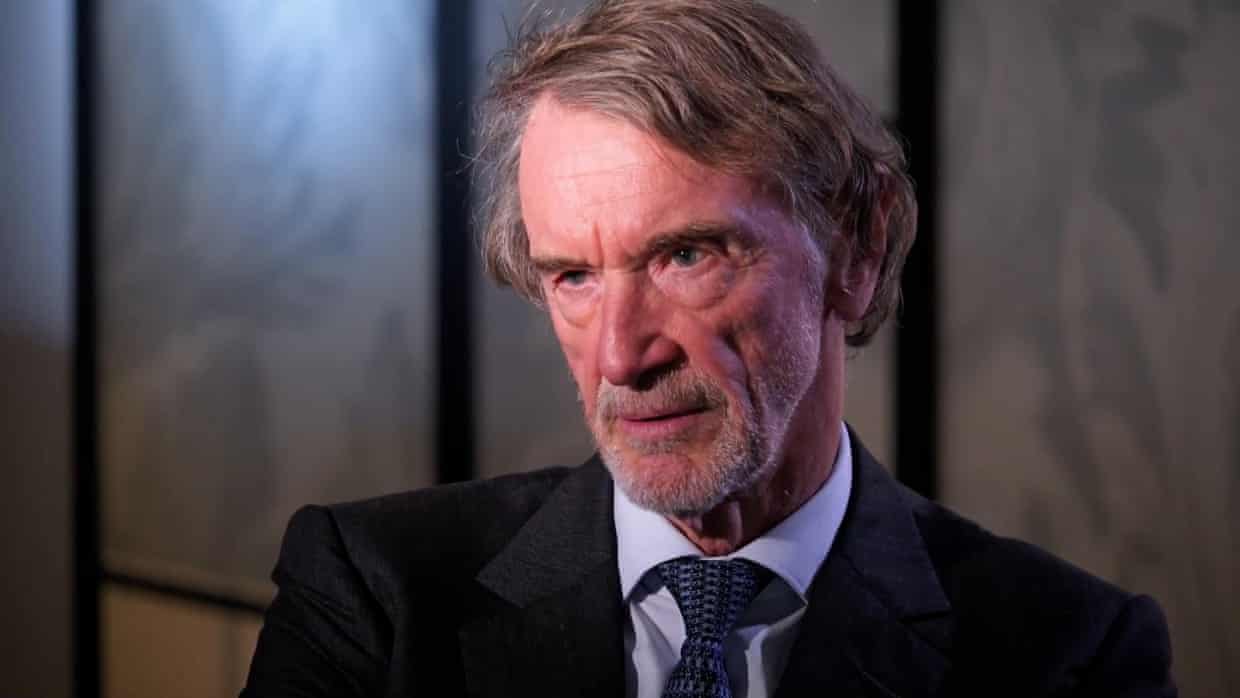
Jim Ratcliffe apologises for ‘choice of language’ after saying immigrants ‘colonising’ UK

To revive manufacturing we must first change attitudes towards labour | Letter