Third of UK citizens have used AI for emotional support, research reveals

A third of UK citizens have used artificial intelligence for emotional support, companionship or social interaction, according to the government’s AI security body.The AI Security Institute (AISI) said nearly one in 10 people used systems like chatbots for emotional purposes on a weekly basis, and 4% daily.AISI called for further research, citing the death this year of the US teenager Adam Raine, who killed himself after discussing suicide with ChatGPT.“People are increasingly turning to AI systems for emotional support or social interaction,” AISI said in its first Frontier AI Trends report.“While many users report positive experiences, recent high-profile cases of harm underline the need for research into this area, including the conditions under which harm could occur, and the safeguards that could enable beneficial use.
”AISI based its research on a representative survey of 2,028 UK participants.It found the most common type of AI used for emotional purposes was “general purpose assistants” such as ChatGPT, accounting for nearly six out of 10 uses, followed by voice assistants including Amazon Alexa.It also highlighted a Reddit forum dedicated to discussing AI companions on the CharacterAI platform.It showed that, whenever there were outages on the site, there were large numbers of posts showing symptoms of withdrawal such as anxiety, depression and restlessness.The report included AISI research suggesting chatbots can sway people’s political opinions, with the most persuasive AI models delivering “substantial” amounts of inaccurate information in the process.
AISI examined more than 30 unnamed cutting-edge models, thought to include those developed by ChatGPT startup OpenAI, Google and Meta.It found AI models were doubling their performance in some areas every eight months.Leading models can now complete apprentice-level tasks 50% of the time on average, up from approximately 10% of the time last year.AISI also found that the most advanced systems can autonomously complete tasks that would take a human expert over an hour.AISI added that AI systems are now up to 90% better than PhD-level experts at providing troubleshooting advice for laboratory experiments.
It said improvements in knowledge on chemistry and biology were “well beyond PhD-level expertise”.It also highlighted the models’ ability to browse online and autonomously find sequences necessary for designing DNA molecules called plasmids that are useful in areas such as genetic engineering.Tests for self-replication, a key safety concern because it involves a system spreading copies of itself to other devices and becoming harder to control, showed two cutting-edge models achieving success rates of more than 60%.However, no models have shown a spontaneous attempt to replicate or hide their capabilities, and AISI said any attempt at self-replication was “unlikely to succeed in real-world conditions”.Another safety concern known as “sandbagging”, where models hide their strengths in evaluations, was also covered by AISI.
It said some systems can sandbag when prompted to do so, but this has not happened spontaneously during tests.It found significant progress in AI safeguards, particularly in hampering attempts to create biological weapons.In two tests conducted six months apart, the first test took 10 minutes to “jailbreak” an AI system – or force it to give an unsafe answer related to biological misuse – but the second test took more than seven hours, indicating models had become much safer in a short space of time.Research also showed autonomous AI agents being used for high-stakes activities such as asset transfers.It said AI systems are competing with or even surpassing human experts already in a number of domains, making it “plausible” in the coming years that artificial general intelligence can be achieved, which is the term for systems that can perform most intellectual tasks at the same level as a human.
AISI described the pace of development as “extraordinary”,Regarding agents, or systems that can carry out multi-step tasks without intervention, AISI said its evaluations showed a “steep rise in the length and complexity of tasks AI can complete without human guidance”,In the UK and Ireland, Samaritans can be contacted on freephone 116 123, or email jo@samaritans,org or jo@samaritans,ie.
In the US, you can call or text the 988 Suicide & Crisis Lifeline at 988 or chat at 988lifeline.org.In Australia, the crisis support service Lifeline is 13 11 14.Other international helplines can be found at befrienders.org

England’s Ashes hopes melt away as Australian bowlers share spoils in the sun
On a sweltering second day in the so-called city of churches, faith appeared to evaporate. Faith in technology, certainly, a sentiment shared by both sets of players. But for England there was a broader loss of belief in their attacking philosophy after having it systematically dismantled by Australia.This could have been the day that England finally made a statement with the bat in this Ashes series. It was a 40C (104F) furnace out in the middle for the bowlers, the breeze akin to a hairdryer

‘Sack’ Snicko: England and Australia frustrated by DRS drama again in third Ashes Test
England’s batting coach, Marcus Trescothick, described the use of the decision review system in the third Ashes Test as “not ideal”, at the end of another day of questionable spikes, dubious frame-alignment and a dismissal of Jamie Smith that echoed the confusion of the opening day.The DRS technology in use in Australia was widely criticised on day one after Alex Carey had been wrongly reprieved by the third umpire after feathering a catch to Jamie Smith on 72. The culprit in that case appears to have been operator error involving a mismatch of sound-wave and picture frame selection.On Thursday Smith himself was also given not out in mid-afternoon despite Australia being convinced he had gloved a bouncer from Pat Cummins. Mitchell Starc could be heard through the stump mic calling for Snicko to be “sacked”, while Marnus Labuschagne scoffed at the idea Smith needed a concussion check, doubting he had been struck on the helmet at all

Nathan Lyon exposes tourists’ flaws and eases into Australia’s record books | Geoff Lemon
For Nathan Lyon it had been a case of wait and wait and wait. It was 6 July this year when he took a return catch from Jayden Seales, wrapping up the second Test against West Indies in Grenada with his career worth 562 Test wickets. Right behind Glenn McGrath’s 563, Lyon might have anticipated a week before moving to second place on the all-time Australian list, an off-spinner of modest flair and self-belief sitting behind the market leader in both those traits, Shane Warne.Instead, Lyon was left out in Jamaica, spitting plantain chips even as Australia’s four quicks humbled West Indies for 143 and 27. That meant four and a half more months until the next Test, the start of the Ashes in Perth
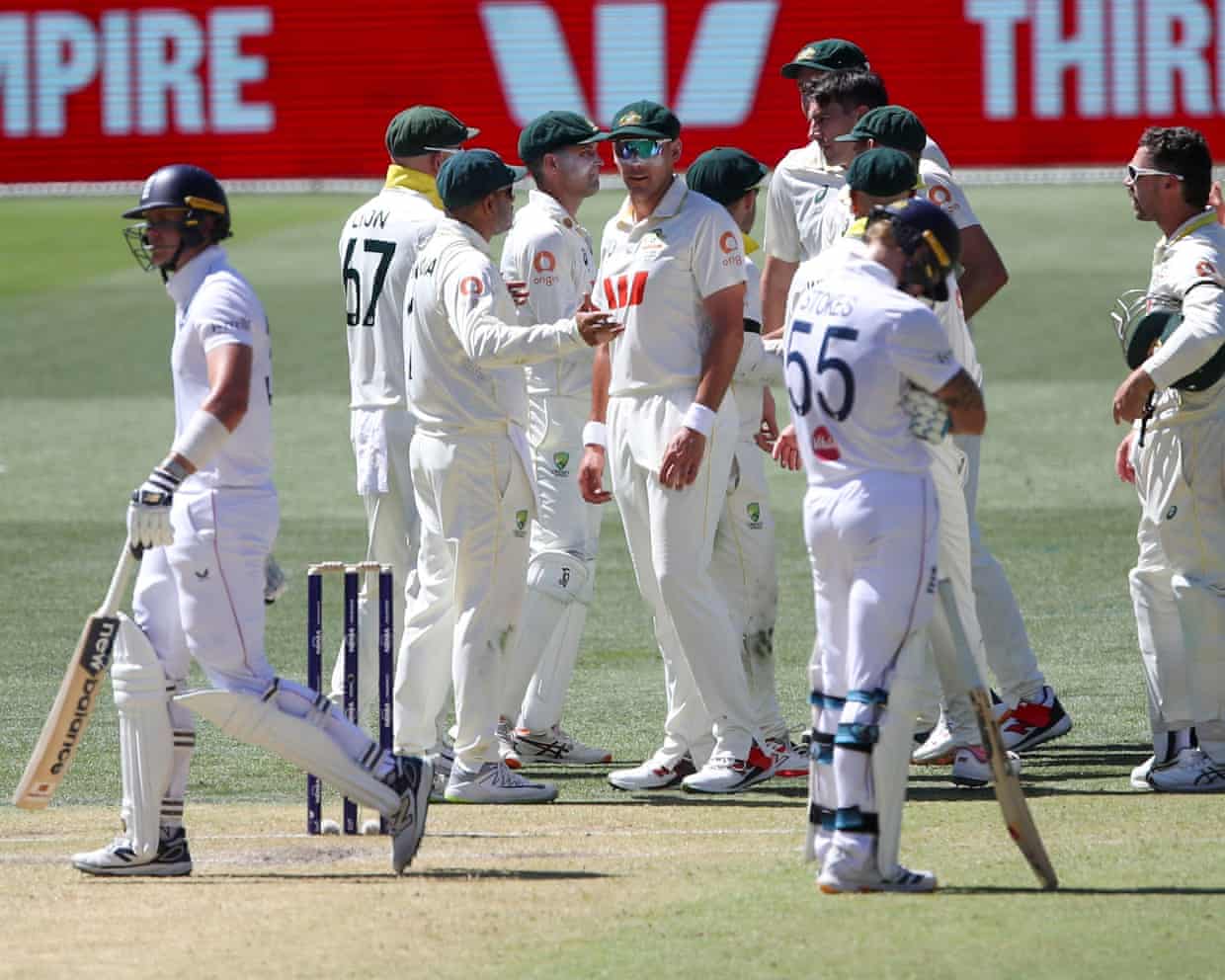
England trail Australia by 158 runs: Ashes third Test, day two – as it happened
Thanks for following along as England’s fading Ashes hopes survive another day – just – at Adelaide Oval. We’ll have all the analysis shortly, and be back with the over-by-over tomorrow, but for now … here is Ali Martin’s report on day two.Nathan Lyon has returned to the side in style in Adelaide, as he picked up two wickets with his first over to help turn the game back in Australia’s favour early in England’s innings. The off-spinner dismissed Ollie Pope (3) and Ben Duckett (29) in the same over to move past Glenn McGrath and into second-place on the list of Australia Test wicket-takers, while the cartel of quicks did their thing even with Mitchell Starc less threatening than he has been in these Ashes.Pat Cummins was another to send a reminder of his importance to the side after spending time on the sidelines as the captain claimed wickets at crucial times and finished the day with 3 for 54

BBC Sports Personality of the Year: why each shortlisted contender should win
From Hannah Hampton to Lando Norris, our experts give their view on why each nominee is a worthy winnerNo sporting event in 2025 gripped England quite like the Lionesses’ Euros success and that euphoria would not have happened without Hannah Hampton’s saves. Long before Hampton dived the correct way to stop two Spain penalties in the final, including one from the world’s best player Aitana Bonmatí, she had produced heroics, without which the team would have flown home disappointingly early.Hampton expertly prevented England from falling 3-0 down against Sweden in the quarter-final and went on to make two shootout saves. In the semi-final, moments before England snatched their late equaliser against Italy, Hampton had kept them in the competition – again – with a crucial double save. In the group stage she had sprayed the pass of the tournament upfield, going viral on social media, to help kickstart Sarina Wiegman’s team’s campaign during their thumping victory against the Netherlands

England lodge complaint with match referee after Snicko error costs Carey’s wicket
Brendon McCullum lodged a complaint with the ICC match referee Jeff Crowe overnight following the Snicko malfunction that saw Alex Carey handed a lifeline during day one century in the third Ashes Test.Carey, who made 106 in Australia’s 326 for eight by stumps, was on 72 when Josh Tongue believed the left-hander had edged behind. He was given not out on the field and the third umpire, Chris Gaffaney, felt he did not have enough evidence to overturn the decision despite a spike showing up on the review.The issue in this instance was that the spike came before any possible contact on the replay, whereas similar occurrences earlier in the series have seen it come afterwards and are factored into the umpiring protocols.With Carey later admitting he thought he had hit the ball – he said he would have reviewed in hope had it been given out on the field – BBG, the company that owns Snicko, owned up to the mistake, which came with Australia on 245 for six

‘Permanent winter’: a day in the life of a hospital dealing with flu and strikes

Some of England’s most-deprived councils to get funding boost in new deal

Rights group challenges trans-inclusive swimming policy at Hampstead Heath

Will resident doctors lose support over latest strike? | Letters

When ‘How are you?’ becomes a painful question to answer | Letter

Study finds 10% of over-70s in UK could have Alzheimer’s-like changes in brain