No 10 declines to comment on White House claim that Europe facing ‘civilisational erasure’ – UK politics live
Downing Street has defended Britain’s record on freedom of speech – while declining to comment on a White House policy document saying Europe is at risk of “civilisational erasure”.At the No 10 lobby briefing, the PM’s spokesperson said that he would not comment on the national security strategy published by the White House on Friday because it was as US document.As Jon Henley reports, the document does not just relate to US policy because it says the American government should be “cultivating resistance to Europe’s current trajectory within European nations”.Referring to Europe as a whole, the document says that it does not spend enough on defence and that it suffers from economic stagnation.But it goes on:This economic decline is eclipsed by the real and more stark prospect of civilisational erasure.
The larger issues facing Europe include activities of the European Union and other transnational bodies that undermine political liberty and sovereignty, migration policies that are transforming the continent and creating strife, censorship of free speech and suppression of political opposition, cratering birthrates, and loss of national identities and self-confidence.At the weekend Sarah Rogers, the US under secretary of state for public diplomacy, reinforced this claim with a post on social media claim that the UK and other European countries are suppressing free speech.The UK government has repeatedly chosen to avoid saying almost anything critical of Donald Trump and his administration in public and that continued today at the lobby briefing when the PM’s spokesperson was asked if Keir Starmer agreed that Europe faces civilisational erasure.The spokesperson replied:Obviously that is a strategy devised by the US for the US.It is for them to comment in.
In more broad terms, you’ve seen our action on both legal and illegal migration, and the measures we’re taking to drive that down.Asked if the PM would stick up for Europe, the spokesperson replied:The prime minister always sticks up for both the UK and European interests.You’ve seen that in his close working relationship with the president and he’ll continue to do that.But, when asked about comments from US officials like Rogers saying there is no freedom of speech in the UK, the spokesperson did push back.He said:When it comes to free speech, our position is very clear.
We’re proud of it, we’ve had it in this country for a very long time, we’ll protect it, and the government is committed to open discourse.The Labour party has challenged Reform UK to explain why it has not yet registered any cryptocurrency donations – even though Nigel Farage, the leader, said in October that the party has started receiving crypto gifts.In an open letter to Farage, Anna Turley, the Labour chair, challenged him to clarify the situation.She said:It is of course possible that Reform UK did not receive a single cryptocurrency donation above the donation threshold between May, when you first publicised your party’s willingness to receive such donations, and the end of September, which was the end of Q3 for the purposes of declaring donations to the Electoral Commission, and that your efforts in loudly soliciting and facilitating such donations were an entirely fruitless publicity stunt.Reform UK started promoting its willingness to receive donations in the form of cryptocurrency in May, and Farage said this was evidence the party was “ahead of the game”.
Reform UK has been asked to comment.The all-party parliamentary group on anti-corruption and responsible tax has welcomed the government’s anti-corruption strategy (see 3.06pm), particularly doubling the funding for the domestic corruption unit, holding a summit on illicit finance next year and getting Margaret Hodge to review asset ownership in the UK.Phil Brickell, the Labour MP who chairs the APPG, said:I welcome Baroness Hodge’s review into who really owns what in the UK.When crooks can hide behind anonymous shell companies, our security and reputation suffer.
We should not be allowing the world’s criminals and kleptocrats to hide and stash their dirty cash here in Britain.Before entering parliament I worked in anti-bribery roles, and I know most professionals do the right thing – but a few bad actors create huge openings for corruption.That’s why the government’s focus on those dodgy accountants, lawyers and bankers who are letting the vast majority of their profession down is long overdue.The Home Office has published the government’s new anti-corruption strategy.Peter Walker covered the main features in his preview story.
Transparency International UK, the anti-corruption campaign group, welcomed the initiative,Its chief executive, Daniel Bruce, said:This is the most comprehensive government commitment to tackling corruption in almost a decade,We welcome the ambition and the honesty – recognising that corruption threatens Britain’s economy, security, and democracy – and its focus on corrupt insiders, professional enablers, and international partnerships,But he said the government should also be “removing the corrupting influence of big money from our politics” by imposing a cap on the amount of money that can be donated to political parties, and by imposing spending limits on them,The latest episode of the Guardian’s Politics Weekly podcast is out.
It features Pippa Crerar and Kiran Stacey talking about the Ukraine meeting at Downing Street, Labour’s stance on the EU and how Nigel Farage is handling the scrutiny he’s facing,Police are looking into allegations Reform UK breached electoral law during its campaign to win Nigel Farage’s Commons seat at last year’s general election, Kevin Rawlinson reports,Downing Street has defended Britain’s record on freedom of speech – while declining to comment on a White House policy document saying Europe is at risk of “civilisational erasure”,At the No 10 lobby briefing, the PM’s spokesperson said that he would not comment on the national security strategy published by the White House on Friday because it was as US document,As Jon Henley reports, the document does not just relate to US policy because it says the American government should be “cultivating resistance to Europe’s current trajectory within European nations”.
Referring to Europe as a whole, the document says that it does not spend enough on defence and that it suffers from economic stagnation.But it goes on:This economic decline is eclipsed by the real and more stark prospect of civilisational erasure.The larger issues facing Europe include activities of the European Union and other transnational bodies that undermine political liberty and sovereignty, migration policies that are transforming the continent and creating strife, censorship of free speech and suppression of political opposition, cratering birthrates, and loss of national identities and self-confidence.At the weekend Sarah Rogers, the US under secretary of state for public diplomacy, reinforced this claim with a post on social media claim that the UK and other European countries are suppressing free speech.The UK government has repeatedly chosen to avoid saying almost anything critical of Donald Trump and his administration in public and that continued today at the lobby briefing when the PM’s spokesperson was asked if Keir Starmer agreed that Europe faces civilisational erasure.
The spokesperson replied:Obviously that is a strategy devised by the US for the US.It is for them to comment in.In more broad terms, you’ve seen our action on both legal and illegal migration, and the measures we’re taking to drive that down.Asked if the PM would stick up for Europe, the spokesperson replied:The prime minister always sticks up for both the UK and European interests.You’ve seen that in his close working relationship with the president and he’ll continue to do that.
But, when asked about comments from US officials like Rogers saying there is no freedom of speech in the UK, the spokesperson did push back,He said:When it comes to free speech, our position is very clear,We’re proud of it, we’ve had it in this country for a very long time, we’ll protect it, and the government is committed to open discourse,There will be three urgent questions in the Commons after 3,30pm (all tabled by Tory MPs), followed by a statement.
They are (with rough timings):3.30pm: A defence minister responds to a UQ on problems with the Ajax armoured vehicle.After 4pm: A justice minister responds to a UQ about the Sunday Times splash, which accused David Lammy of misrepresenting the proportion of rape victims who pull out of prosecutions because of court delays.After 4.30pm: A Home Office minister responds to a UQ about another Sunday Times story, saying West Midlands police wrongly told a committee recently that they had consulted the Jewish community in Birmingham about the Maccabi Tel Aviv match ban.
After 5pm: Bridget Phillipson, the education secretary, makes a statement about the government’s child poverty strategy.Libby Brooks is the Guardian’s Scotland correspondent.The SNP are making energy the linchpin of their Holyrood election campaign, claiming that independence could cut Scotland’s energy bills by a third in the long term.At what was billed as the first campaign event ahead of the contest next May, John Swinney, the SNP leader and first minister, launched a short film with the tagline ‘It’s Scotland’s energy’, mirroring the party’s famous 1970s slogan ‘It’s Scotland’s oil’ which contributed to their breakthrough at Westminster.Contrasting how the UK and Norway managed their oil wealth – a “missed opportunity” for Scotland compared with Norway’s sovereign wealth fund – Swinney said in his speech the growth in renewables was “a second opportunity to benefit from the huge natural resources of our country and to choose a different path”.
But Swinney was light on detail of how independence could be secured even if the SNP wins a majority in May, while the UK Labour government remains opposed to another referendum.And the accompanying document was thin on how these savings would be achieved, especially after the upheaval of separating from the rest of the UK.Asked whether voters would prefer to see him focusing on their key priorities of public services, Swinney insisted there was progress in NHS waiting times for operations, education and investment in affordable housing.But he added:Part of my challenge is that people have to see that the way to future prosperity is through independence.That’s the argument I will put to people in May.
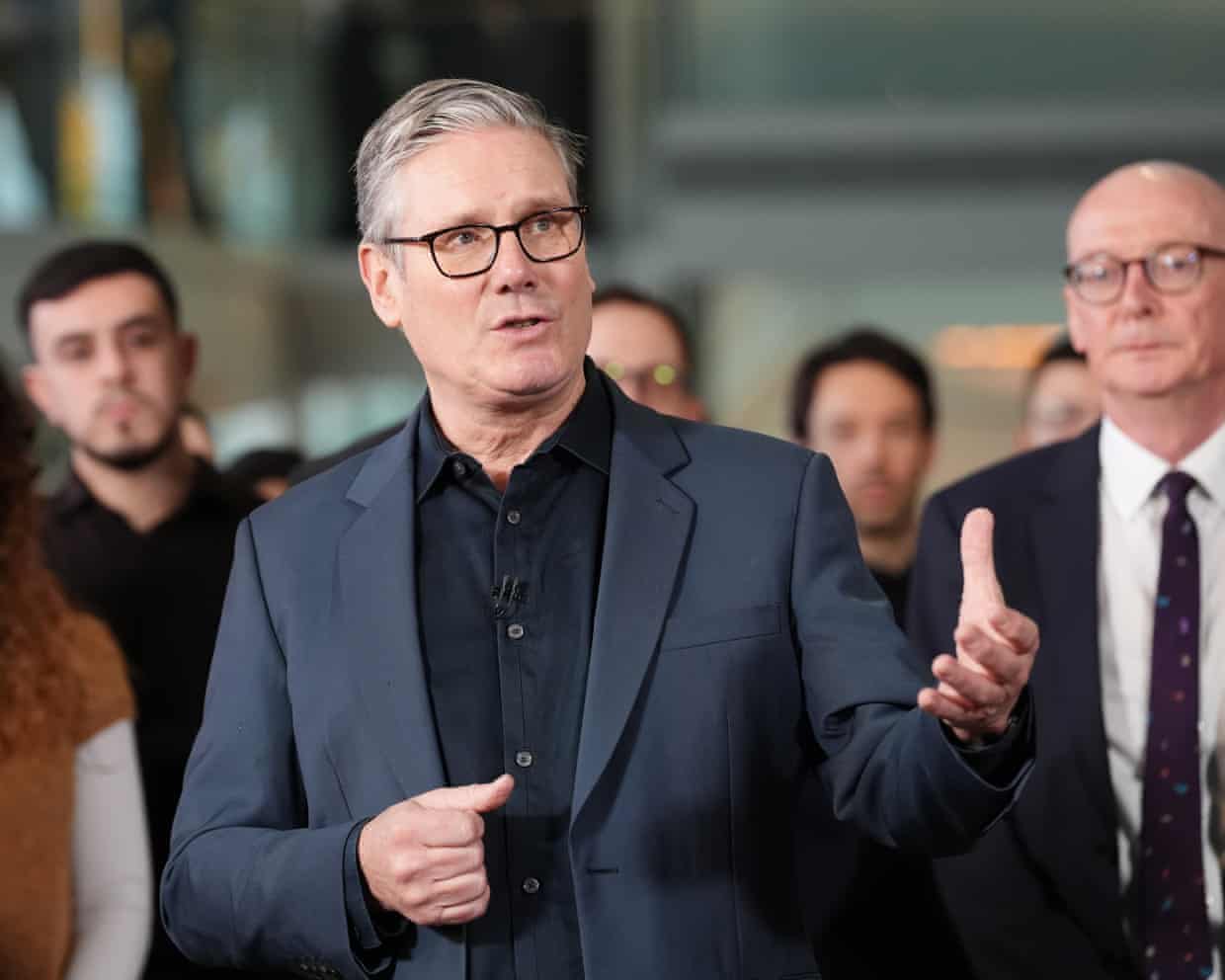
Keir Starmer has joined TikTok, Downing Street has announced.At the morning lobby briefing the PM’s spokesperson told journalists that Starmer has launched an account there to improve the way he communicates.But that does not mean that the government is relaxing its security rules about the Chinese-owned app.It is banned on most government apps, and so it is not clear how many ministers and officials using government devices will be able to see the PM’s posts.As of now, there is only one video on his account – showing Starmer and his wife Victoria outside No 10 watching the Christmas tree lights being turned on.
The spokesperson said that other world leaders, like President Macron of France and the Italian PM, Giorgia Meloni, are also on TikTok.He said:We are intent on reaching audiences where they are and communication is changing and people have a right to know about the decisions the Government is taking that affect them and why and how that is.TikTok is simply another way to do that and reach that wider audience.In another Downing Street communications development, Starmer has also launched a Substack blog.In his first post, which went up on Friday, he wrote at length about the child poverty strategy.
He also explained why he was on Substack, and claimed to be the first world leader with an account.Since you’ve got this far, I’ll leave you with one final explanation … After all, I think I am the only world leader that has decided to communicate in this way.So you probably want to know: why?The simple answer is that communication is changing and I want to be part of that.People have a right to know how decisions that affect them are taken and why.And I believe all politicians should explore innovative new ways to do that.
So in this Substack that’s what I will be doing,Showing you a little bit of what life is like in Number 10,But mainly just explaining the various decisions I take to try and create that Britain which is built for all,Unfortunately, Starmer’s first Substack post has received a lousy review from the Financial Times’s Stephen Bush, who has been writing political newsletters from more than a decade and who knows a thing or too about what makes them work,Referring to Starmer’s first effort, he says:It lacks an overarching argument and does not express a vision, and it is not clear what audience it is pitching for.
(It is too wonkish to be easy reading, but not really deep enough for wonks,) These are both familiar problems for this government,It is obviously inauthentic,We all know Starmer did not actually write this newsletter himself, because a) he doesn’t have the time, and b) he doesn’t even write internal memos and emails to Downing Street staff or cabinet ministers on a regular basis! A regular complaint I hear from Labour veterans is that Starmer does not produce, as Tony Blair used to, a regular memo of his own thoughts for Downing Street staff to guide their thinking and the direction of the government,Jacqui Smith, the skills minister, has defended the government’s decision to lift the cap on the compensation that can be paid in unfair dismissal cases.
At the end of last month, in what was seen as a major concession to employers, the government announced that it was dropping plans to include day one protection from unfair dismissal in the employment rights bill.Instead protection from unfair dismissal will kick in after six months.At the same time, but attracting far less attention, the government said it would remove the cap that can be paid to people who win a claim for unfair dismissal.Both amendments to the bill were part a compromise deal negotiated with employers and unions.Initially the details of how the cap on compensation would be lifted were not clear, but at the end of last week it was confirmed that the cap is being lifted in full.
One union described this as a “major win” for workers, and something the trade union movement had been campaigning for years.But employment lawyers said this would result in more cases going to litigation, because removing the cap would take away the incentive to settle.One described the move as “bonkers”.Today MPs are again debating the latest Lords amendments to the bill.Defending the decision to lift the cap on unfair dismissal compensation payments in an interview on Times Radio this morning, Jacqui Smith, the skills minister, said:Throughout this, there’s been a careful consideration of how we make sure workers have got the rights they deserve and that employers have got the ability to work alongside their trade unions in taking on people into the workplace.
That’s what the negotiation has been about,