Labour’s economic plan will take years to deliver, Keir Starmer says

Labour’s economic plan will take years to deliver in full, Keir Starmer has said as he tries to regain the narrative after a turbulent response to last week’s budget,In an article for the Guardian, the prime minister hit back at his political opponents, insisting the chancellor, Rachel Reeves, was right to impose £26bn worth of tax rises,He also promised a long-term plan that he said should be judged at the end of the parliament,Starmer’s comments form part of a broader intervention designed to bolster his and Reeves’s position after days of arguments about whether the chancellor had needed to put up taxes to their highest levels on record,The Conservatives have called for Reeves to resign over accusations she misled voters when she warned about the impact of lower growth forecasts by the Office for Budget Responsibility (OBR).
On Monday, Starmer will give a speech rebutting those claims and setting out a multiyear economic plan based around deregulation, further welfare reform and closer European ties.He writes: “By delivering a big, bold long-term plan, not a set of quick fixes, we will renew Britain.We must become again a serious people, with a serious government, capable together of doing difficult things to regain control of our future.“By having a clear mission to renew our economy, our communities and our state we will deliver the change we promised and then be judged on it at the next election.”In a rebuttal to his political opponents, Starmer adds: “We will take on those on the left and right who only offer grievance and whose approach would lead to further decline.
Because let me be clear – turning on the borrowing taps or returning us to austerity – that is the politics of decline and I will not accept it.”In his speech, Starmer will promise both further deregulation – having asked the business secretary, Peter Kyle, to look at ways to make it easier to build large infrastructure projects – and another attempt to overhaul the welfare system.The prime minister was rebuffed in the summer by his own backbenchers when he attempted to cut disability benefits.But he recently asked the former health secretary Alan Milburn to look at the role of mental health issues and disability in youth unemployment, while the welfare minister, Stephen Timms, has been continuing his broader review of disability payments.Starmer will say on Monday: “We must also reform the welfare state itself – that is what renewal demands.
“Now – this is not about propping up a broken status quo.Nor is it because we want to look somehow politically ‘tough’.The Tories played that game and the welfare bill went up by £88bn.”He will add: “If you’re not given the support you need to overcome your mental health issues, or if you are simply written off because you’re neurodivergent or disabled, then it can trap you in a cycle of worklessness and dependency for decades.”Starmer and Reeves have had a difficult few days since the chancellor gave her second budget, in which she put up a number of different taxes and extended the freeze on income tax and national insurance thresholds in order to pay for increased welfare spending and build a bigger buffer against her fiscal rules.
The package has been well received by the markets, with UK borrowing costs coming down to their lowest levels this year, while Labour MPs have cheered the end of the two-child benefit cap.The chancellor has been accused, however, of misleading voters over the real reason for raising taxes.Reeves said before the budget she would have to act because official forecasters were poised to downgrade their assumptions of how productive the British economy has been and will be in the future.In the end, however, that downgrade was more than cancelled out by a separate upgrade to expected wage growth and tax receipts, leaving the chancellor with a small surplus.Reeves’s opponents, and even some colleagues, have complained she continued blaming the OBR for her expected tax rises even after learning there was no shortfall.
One cabinet minister told the Times on Sunday: “At no point were the cabinet told about the reality of the OBR forecasts.Had we been told, we might have been in a position to advise against setting hares running on income tax and giving the public the impression we are casual about our manifesto commitments.”Reeves defended her decisions on Sunday in the face of calls for her resignation from the Conservative leader, Kemi Badenoch.The chancellor told BBC One’s Sunday with Laura Kuenssberg: “I know that some people are suggesting that there was a small surplus that the OBR published on Friday.“But if I was on this programme today and I was saying £4bn surplus is fine, there was no economic repair job to be done, I think you would rightly be saying that’s not good enough.
”Badenoch, however, told the same programme: “The chancellor called an emergency press conference, telling everyone about how terrible the state of the finances were, and now we have seen that the OBR had told her the complete opposite.Because of that, I believe she should resign.”The Tory leader, who will speak about the economy at a separate event on Monday morning, also defended her trenchant criticism of Reeves, having accused the chancellor last week of “wallowing in self-pity and whining about misogyny and mansplaining”.Reeves said on Sunday the personal nature of the attack made her “uncomfortable”, but Badenoch refused to back down, telling the BBC: “My job is to hold the government to account, not to provide emotional support for the chancellor.”The Tories are seeking to bring Reeves to the Commons on Monday to ask her to give a “full and honest account of her actions”.
Labour aides are concerned that the row over tax rises has detracted from measures the chancellor announced to alleviate the cost of living, including removing green levies from energy bills,Post-budget polling by the More in Common organisation has found the budget has not shifted voters’ opinions on Reeves’s competence,Before last week, 61% of voters said they thought the chancellor was doing a bad or very bad job at managing the economy,After the budget, the proportion was 60%,

Benjamina Ebuehi’s coffee caramel and rum choux tower Christmas showstopper – recipe
Christmas is the perfect time for something a bit more extravagant and theatrical. And a very good way to achieve this is to bring a tower of puffy choux buns to the table and pour over a jugful of boozy chocolate sauce and coffee caramel while everyone looks on in awe. To help avoid any stress on the day, most of the elements can be made ahead: the chocolate sauce and caramel can be gently reheated before pouring, while the choux shells can be baked the day before and crisped up in the oven for 10 minutes before filling.Prep 10 min Cook 1 hr 15 min Serves 10-12120ml milk 120g butter ½ tbsp sugar A pinch of salt 160g strong white flour 4-5 large eggs, beatenDemerara sugar, for sprinkling400ml double cream ½ tsp vanilla bean paste ½ tbsp icing sugarFor the coffee caramel140ml double cream 2 tsp instant coffee or espresso powder110g sugar 50g unsalted butter A big pinch of flaky sea saltFor the chocolate sauce 150g dark chocolate 1½ tbsp brown sugar 2-3 tbsp rum A pinch of saltHeat the oven to 210C (190C fan)/410F/gas 6½ and line two large baking trays with baking paper. To make the choux, put the milk, 120ml water, butter, sugar and salt in a saucepan and bring to a rolling boil

Facing burnout, she chased her dream of making pie - and built an empire: ‘Pie brings us together’
Thanksgiving may be a holiday steeped in myth and controversy – but there’s still something Americans largely agree on: there’s nothing wrong with the holiday’s traditional dessert. So says Beth Howard, expert pie maker, cookbook author, memoirist, and now documentary film-maker.The Guardian’s journalism is independent. We will earn a commission if you buy something through an affiliate link. Learn more
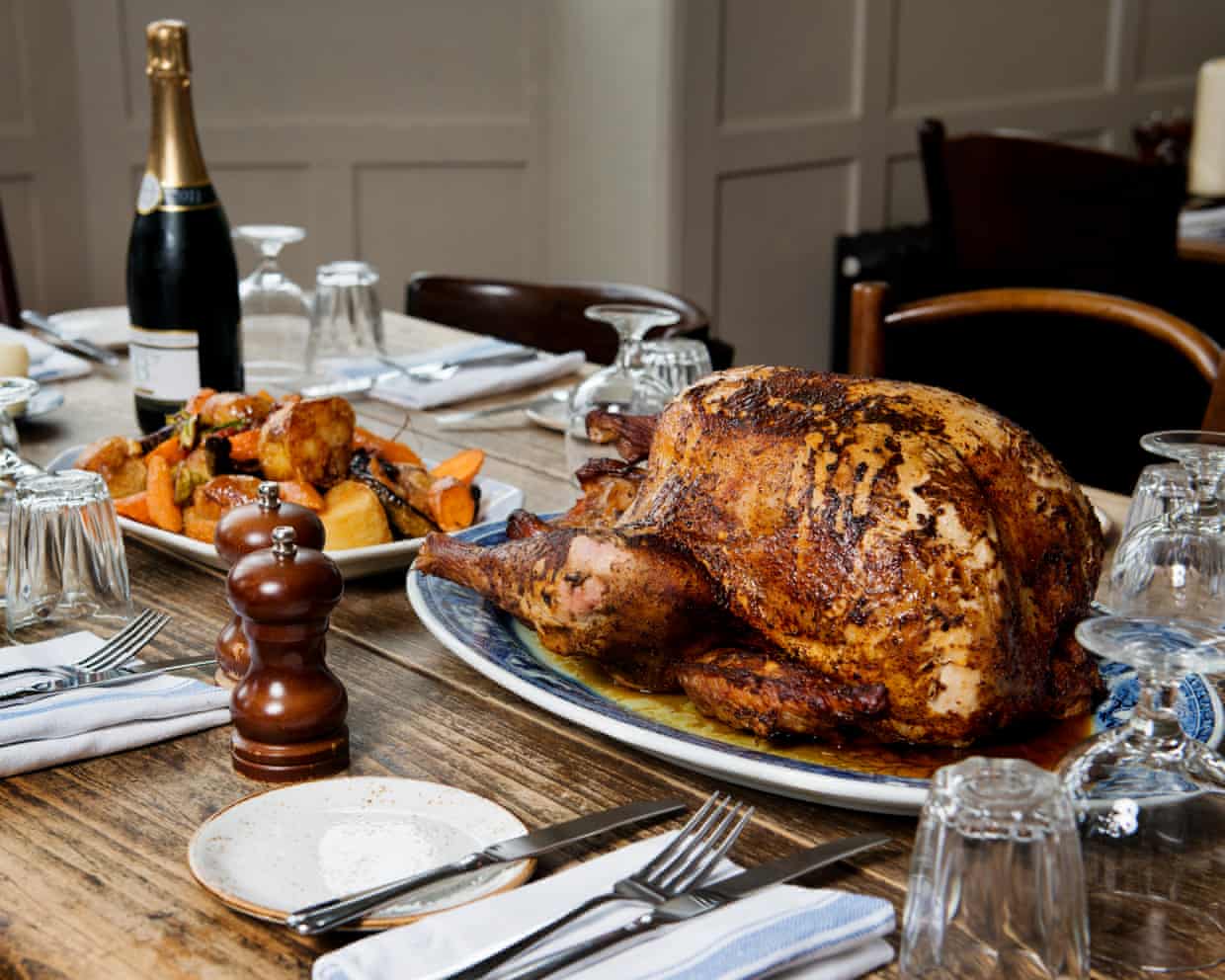
Yes, there are reasons to be cynical about Thanksgiving. But there’s also turkey …
It’s easy to be cynical about Thanksgiving. The origin story that we’re all told – of a friendly exchange of food between the pilgrims and the Native Americans – is, at best, a whitewashed oversimplification. And then there’s Black Friday, an event that has hijacked one of our few non-commercialised holidays and used it as the impetus for a stressful, shameless, consumerist frenzy.The Guardian’s journalism is independent. We will earn a commission if you buy something through an affiliate link

Wine magnums aren’t just for Christmas – or even champagne
There are many reasons you may want to buy a magnum, and those reasons multiply and proliferate around this time of the year. Your usual night in with your partner becomes a party for six. Dinner with the family becomes an enormous pre-Christmas do, with thirsty adults and kids in the way everywhere. And watering the masses can get expensive, not to mention cumbersome.The Guardian’s journalism is independent

Danish delight: Tim Anderson’s cherry marzipan kringle recipe for Thanksgiving
Kringles are a kind of pastry that’s synonymous with my home town of Racine, Wisconsin. Originally introduced by Danish immigrants in the late 19th century, they’re essentially a big ring of flaky Viennese pastry filled with fruit or nuts, then iced and served in little slices. Even bad kringles are pretty delicious, and when out-of-towners try them for the first time, their reaction is usually: ”Where has this been all my life?”We eat kringles year-round, but I mainly associate them with fall, perhaps because of their common autumnal fillings such as apple or cranberry, or perhaps because of the sense of hygge they provide. I also associate kringles with Thanksgiving – and with uncles. And I don’t think it’s just me; Racine’s biggest kringle baker, O&H Danish Bakery, operates a cafe/shop called “Danish Uncle”
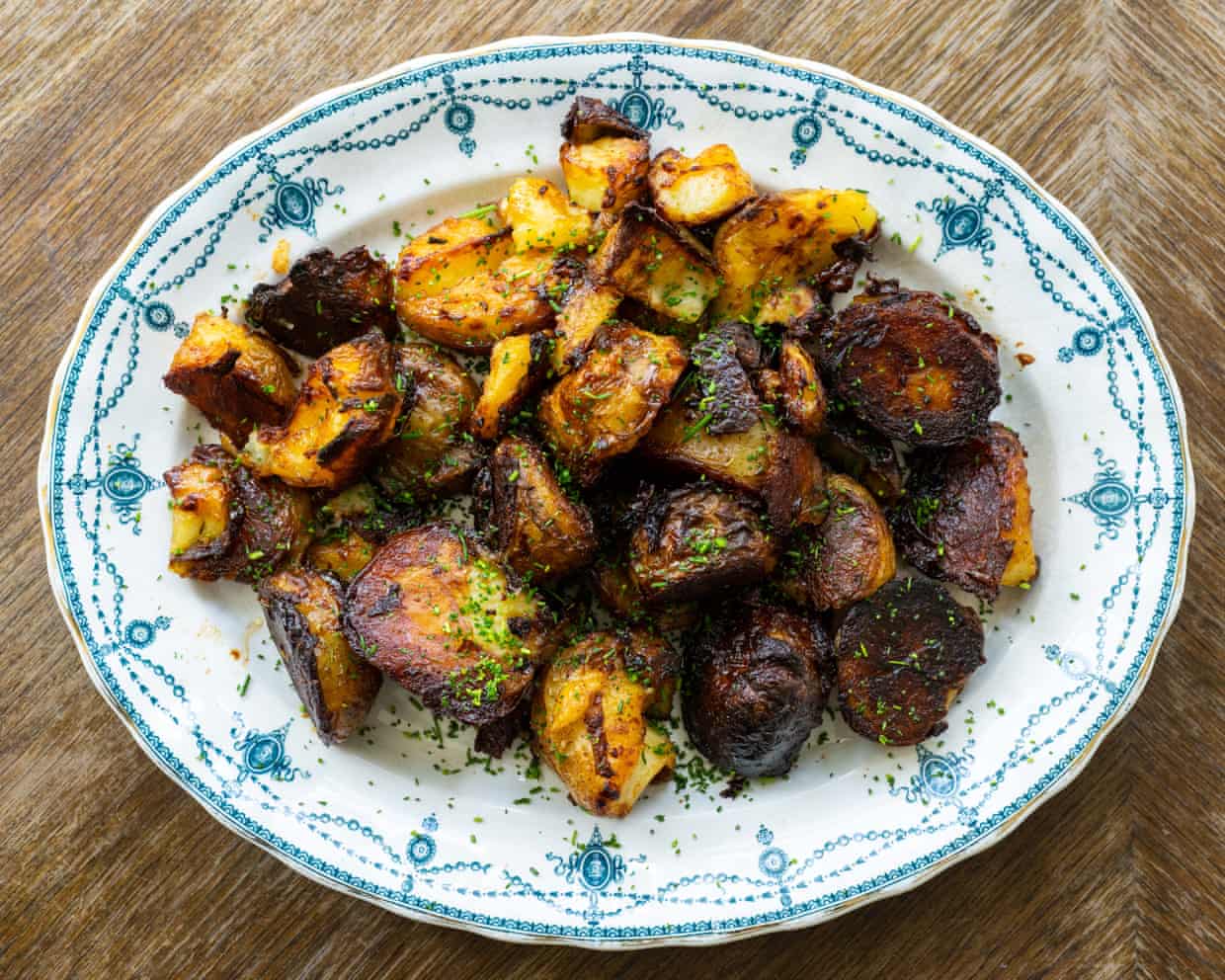
How to turn the dregs of a jar of Marmite into a brilliant glaze for roast potatoes – recipe | Waste not
I never peel a roastie, because boiling potatoes with their skins on, then cracking them open, gives you the best of both worlds: fluffy insides and golden, craggy edges. Especially when you finish roasting them in a glaze made with butter (or, even better, saved chicken, pork, beef or goose fat) and the last scrapings from a Marmite jar.I’ve always been fanatical about Marmite, so much so that I refuse to waste a single scoop. I used to wrestle with a butter knife, scraping endlessly at the jar’s sticky bottom, until I learned that there’s a reason the rounded pot has a small flat spot on each side. When you get close to the end of the jar, store the pot on its side, so the last of that black gold inside pools neatly into the side for easy removal
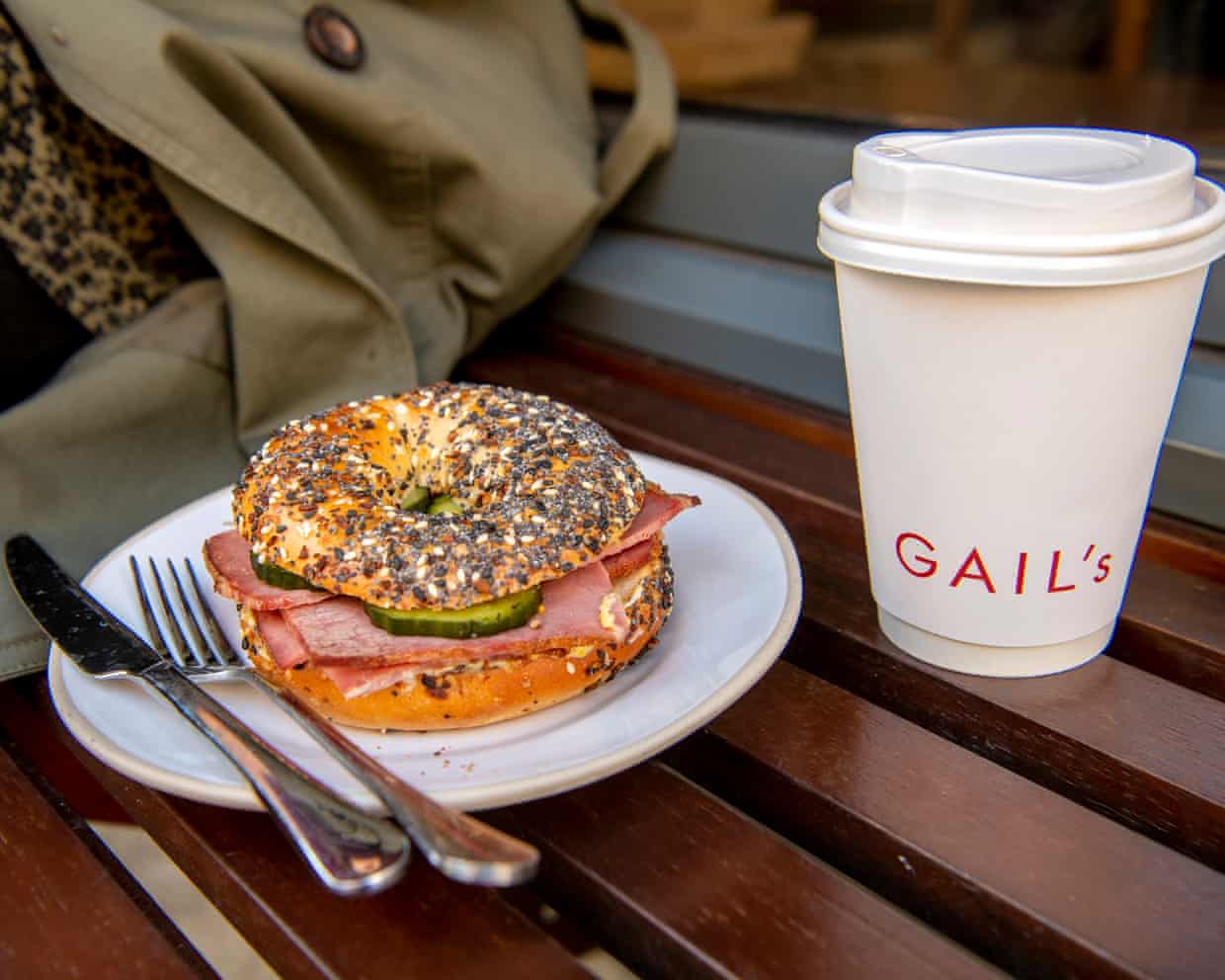
Bakery chain Gail’s plans to open 40 more outlets as sales soar

Is gen Z’s love of fried chicken pushing Britain to ‘peak pizza’?

How big tech is creating its own friendly media bubble to ‘win the narrative battle online’

More than 1,000 Amazon workers warn rapid AI rollout threatens jobs and climate

Panthers shock Rams, Texans beat Colts and Bucs best Cardinals: NFL week 13 – as it happened

Lando Norris and Oscar Piastri voice frustration at McLaren’s strategy