Man who pocketed tiles from medieval priory as boy returns them 60 years later
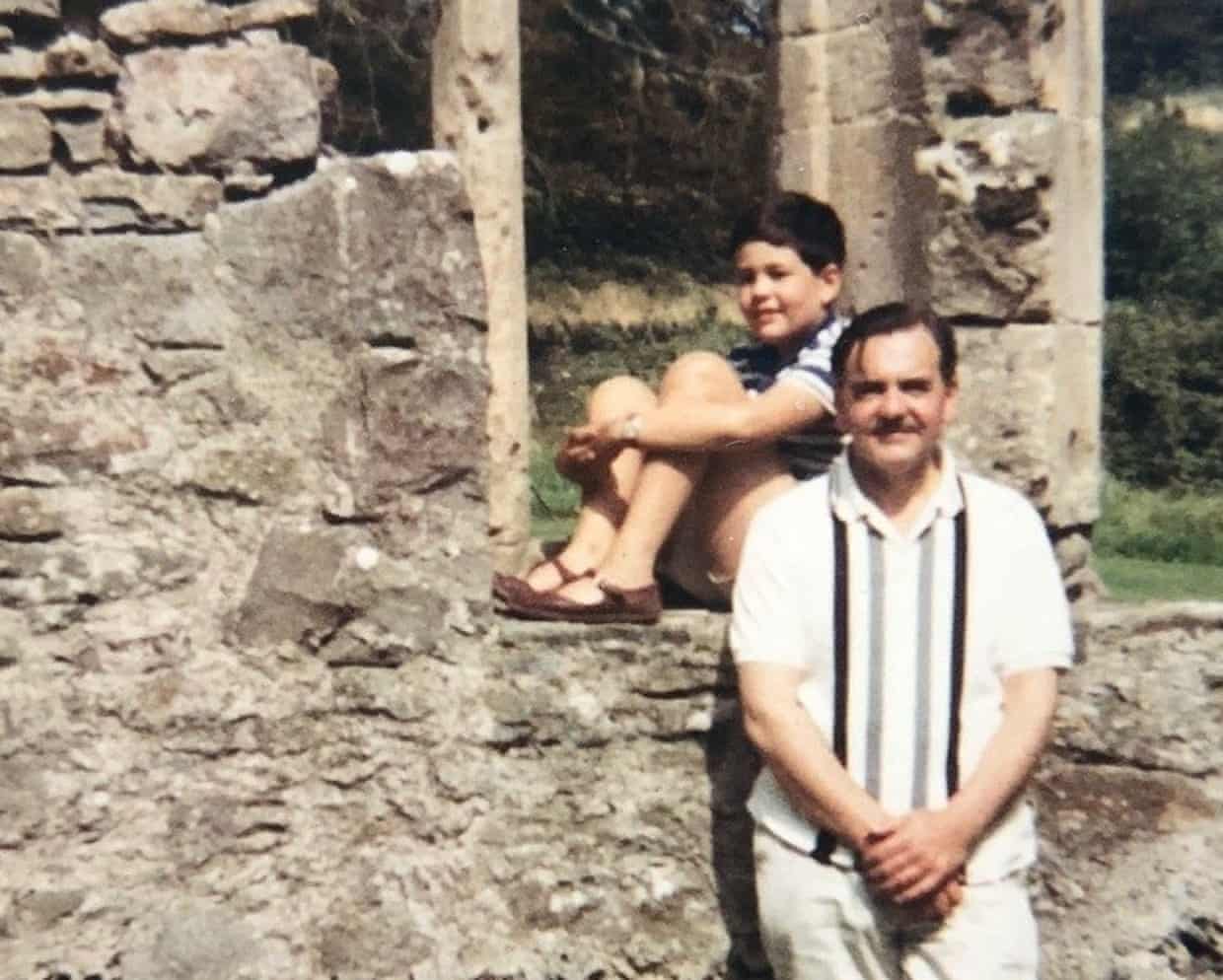
Fragments of a priory’s medieval tiled floor that spent almost 60 years stashed in a toffee tin after being pocketed by a nine-year-old boy during a family outing have finally been handed back,The three pieces of decorative clay tiles, dating from the late 13th to early 14th century, were taken as a souvenir by Simon White during a family visit to Wenlock Priory in Shropshire in the late 1960s,White, now a 68-year-old retired chartered surveyor, found the fragments in an old toffee tin during a house move and owned up to English Heritage,He told officials he recalled his father encouraging him to take the pieces but had always felt a little uneasy and was delighted when he rediscovered them,“I can remember the day this all happened with my father standing guard,” he said.
“Heaven knows what he would have said if we’d been caught,What happened to the tiles afterwards I’m not really sure, but they survived numerous house moves and assorted family upheavals only to turn up in my loft earlier this year in a battered tin,”With the help of family diaries, White worked out that they probably came from Wenlock Priory and contacted the site’s custodians, English Heritage,Matty Cambridge, assistant curator at the charity, said medievalists had concluded White was right to pinpoint Wenlock as the scene of the act,She said tiles like the ones White had taken were only known to have existed at three places in Shropshire: Haughmond Abbey, Bridgnorth Friary and Wenlock Priory.
Cambridge added: “Given Bridgnorth Friary has no in situ tile and wasn’t excavated until after Simon’s trip, and Haughmond Abbey only has a small patch of tile still at the site, we can narrow down the tiles found to Wenlock Priory.”Wenlock was once home to Cluniac monks, who were fond of elaborate architectural decoration.Cambridge said English Heritage was particularly thrilled that one of the fragments had a dragon motif on it, which was previously unknown at the site.“That’s quite exciting,” she said.Another fragment shows the face of what is thought to be a lion, or possibly a grimacing face.
White met Cambridge at Wenlock Priory to hand the fragments back.“He wanted to make a bit of a pilgrimage,” Cambridge said.“There are no hard feelings.He was only nine and was told: ‘Oh, this is pretty – take it home.’ We are very grateful to Mr White for coming forward.
“It’s not unheard of for mementos to have been taken from historic buildings, though is it unusual in this case that the artefacts were kept so well for so long and preserved.Nowadays we have far more stringent measures in place to prevent it, but if Mr White’s example pricks anyone else’s conscience from years ago, we’d love to hear from them.”The tiles will not be put back on to the floor but will be moved to an English Heritage archaeology store for further analysis.White said since his retirement he had taken a keen interest in archaeology.“The local society I’ve joined are likely to take a dim view of this.
It’s only right and proper that the tiles are returned home,”

AI outperforms doctors in Harvard trial of emergency triage diagnoses
From George Clooney in ER to Noah Wyle in The Pitt, emergency department doctors have long been popular heroes. But will it soon be time to hang up the scrubs?A groundbreaking Harvard study has found that AI systems outperformed human doctors in high-pressure emergency medicine triage, diagnosing more accurately in the potentially life and death moments when people are first rushed to hospital.The results were described by independent experts as showing “a genuine step forward” in the clinical reasoning of AIs and came as part of trials that tested the responses of hundreds of doctors against an AI.The authors said the results, published in the journal Science, showed large language models (LLMs) “have eclipsed most benchmarks of clinical reasoning”.One experiment focused on 76 patients who arrived at the emergency room of a Boston hospital
Calls grow to ban Palantir in Australia after manifesto described by UK MP as ‘ramblings of a supervillain’
Just weeks after it implied some cultures are inferior to others in a manifesto described by one UK MP as the “ramblings of a supervillain”, the US spy tech company Palantir says it is just “a software company” amid calls for Australian government agencies to ban any new contracts with the controversial company.In Australia, state and federal contracts with Palantir have reached nearly $80m, and federal investment in the company is reportedly more than $160m.Palantir, a Trump-aligned company that was co-founded by billionaire Peter Thiel, develops software for companies and government agencies to analyse vast amounts of data.Earlier this month, Palantir published a manifesto on X, arguing the benefits of American power and implying some cultures are inferior to others.“Some cultures have produced vital advances; others remain dysfunctional and regressive,” Palantir wrote in the post

Galaxy S26 review: Samsung’s still-compact flagship Android
Samsung’s compact flagship phone hasn’t changed much in a year, but the S26 is still one of the best smaller handsets available as rivals grow larger and larger.The Guardian’s journalism is independent. We will earn a commission if you buy something through an affiliate link. Learn more.The S26 is the cheapest and smallest of this year’s top Samsungs, dwarfed by the top-of-the-line S26 Ultra in size and price

‘Your questions are designed to trick me’: combative Musk grilled over battle with Sam Altman
After a dramatic first day of opening statements and testimony from Elon Musk in his case against Sam Altman and OpenAI, the trial continued on Wednesday with a cross-examination of the Tesla CEO. Musk began his second day of on the stand by repeating the accusation that Altman “stole a charity” and would endanger humanity with AI multiple times. OpenAI’s attorneys pressed the world’s richest man on his allegations, resulting in testy exchanges and multiple interventions from the judge.Musk often refused to answer questions as instructed, and the judge interjected several times to tell Musk to simply give a yes-or-no response. At various points, Musk told OpenAI’s counsel, “You’re being misleading with your question,” and “Your questions are not simple, they are designed to trick me, essentially

Maryland becomes first state to ban surveillance pricing in grocery stores
Maryland has become the first state in the US to ban surveillance pricing in grocery stores.Maryland’s law bans grocers and third-party delivery services from using a person’s personal data to set higher prices. Wes Moore, the governor, signed the measure into law on Tuesday. “At a time when technology can predict what we need, when we need it, when we’ll pay for it and also – when we’ll pay more for it, and at a time when we’re watching how big companies are then using these analytics against us to make record profits, Maryland is not just pushing back. Maryland is pushing forward because we are going to protect our people,” Moore said at the bill signing ceremony

Tech giants’ results show rosy outlook for AI boom and US stock market
Unusual simultaneous reports of financial results by several of the US’s largest tech companies gave positive indications for the stock market despite widespread fears of an AI bubble on Wednesday.Four of the so-called Magnificent Seven tech stocks, the most valuable publicly traded companies in the world, reported their quarterly financial results on Wednesday. The cluster is not typical, as these disclosures do not often occur on the same day, and provides a snapshot of how the tech industry is faring as it rides the AI boom. Amazon, Alphabet and Microsoft all revealed double-digit gains in their cloud computing units, which have seen supercharged growth thanks to increasing adoption of AI. Meta, not in the business of cloud computing, failed to meet Wall Street expectations

Stephen Fry sues tech conference organisers for £100,000 over fall from stage

Jimmy Kimmel on the Trump administration: ‘They’ve hit peak ridiculous’

Letter: Desmond Morris obituary

Boom! A melodrama fit for Elizabeth Taylor and Richard Burton’s doomed love affair

Jon Stewart on White House correspondents’ dinner: ‘We can’t even pull off a dinner that shouldn’t have existed in the first place’

Antiquities dealer who exposed thefts at British Museum dies aged 61