US datacenters face slew of problems amid grassroots protests against AI
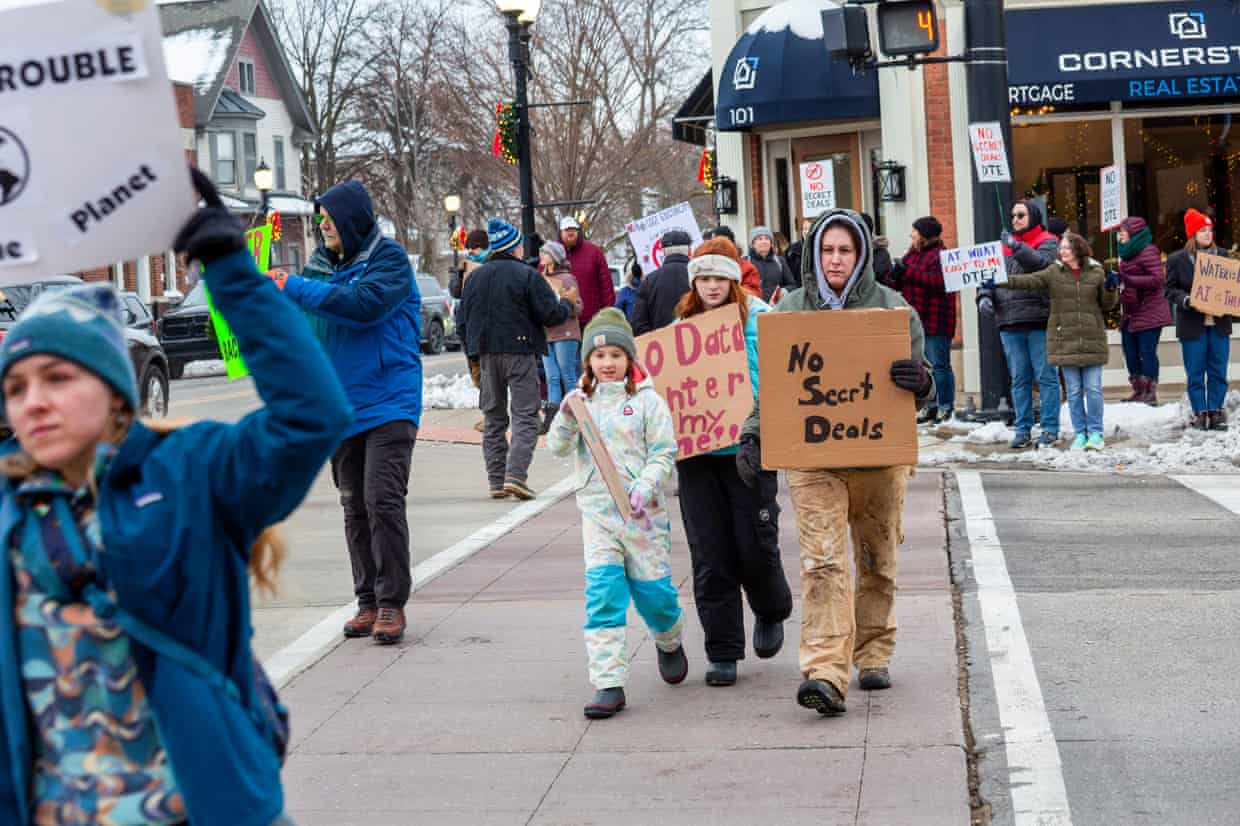
Cancellations and delays of new US datacenters have increased as the artificial intelligence boom runs up against a slate of issues, including supply chain snags, energy shortages and tariff-induced restraints.Grassroots opposition from local communities has also derailed some plans, and some investors have grown wary of datacenters amid fears of an AI bubble.Dozens of plans for datacenters were killed or delayed in December or January, according to reports from the investment research firm MacroEdge and climate news outlet Heatmap.MacroEdge’s research identified 26 cancellations through January – up from one in October.The complex knot of issues raises questions about the US’s ability to quickly facilitate the datacenter boom.
Because the increase in production has been powering US growth over the last 18 months, major delays could have broader economic implications, MacroEdge’s chief economist, Don Johnson, wrote.“The [Trump] administration is going to be scrambling to find its next growth engine as the datacenter machine winds down as a tailwind,” Johnson wrote.Dozens of proposals for new hyper-scale datacenters, which house the infrastructure for artificial intelligence, have been proposed across the US.The centers can consume as much power as the largest US cities, meaning grids need to rapidly expand their infrastructure, adding transformers, circuit breakers, high-voltage cables, steel poles and other pieces of equipment, to connect datacenters to the grid.Connecting to the grid is “the No 1 challenge we’re seeing”, Marsden Hanna, head of energy and sustainability for Google, said at a utility industry conference last month.
“We have utilities in many markets telling us four or five, sometimes 10 years to interconnect,” Hanna said, adding that one utility told Google it would take 12 years just to study the interconnection timeline.While the reports suggest an increase in cancellations, tracking the number of proposals and cancellations is difficult, said Douglas Jester, managing partner at the 5 Lakes Energy consulting firm in Michigan, which works on regulatory issues around datacenter construction.No agency keeps tabs on proposals, and the datacenter planning process is long and complex, Jester said.When a datacenter developer such as Google or Oracle wants to build a facility, it approaches energy utilities in multiple regions to study cost and how long it might take to connect to the grid.Developers often propose the same plans in multiple locations around the US and move forward where the costs and conditions are most favorable.
That makes it difficult to gauge exactly when a project is legitimately under way.Regardless, centers are increasingly running up against mounting energy grid obstacles, especially a shortage of energy, Jester said.Many grids simply cannot generate enough power, or add it in time to meet datacenter developers’ timelines, and the process of adding power supply to the grid is slow.That is partly because it can take regional grid operators, which coordinate the local energy utilities’ power generation and transmission, up to five years to review how proposed gas plants, solar fields or other generation sources could affect the grid, Jester said.This protracted process was already slowing the nation’s transition to clean energy.
It can take five or more solar installations to generate the same amount of power as one gas plant, which means an increase in the review backlog as the clean energy transition accelerates.The sudden datacenter demand piles on to this already difficult problem.“The interconnection process is really getting bogged down, and it has been a problem even before datacenters,” Jester said.The review process primarily ensures the new additions will not disrupt supply in the grid, but the Texas grid operator, Electric Reliability Council of Texas (Ercot), has a better approach, Jester said.In short, Ercot – which operates with little federal oversight compared with other operators – quickly adds new energy generation to its grid, then addresses problems if they arise.
Meanwhile, the surge in new datacenter projects has hammered energy grid supply chains still recovering from Covid-era snags and that are strained from the clean energy buildout, said Qiuhua Huang, an associate professor of electrical engineering with the Colorado School of Mines, which studies grid supply chain issues.Demand for grid equipment, like transformers, has spiked, but only one plant in the US produces the type of steel needed for many of the pieces.Copper shortages are also slowing the buildout, Huang said.High-voltage transformers that once had lead times of six months now take up to four years to manufacture, for example.Relatedly, a skilled labor shortage represents another restraint, industry experts say.
The US utility industry has leaned heavy on utility infrastructure imports from China and other countries, but demand abroad has also spiked.Donald Trump’s tariffs have also made the US a less attractive market for foreign producers as prices continue to increase, Jester said.Data shows transformers’ costs are up to six times above pre-2022 levels.“The tariffs are exacerbating, if not causing, the problem in the US,” Jester said.Grid limitations have stretched the timelines for the new datacenters.
PJM, the largest grid operator in the US, is pushing connection times back as far as 2030, MacroEdge noted.“This, of many factors, should put caution into investor minds,” Johnson wrote.Some hedge funds and other datacenter investors are growing nervous.Blue Owl, an investor in the highly controversial Saline Township datacenter in Michigan, backed out on its $10bn investment in December.Though Oracle said it would not stop the project, Bain Capital and other investors seem similarly hesitant.
Some solutions are in the works, and steel manufacturers are scaling up production.Battery storage is becoming a viable alternative to new power generation, Jester said.Large-scale battery storage that is added to the grid can hold energy for later use, reducing the need for new power plants and grid infrastructure.Oracle recently proposed that such battery storage could help meet its goal to build a 1.4GW datacenter in Michigan, which would require as much power as Detroit, by 2027.
DTE Energy, the monopoly utility that serves the region, is near grid capacity and probably could not install a gas plant or enough solar fields to meet that timeline, in part because the review process is so slow.Big tech, which is far more resourced than the utility industry, is also developing new transformer technology that does not demand the same steel or infrastructure pieces, Huang said.“It’s in the early phase of mass adoption, but datacenters have a much larger budget than utilities, so they can better handle those technology adoptions, and that will diversify the supply chain,” Huang said.

Government accused of caving in to building lobby amid plans to shake up housing sector in England
The government has been accused of bowing to lobbying by housebuilders, in proposals that would prevent English local authorities from pursuing improvements to low-carbon homes standards.Under a consultation on planning rules, councils would be issued with guidance that would effectively limit their scope to demand builders construct new homes within their areas to the highest possible standards.These changes to the National Planning Policy Framework would benefit housebuilders, which could be assured of the same standards across England, but would bind the hands of councils, some of which have declared a “climate emergency”.Ministers have yet to publish separate much-delayed rules for the future homes standard (FHS), which requires new homes to be built with low-carbon equipment such as heat pumps, high-grade insulation and solar panels. But there are fears that the FHS will not go far enough

Tell us your experience living with Tourette syndrome
Controversy erupted at the Baftas award ceremony after the BBC initially failed to edit out the N-word spoken involuntarily by John Davidson, who has Tourette syndrome (TS).In a statement Davidson said he was “deeply mortified if anyone considers my involuntary tics to be intentional or to carry any meaning”. He added: “I have spent my life trying to support and empower the Tourette’s community and to teach empathy, kindness and understanding from others and I will continue to do so. I chose to leave the auditorium early into the ceremony as I was aware of the distress my tics were causing.”We would like to hear from people who are affected by Tourette syndrome (TS), and in particular those who have vocal tics involving swearing (coprolalia)

Baby boy born to UK mother after womb transplant from dead donor
A baby boy named Hugo is the first child to be born in the UK to a mother with a womb transplant from a dead donor.Hugo Powell was delivered at Queen Charlotte’s and Chelsea hospital in London weighing 3.09kg (6lb 13oz), after his mother, Grace Bell, received a transplanted womb from someone who had died.It is the first birth in the UK using a womb from a deceased donor, with only two previous cases reported in Europe.Bell, an IT programme manager, was born with Mayer-Rokitansky-Küster-Hauser (MRKH) syndrome, a rare condition resulting in an underdeveloped or missing womb

My maddening battle with chronic fatigue syndrome: ‘On my worst days, it feels almost demonic’
At the Croydon secondary school I attended in the late 1990s, the deputy headmistress was a stocky woman with a military haircut who patrolled the corridors in voluminous outfits patterned in shades of brown. The outfits were much discussed, not charitably, by the teenage girls in her charge – as was her voice, which made you think of a blunt knife being drawn across a rough surface. Thirty years later, I can still hear that terrible voice refer to my “mystery illness”. In truth, the deputy headmistress never actually spoke those words – they were included in a typed letter she sent to my parents concerning my prolonged absence from school. Still, the indicting force of five syllables is as distinct in my ear as if she were looming over me

Unlicensed gambling firms could be barred from sponsoring Premier League clubs
Unlicensed gambling firms could be barred from sponsoring Premier League football clubs, after a string of controversies involving pornographic videos, failures in anti-money laundering rules and concerns about links to organised crime.Shirts worn by players for several major English football teams, including Everton, Fulham and Burnley, feature the logos of unlicensed online casinos or bookmakers.Premier League clubs have pledged to end all front-of-shirt gambling deals from the end of this season, including those with large operators with a licence.But the voluntary measure will not apply to shirt sleeves or other commercial tie-ups. This leaves the door open to gambling firms who do not hold a British licence to continue hitching themselves to the popularity of the Premier League, as long as they promise not to offer their services to UK consumers

What is Tourette syndrome, what are tics and what happened at the Baftas?
Controversy has erupted over the Baftas after the BBC initially failed to edit out a racial slur shouted by John Davidson, who has Tourette syndrome (TS). Here we explore what vocal tics are, and how they should be understood.One of the films up for awards was I Swear – a movie inspired by the real-life story of the TS campaigner Davidson, who was present at the event on Sunday.Davidson shouted several times during the ceremony. In one case, he used the N-word while the actors Delroy Lindo and Michael B Jordan were presenting a prize on stage
AstraZeneca boss Pascal Soriot’s pay rises to £17.7m

Oil prices hit seven-month highs as tensions rise before US-Iran talks

Meta agrees $60bn deal with chipmaker AMD despite AI bubble fears

Police AI chief admits crime-fighting tech will have bias but vows to tackle it
US hockey was bathed in a golden Olympic glow. Then Donald Trump and Kash Patel stepped in | Beau Dure
‘I felt tears welling in my eyes’: our readers’ Winter Olympics highlights