Rachel Roddy’s Easter cannelloni with spinach, peas, ricotta and mozzarella – recipe
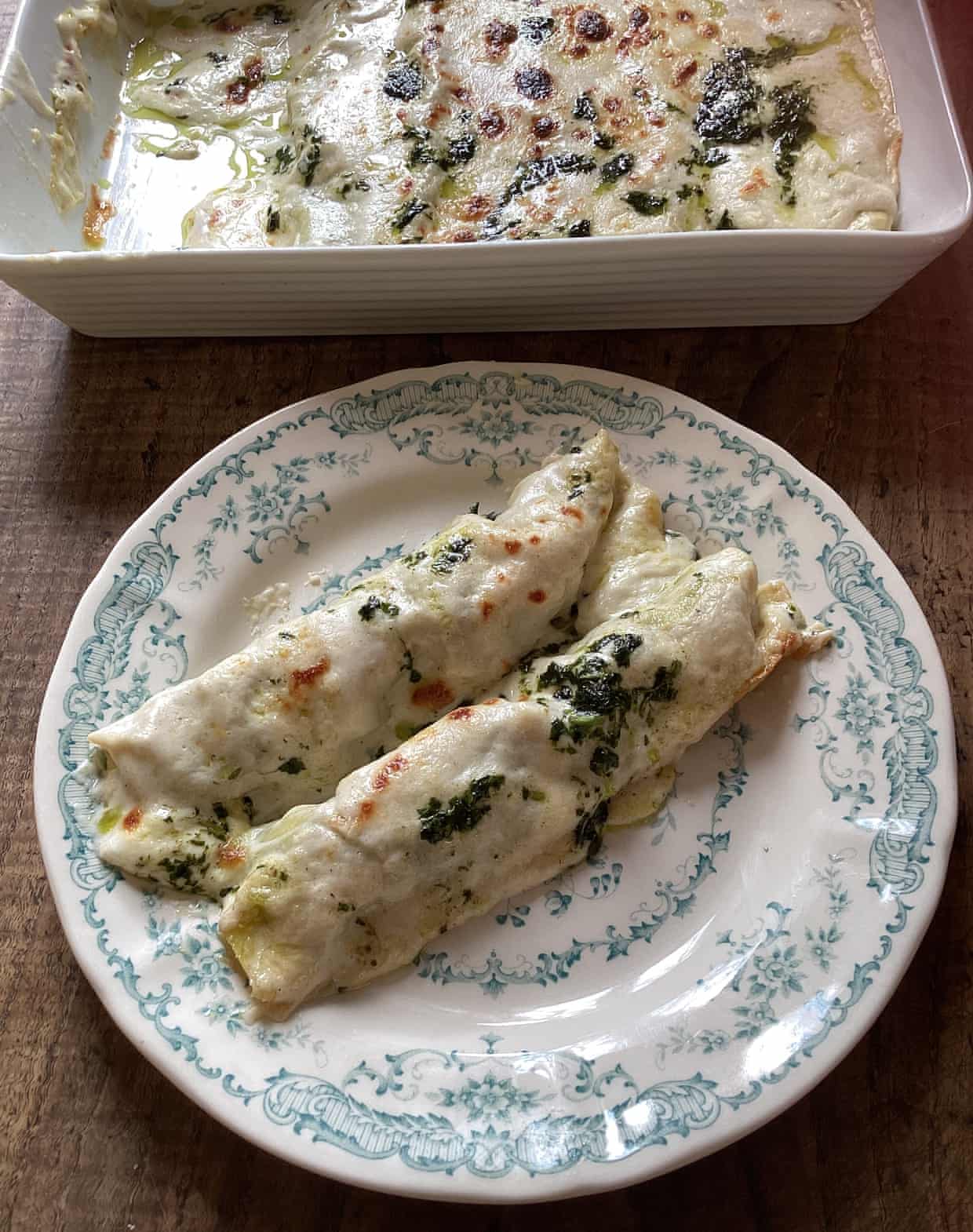
Fresh sheets smelling of fresh air or fabric softener (or both) with hospital corners are one of life’s great pleasures.As are fresh sheets of egg pasta – the sort that comes in squat boxes protected by clingfilm and found in the fridge section alongside ravioli.They are also one of the most useful and certainly the most multi-talented of all the pasta shapes.That they are labelled lasagne is limiting; of course, they can be lasagne, but they could just as easily be numerous other shapes.The most easy-going of which is maltagliati, meaning badly cut, which tells you everything you need to know about the approach required as you cut them (using a knife, pizza wheel or pair of scissors) into uneven bits that are ideal in all sorts of soups, but especially those with beans.
With slightly more precision, the sheets can be turned into 1cm-wide ribbons (short tagliatelle, if you like) for meat or vegetable ragu.Similar ribbons, made with a fluted pasta cutting wheel, can be mafalde, while thicker ribbons create a sort of ersatz pappardelle.All ribbons, though, can be cut into quadrucci (little squares) – another shape ideal for soup.Larger squares can be mandilli de sea (silk handkerchiefs), which are great dressed with pesto.If the pasta is fresh enough, rectangles can also be pinched into farfalle (butterflies), although I think bow ties is a better description.
Alternatively, the sheets can be rolled around a generous, well-seasoned filling and turned into cannelloni.“Bigs tubes” cannelloni is a relatively recent shape, first mentioned in dictionaries in the mid 1800s and defined as a large shape of pasta to be filled and baked.It was only in the 20th century that recipe books featured the cannelloni we recognise today: fresh or dried tubes stuffed with meat or cheese and vegetables, covered with sauce or bechamel and gratinèed in the oven.As useful and good as the dried tubes are, I think cannelloni made with sheets of fresh egg pasta, both tender but with bite, are more of a treat, especially if the dish is for a feast day.The other beauty of cannelloni is the practicality of preparation, which can be done a few hours or even the day before.
Ignore any instructions that suggest no par-cooking; plunge the sheets into fast boiling water for two minutes, then lift them into a bowl of cold water and then on to a clean cloth before rolling around a spring-loaded filling of spinach, peas, ricotta and lemon zest.Par-boiling means you don’t need an extremely liquid sauce in order for the tubes to cook through, rather a blanket of bechamel and Jackson Pollock splatters of basil pesto.Serves 4Salt and black pepper 8 sheets fresh lasagne 200g fresh or frozen peas 300g spinach 250g ricotta 6 tbsp grated parmesanZest of 1 small lemon 40g butter 40g flour 500ml whole milk, warmed Nutmeg Butter, to grease 200g mozzarella For the pesto1 big handful basil 3 tbsp olive oil A pinch of saltBring a large pan of salted water to a boil, prepare a bowl of cold water and lay a clean tea towel out on the worktop.In two batches, par-boil four lasagne sheets for two minutes, then lift them into the cold water and lay them on the tea towel.Pour boiling water over the peas, then drain.
Wash then wilt the spinach in a large pan with the lid on, stirring regularly; drain thoroughly.Chop the spinach and mix with the ricotta, peas, three tablespoons of grated parmesan, the lemon zest and salt and pepper to taste.Make the bechamel by melting the butter and flour, stirring until a thick paste forms.Whisk in the warm milk and keep whisking until the milk thickens and coats the back of a spoon.Add two tablespoons of parmesan, a generous grating of nutmeg, and some salt and pepper.
Construct the cannelloni by putting a line of spinach filling the bottom half of each sheet and rolling them up and over to form a neat tube,Arrange the tubes seam side down in a buttered baking dish,Pour the bechamel over the tubes then rip over the mozzarella and sprinkle over the final tablespoon of parmesan,Bake at 200C (180C fan)/390F/gas 6 for 20 minutes, or until the edges bubble and top is spotted with gold,To make the pesto, blend all the ingredients together, then use this to dot over the cannelloni for the final few minutes of cooking.
Claude’s code: Anthropic leaks source code for AI software engineering tool
Anthropic accidentally released part of the internal source code for its AI-powered coding assistant, Claude Code, due to “human error”, the company said on Tuesday.An internal-use file mistakenly included in a software update pointed to an archive containing nearly 2,000 files and 500,000 lines of code, which were quickly copied to developer platform GitHub. A post on X sharing a link to the leaked code had more than 29m views early on Wednesday, and a rewritten version of the source code quickly became GitHub’s fastest-ever downloaded repository. Anthropic issued copyright takedown requests to try to contain the code’s spread. Within the code, users spotted blueprints for a Tamagotchi-esque coding assistant and an always-on AI agent, per the Verge
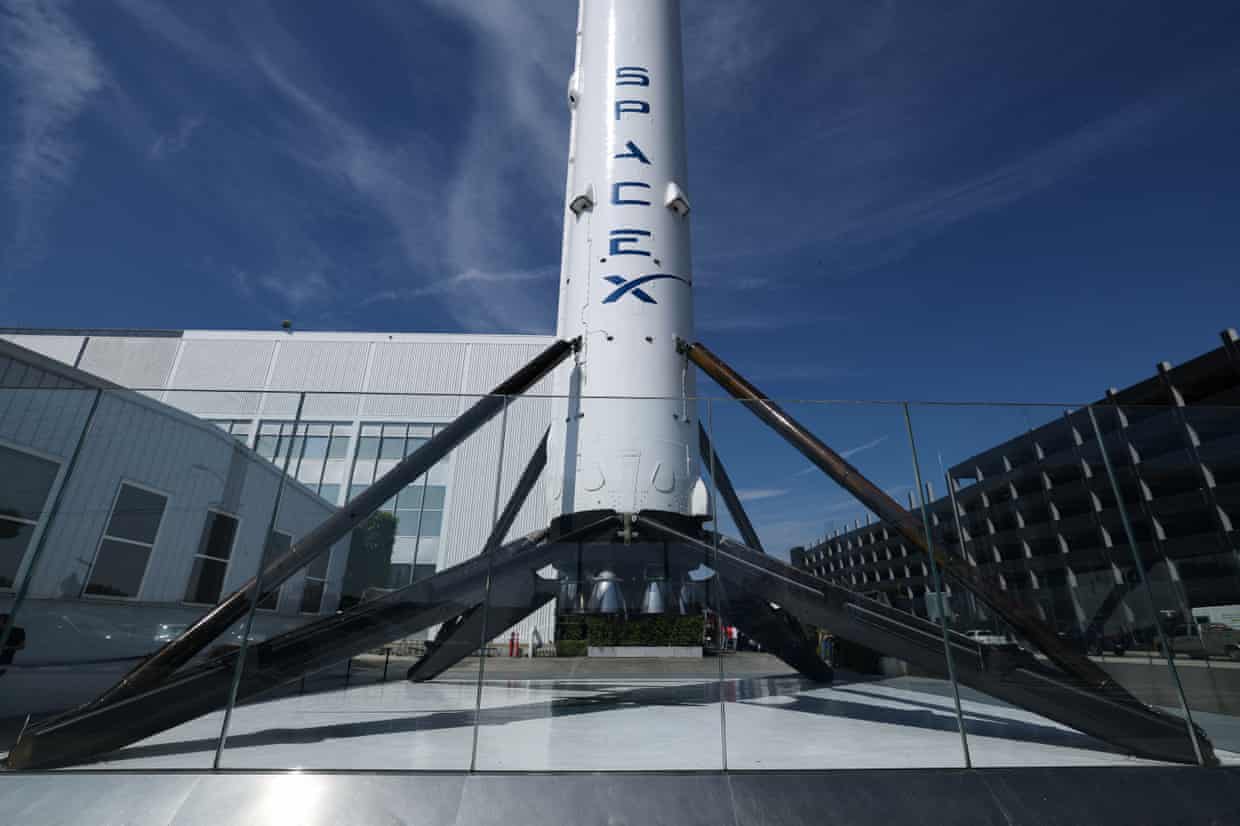
SpaceX confidentially files to go public at $1.75tn, reports say
SpaceX has confidentially filed for an initial public offering on the US stock market, according to reports from Bloomberg and the Wall Street Journal. The IPO is set to be one of the most closely watched and highly valued listings in market history.Elon Musk’s company, which has become a dominant power in both space travel and satellite communications, could potentially seek a valuation upwards of $1.75tn. The confidential filing will give regulators a period to review and discuss the company’s financial disclosures before investors and the public are able to view them

‘System malfunction’ causes robotaxis to stall in the middle of the road in China
A “system malfunction” has caused several self-driving robotaxis to stall in the middle of the road in China, police have confirmed, after distressed riders were stranded for hours.Local authorities in the central Chinese city of Wuhan said they began receiving calls “one after another” on Tuesday night from riders reporting that autonomous vehicles operated by the Chinese internet company Baidu had frozen.“Multiple Apollo Go cars stopped in the middle of the road, unable to move,” police said in a statement on Wednesday, referring to Baidu’s driverless taxi service. “After investigation, preliminary findings suggest the cause was system malfunction.”Baidu has a fleet of more than 500 driverless cars in Wuhan

Unregulated chatbots are putting lives at risk | Letters
Your coverage of AI-associated delusions exposes a gap that training-level guardrails cannot close (Marriage over, €100,000 down the drain: the AI users whose lives were wrecked by delusion, 26 March). As someone who has worked in health systems across fragile and low-income contexts, I find it striking that AI companies have failed to adopt a safeguard that even the most underresourced clinic in the world already uses: screening patients before exposing them to risk.The Patient Health Questionnaire-9 for depression and the Columbia Suicide Severity Rating Scale are administered daily in settings with no electricity, limited staff, and patients who may never have seen a doctor. These tools take minutes. They are validated across dozens of languages and cultural contexts

Don’t blame AI for the Iran school bombing | Letters
Your article on the Iran school bombing rightly challenges the reflex to blame artificial intelligence (AI got the blame for the Iran school bombing. The truth is far more worrying, 26 March). However, the deeper problem lies not in the technology but in the language now forming around it. To say that there was an “AI error” quietly removes the human subject from the sentence. Where once civilians were “dehoused” or “collateral damage”, responsibility is now displaced altogether: from people to systems

Patrick McKeown obituary
For the past four years, the James Webb space telescope has been returning stunning images of stars and galaxies that formed in the early universe. Parked in orbit a million miles from the Earth, the observatory is an extraordinarily sophisticated machine that shares a special engineering heritage with a swelling number of modern devices, from mobile phones to medical scanners and turbine blades.All are products of precision engineering, a discipline that blends the traditions of surveying, navigation, astronomy and time-keeping to create the technology that underpins our lives today. And one of its prime exponents was Patrick McKeown.McKeown, who has died aged 95, wrote the “11 principles of machine design” that were a distillation of everything he had learned about accuracy, stability and error correction in mechanical systems, and that have become the bedrock of precision engineering across the world
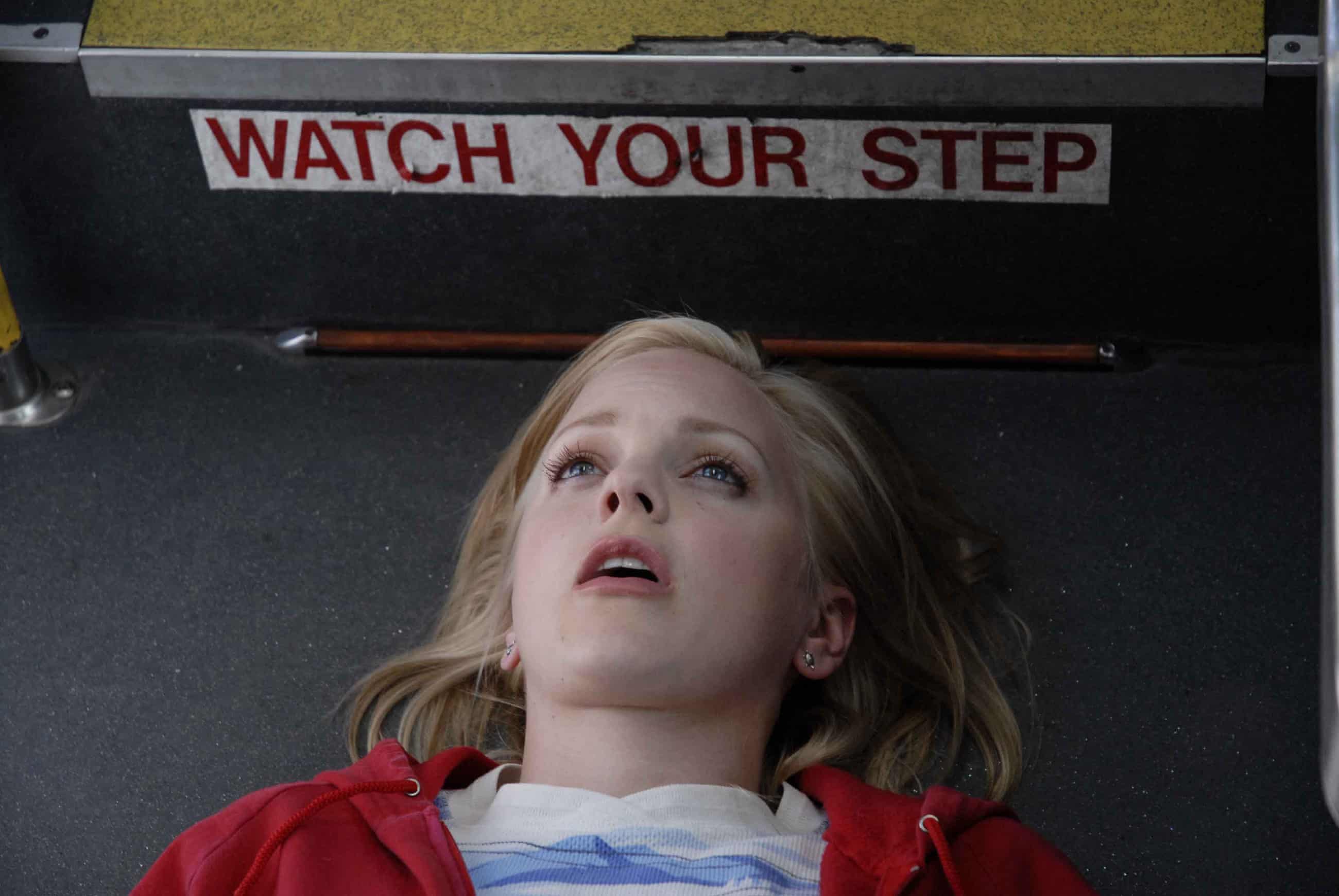
Smiley Face: finally, a stoner comedy for the girls who get overstimulated at the supermarket

‘After one gig, someone stole my car with my dole money in it’: Morcheeba on how they made The Sea

Jayson Gillham announces tour with Palestinian-Jordanian musician ahead of MSO court case

Fill that Glasto-shaped hole! The 40 best UK festivals you can still book

Shaun Micallef: ‘Charlie Pickering said that’s the only thing keeping him going – to vanquish me’

I thought I’d been coping with my sister’s death – a Taylor Swift song showed me I hadn’t