Energy price shock and interest rate rises could cause ‘pronounced’ UK recession, economist warns – as it happened
Britain’s economy could be dragged into recession by the end of this year by high energy prices and interest rate hikes, economists at Morgan Stanley have warned,Following this morning’s data showing a slowdown in private sector growth this month and a surge in input costs (see 9,41am), Morgan Stanley economist Bruna Skarica has warned that the energy price shock is likely to prompt the Bank of England to raise interest rates, which would hurt growth,Skarica points out that oil prices have risen by around 40% since January, with natural gas contracts up by around 80%, prompted the financial markets to predict the BoE will raise rates this year,Skarica told clients:double quotation markShould these financial conditions and commodity prices be sustained in the coming months, we would be calling for a pronounced UK recession at the turn of the year.
Yesterday, before Donald Trump claimed that “very good” talks had taken place with Iran, the markets were predicting UK interest rates would be a whole percentage point higher by December,Now, though, the money markets are only predicting 66 basis points (0,66 of a percentage point), implying two quarter-point rises are fully priced in,Time to wrap up…The UK economy could be dragged into a recession if the energy price shock continues, and prompts higher interest rates, Morgan Stanley has warned,The Bank of England’s chief economist has flagged that the UK faces ‘upside risks to price stability’ from the Iran war.
British firms have been hit by soaring costs this month, with input price inflation jumping by the most since the Black Wednesday sterling crisis of 1992.Growth has also slowed across eurozone companies, with companies in Japan and India also reporting a slowdownUK petrol and diesel prices have jumped again….…while interest in electric cars has risen.Mortgage rates have risen again too, as lenders remove products from the market in a blow to first-time buyersThe Iran war may also have dampened consumer spending, with retail sales dropping this month at the fastest rate since shops were closed in the Covid-19 pandemic.Thomas Pugh, chief economist at audit, tax and consulting firm RSM UK, has also suggested the UK could drop into recession (usually defined as two quarterly contractions in a row).
He wrote this morning:double quotation mark“Looking ahead, the inevitable impact of soaring energy prices will be slower growth.We now expect the economy to stagnate for the rest of this year as higher energy prices and tighter financial conditions cause disposable income to shrink.Admittedly, the household saving rate is high entering the crisis, which would allow households to cushion the blow to disposable incomes by saving less and government support may also reduce the impact on GDP.But the given real household disposable income was already predicted to grow by less than 1% this year, it is inevitable that consumer spending will slow.Obviously, everything depends on how energy prices move going forward but we now expect growth of around 0.
5% this year with a decent chance of a recession.”Britain’s economy could be dragged into recession by the end of this year by high energy prices and interest rate hikes, economists at Morgan Stanley have warned.Following this morning’s data showing a slowdown in private sector growth this month and a surge in input costs (see 9.41am), Morgan Stanley economist Bruna Skarica has warned that the energy price shock is likely to prompt the Bank of England to raise interest rates, which would hurt growth.Skarica points out that oil prices have risen by around 40% since January, with natural gas contracts up by around 80%, prompted the financial markets to predict the BoE will raise rates this year.
Skarica told clients:double quotation markShould these financial conditions and commodity prices be sustained in the coming months, we would be calling for a pronounced UK recession at the turn of the year.Yesterday, before Donald Trump claimed that “very good” talks had taken place with Iran, the markets were predicting UK interest rates would be a whole percentage point higher by December.Now, though, the money markets are only predicting 66 basis points (0.66 of a percentage point), implying two quarter-point rises are fully priced in.The Iran war risks undermining the US dollar’s role as the world’s reserve currency, Deutsche Bank strategists have suggested.
Deutsche Bank’s Mallika Sachdeva and George Saravelos argue the foundations of the “petrodollar regime” – under which global oil sales are priced in US dollars (USD) – will be tested by the Middle East conflict.New research from Sachdeva shows there could be “significant downstream effects” to the dollar’s use in global trade and savings, and the dollar’s role as the world’s reserve currency, he argues – after all, a world that is more self-sufficient in defence and energy could also be a world that holds fewer reserves in dollars….Sachdeva and Saravelos explain:The world saves in dollars in large part because it pays in dollars.The dollar’s dominance in cross-border trade is arguably built on the petrodollar: globally traded oil is priced and invoiced in USD.This arrangement can be traced to a deal struck in 1974 where Saudi Arabia agreed to price oil in USD and invest surpluses in USD assets, in exchange for US security guarantees.
Because oil is a core input to global manufacturing and transport, there is a natural incentive for global value chains to dollarize, and global surpluses to accumulate in USD.The foundations of the petrodollar regime have been under pressure even before this conflict.Most Middle East oil is now sold to Asia not the US; sanctioned oil from Russia and Iran has already been trading off dollar rails; Saudi Arabia has been localizing defence, and experimenting with forms of non-dollar payment infrastructure such as Project mBridge.The current conflict may expose further fault lines, by challenging the US security umbrella for Gulf infrastructure and the maritime security for global trade in oil.Damage to Gulf economies could encourage an unwind in their foreign asset savings.
In this context, reports that the passage for ships through the strait of Hormuz may be granted in exchange for oil payments in yuan should be closely followed.The conflict could be remembered as a key catalyst for erosion in petrodollar dominance, and the beginnings of the petroyuan.A bigger risk could come if the world begins to move away from globally traded oil and gas itself, to more resilient sources of energy including domestically available fuels, renewable energy, and nuclear power.The energy choices of the Global South, Europe and North Asia will be key to track.A move away from oil could be as powerful as the pressure to price it in other currencies.
Interest in electric cars has surged since the Iran war sent the price of petrol and diesel spiralling higher, according to listings site Autotrader.The company said inquiries about new electric vehicles had jumped 28% since fighting began at the end of February, with searches for used EVs up 15% over the same period.Ian Plummer, Autotrader’s chief customer officer, said the conflict had “clearly moved fuel costs to the front of buyers’ minds,” even though pump prices remain below their 2022 peak.“This isn’t just about price, it’s about confidence,” he said, adding:double quotation mark“When people feel that traditional fuel is vulnerable to global events, the appeal of electric becomes far stronger so the conflict is acting as a significant catalyst for EV interest across the UK market.”Used EVs now account for nearly 20% of all of Autotrader’s enquiries for cars under five years old, the highest share the platform has ever recorded.
“That said, previous peaks in interest like in 2022 haven’t led to sustained increases in electric purchases,” Plummer cautioned, “so there is still work to do to ensure consumers are confident that electric cars can fit their lifestyles.”Jitters about the private credit market are rising, as more firms in the sector curb withdrawals from some of their funds.Ares, an alternative asset manager, has limited redemptions at its $10.7bn private credit fund, Ares Strategic Income Fund, at 5% after clients sought to redeem 11.6%.
According to Ares, investors asked to withdraw more than $1,2bn from the fund in the last quarter, but it limited withdrawals to $524,5m,It plans to allow 43% of the requested redemptions, so each requesting shareholder receives a portion of their request,Shares in Ares are down 1.
5% in morning trading in New York,The move comes shortly after a similar move from Apollo Global Management,Apollo said last night it would curbing redemptions from one of its largest non-traded private credit funds after clients sought to redeem 11,2% – more than double the fund’s 5% quarterly cap (which it is sticking to),These redemption requests are a sign that risks in the Private Credit market may be growing, as the Iran crisis pushes up financing costs and creates worries about the global economy.
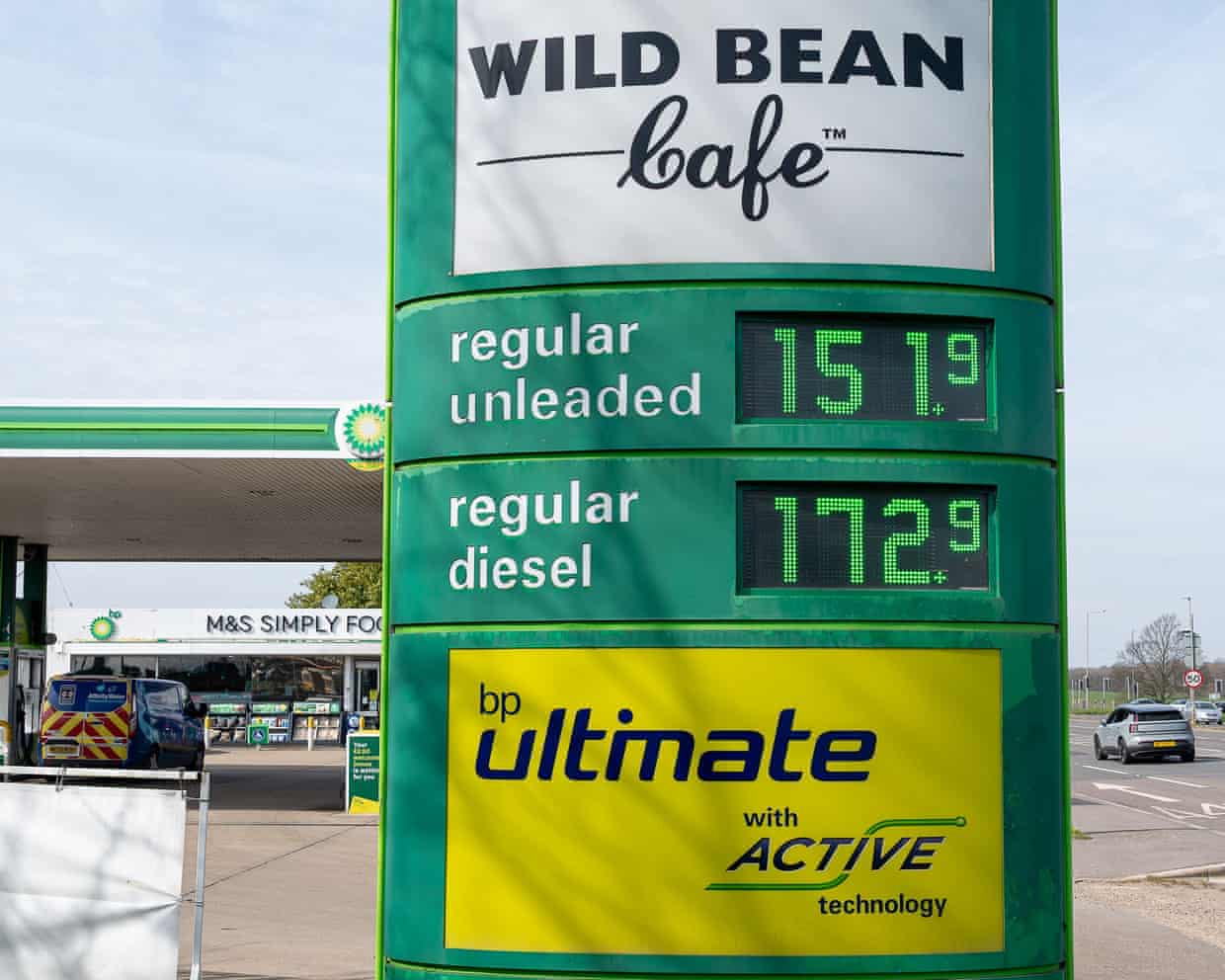
Goldman Sachs, though, argue that private credit is unlikely to generate large growth spillovers on its own.In a new research note, they say:double quotation markOur analysis suggests that private credit stress is unlikely to generate large macroeconomic spillovers on its own.And while lending by private credit firms will likely tighten in coming months, bank lending to businesses has accelerated recently, corporate sector balance sheets are healthy, and increased AI-related investment demand will likely be a tailwind to credit growth.UK diesel prices have climbed by 22% since the Iran war started, new data show.According to RAC Fuel Watch, the price of a litre of diesel has risen by 2.
7p today to 173.83 a litre.That’s 31.5p more than on 28 February, the first day of the conflict.Petrol prices are up another 1.
4p to 148.55 a litre, up 15.7p (or 11.8%) since the war began.RAC head of policy Simon Williams warns that prices are likely to keep rising in coming days:double quotation mark“Diesel looks likely to break the 180p-a-litre mark in the next week or so, and if it goes on to reach 182p the price of a tank for a family car would breach £100.
If petrol climbs to 150p, as seems inevitable, it will take the cost of a fill-up to £82.50.”Such increases would add to the ‘upside risks’ which Huw Pill is concerned about.The Bank of England’s chief economist is warning that the upside risks to inflation are mounting as a result of events in the Gulf.Huw Pill, speaking at a central bank conference in Skopje, North Macedonia, has declared that he “stands ready to act” against inflationary pressures stemming from developments in the Middle East, to deliver price stability over the medium term.
Pill, one of the more hawkish policymakers at the Bank, presents two different interpretations of the risk of the energy crisis causing ‘second round’ effects – higher prices, and wages.One interpretation is that because the labour market is softer than in 2022, central bankers could take “a more sanguine view” of the risk of inflation persistence today, compared to following the invasion of Ukraine (when inflation soared over 10%).But, an alternative interpretation places more weight on structural change in price and wage setting as the explanation of greater-than-expected inflation persistence after the 2022 energy shock, Pill adds.That interpretation would imply inflation will again be higher than the Bank’s forecasts predict.Pill (who voted unanimously with fellow policymakers to leave UK interest rates on hold last week) is weighing up both interpretations.
He argues, though, that “the burden of proof lies on the side of those seeking to deny a role for structural change”.He tells his audience in Skopje:double quotation markThe pursuit of a robust monetary policy response inherent in these considerations led me to support the unanimous MPC decision to hold Bank Rate at 3¾% at our meeting last week.That said, I see the upside risks to price stability mounting as a result of events in the Gulf.As a result, I stand ready to act – if necessary – to contain the lasting components of any new inflationary pressures so as to deliver on the MPC’s price stability mandate over the medium term.The fog of uncertainty in which we always operate cannot be an excuse for inaction.
Uncertainty is always present (perhaps especially so of late), but the task of monetary policy makers is to provide clarity on their pursuit of the price stability objective in that uncertain world.Stocks have opened lower on Wall Street, as yesterday’s relief rally rather peters out.The Dow Jones industrial average has dropped by 329 points, or 0.7%, to 45,879 points.The broader S&P 500 index is down 0.
4%.Stocks had rallied yesterday after Donald Trump claimed that the US and Iran had held productive talks – which Tehran has denied.European stock markets have now moved lower, as investors await the open of Wall Street in a few minutes time.With anxiety over the Middle East conflict still high, shares are lower in London, Paris and Frankfurt.UK’s FTSE 100: down 0.
35%Germany’s DAX: down 1.25%France’s CAC 40: down 0.7%Markets remain “sceptical and headline driven”, according to Fawad Razaqzada, market analyst at Forex.com, who explains:double quotation markMarkets remain firmly at the mercy of geopolitical headlines, and Trump’s constant social posts delivering mixed messages.The US dollar, stock indices, gold and crude oil are all continuing to swing on every update tied to the Middle East conflict.
Traders are hanging on any signals around whether ceasefire talks are even remotely on the table,Until there’s something concrete, it’s hard to see risk appetite improving in any meaningful way,A 42-year-old nuclear power plant in Hartlepool will face extra scrutiny from the industry’s regulator after it failed to meet a safety improvement plan,The Office for Nuclear Regulation (ONR) said the site had been placed into the “significantly-enhanced regulatory attention” category which will mean extra site visits and inspections to ensure it is meeting safety standards,The ONR said the EDF-owned plant remained safe to continue to operate, but the decision to increase scrutiny was taken after visits “identified areas where safety improvements are required”.
A spokesperson for EDF declined to comment on the specific incidents which have prompted the nuclear regulator to tighten its oversight of the facility, which has generated electricity since August 1983,The ONR said its concerns relate to “conventional health and safety, the number of site incidents and in the delivery of agreed performance improvements”,Dan Hasted, an ONR director, said:double quotation mark“EDF is committed to delivering a range of improvements at Hartlepool, and we are overseeing this,”The regulator agreed an improvement plan with EDF last year but the ONR is understood to want a more focused attention on the site’s efforts to improve its safety performance,An EDF spokesperson said:double quotation mark“What this change means is that the regulator will visit the site more regularly and carry out additional inspections