Twelve top central bankers defend Fed’s Jerome Powell over DoJ investigation; oil hits two-month high as Trump threatens Iran’s trading partners – as it happened
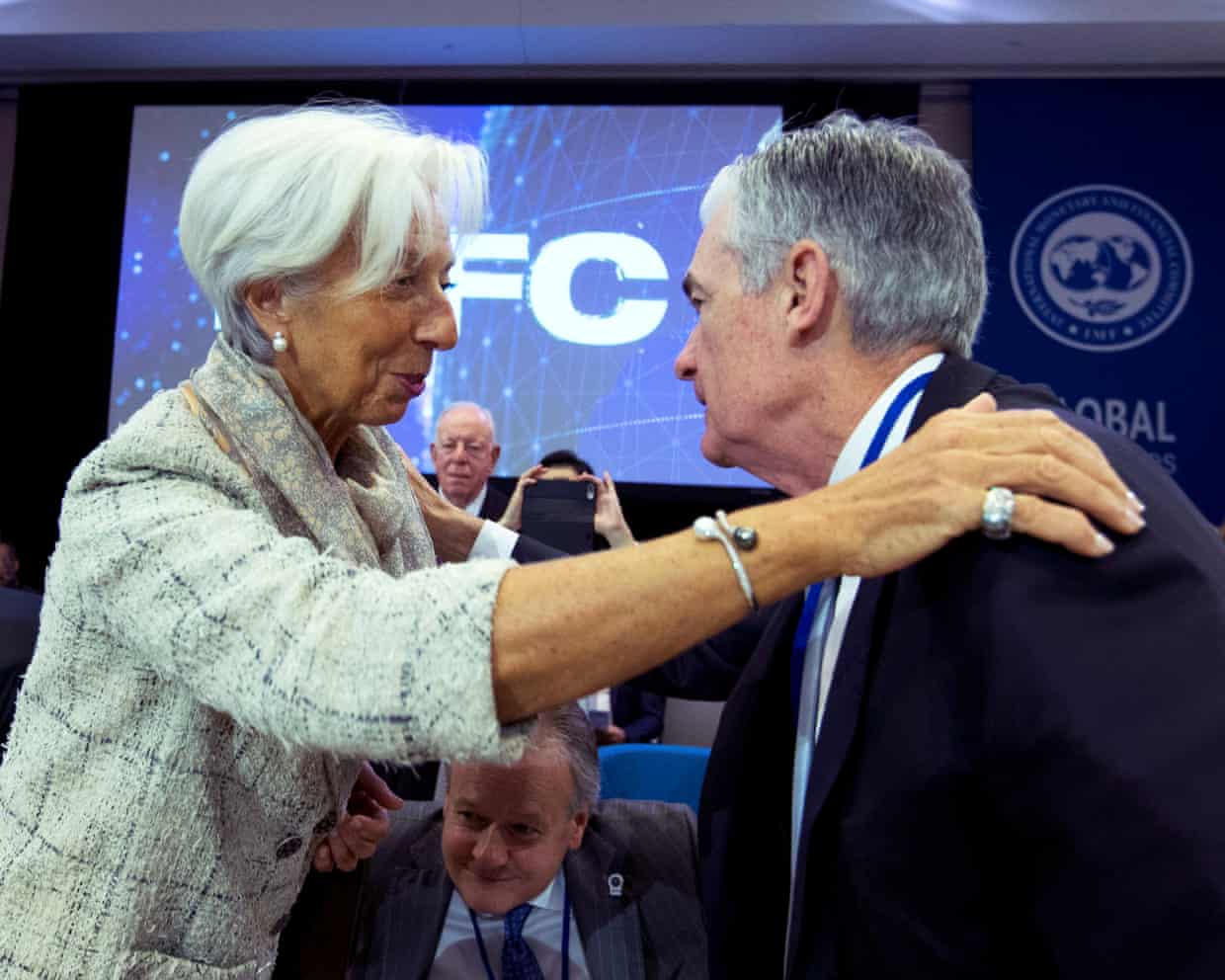
Newsflash: Eleven of the world’s top central bankers have released a statement of support for Federal Reserve chair Jerome Powell, after the US Department of Justice opened a criminal investigation into him.In an unprecedented move, top central bank chiefs including the Bank of England’s Andrew Bailey, and Christine Lagarde of the European Central Bank, have backed Powell, and warned against undermining central bank independence.The heads of the Swedish, Denmark, Swiss, Australian, Canadian, South Korean, and Brazilian central banks have also signed, as have two top officials at the Bank of International Settlements (known as the “central bank for central banks”).Others may yet sign the letter too, Reuters suggested this morning.The central bank chiefs say:We stand in full solidarity with the Federal Reserve System and its Chair Jerome H.
Powell,The independence of central banks is a cornerstone of price, financial and economic stability in the interest of the citizens that we serve,It is therefore critical to preserve that independence, with full respect for the rule of law and democratic accountability,Chair Powell has served with integrity, focused on his mandate and an unwavering commitment to the public interest,To us, he is a respected colleague who is held in the highest regard by all who have worked with him.
The letter is signed by:Christine Lagarde, President of the European Central Bank on behalf of the ECB Governing CouncilAndrew Bailey, Governor of the Bank of EnglandErik Thedéen, Governor of Sveriges RiksbankChristian Kettel Thomsen, Chairman of the Board of Governors of the Danmarks NationalbankMartin Schlegel, Chairman of the Governing Board of the Swiss National BankMichele Bullock, Governor of the Reserve Bank of AustraliaTiff Macklem, Governor of the Bank of CanadaChang Yong Rhee, Governor of the Bank of KoreaGabriel Galípolo, Governor of the Banco Central do BrasilFrançois Villeroy de Galhau, Chair of the Board of Directors of the Bank for International SettlementsPablo Hernández de Cos, General Manager of the Bank for International SettlementsUPDATE: Here’s the full story on today’s letter,This is the second show of support for Powell in two days, after his predecessors at the Fed also backed him:Time to wrap up…,Global central banks have issued an extraordinary joint statement offering “full solidarity” to the US Federal Reserve chair, Jerome Powell, in the face of the latest threat to his independence from Donald Trump’s White House,The statement declares:“The independence of central banks is a cornerstone of price, financial and economic stability in the interest of the citizens that we serve,It is therefore critical to preserve that independence, with full respect for the rule of law and democratic accountability.
”It was signed by 10 central bank governors including the Bank of England governor, Andrew Bailey, and the chair of the European Central Bank, Christine Lagarde.It was coordinated by the Basel-based Bank for International Settlements, which added its chair and general manager to the signatories.Other signatories to the unprecedented statement include the central bank governors of Australia, Sweden, Denmark, Switzerland, Brazil, South Korea and Canada.Ida Wolden Bache, the governor of the Norwegian Norges Bank, added her name later on Tuesday.They pay testament to Powell’s “integrity” and “unwavering commitment to the public interest”, calling him a “respected colleague who is held in the highest regard by all who have worked with him.
In other news…,President Trump has said “it would be a complete mess” if the US supreme court were to strike down his global trade tariffs,Brent crude oil has risen by 2,5% today, to its highest in over two months, as Donald Trump threatened new tariffs on countries who deal with Iran, as protests continue in the country,China, who could be hit by the new levies, has criticised the move and threatened to hit back.
The World Bank has nudged up its forecast for global growth, but also reported that a quarter of developing countries are poorer than in 2019.US inflation held firm last month as Donald Trump faces mounting pressure over the cost of living for millions of Americans.The closely-watched consumer price index rose 2.7% in the year to December, in line with the previous month, according to official data published on Tuesday morning, ahead of a speech by the US president on the economy.The Americans are coming, to Davos!Next week’s World Economic Forum meeting in Davos will include the largest US delegation ever including secretaries for state, treasury, commerce, trade and energy alongside U.
S.President Donald Trump.This will be Trump’s third visit to Davos – he attended in 2018 and 2020, and was also beamed in for a video address last year.WEF president and CEO Borge Brende told reporters today:“We’re pleased to welcome back President Trump to Davos, and he’s bringing the largest U.S.
delegation,”Special envoy Steve Witkoff and Trump’s son-in-law Jared Kushner are also attending, along with a large bipartisan delegation from the U,S,Congress,Previous US presidents haven’t really embraced Davos in the same way as Trump (despite his America First rhetoric); he did seem to enjoy being the absolute centre of attention in 2018.
Today’s “benign” US inflation report keeps the door open for at least two further rate cuts, predicts analysts at ING,They add:The December inflation data was weaker than anticipated and confirms that tariffs are not having the immediate impact on prices that most feared,The fact it is coming through so slowly gives more opportunity for falling energy costs, slowing housing rents and weaker wage growth to mitigate,A quarter of countries in the developing world are poorer than they were in 2019 before the Covid pandemic, the World Bank has found,The Washington-based organisation said a large group of low-income countries, many in sub-Saharan Africa, had suffered a negative shock in the six years to the end of last year.
The bank said global growth had “downshifted” since the pandemic, and the pace was now “insufficient to reduce extreme poverty and create jobs where they’re needed most”.Economic growth in emerging market and developing economies was estimated to slow from 4.2% last year to 4% next year, the bank said.The World Bank has slightly lifted its growth forecast for the global economy this year.The World Bank’s semi-annual Global Economic Prospects report shows that global output growth rise by 2.
6% this year, up from a previous forecast of 2,4% growth in 2026,Today’s forecasts also show the world economy was stronger than expected last year; the World Bank now estimates it grew by 2,7% in 2025, up from the 2,3% it predicted last June.
Most of today’s upward revision reflects better-than-expected growth in the U.S.despite tariff-driven trade disruptions.Indermit Gill, the World Bank’s chief economist, warns that global growth is still low by historic standards:“With each passing year, the global economy has become less capable of generating growth and seemingly more resilient to policy uncertainty,”“But economic dynamism and resilience cannot diverge for long without fracturing public finance and credit markets.”Heather Long, chief economist at credit union Navy Federal, has spotted a rise in US utility prices in today’s inflation report:Overall, a mild inflation report for December.
This is encouraging news for the economy,But keep an eye on utility costs,They have risen a lot in the past year,This helps explain some frustration on Main Street right now,Electricity: +7% in past yearUtility gas: +11% in… pic.
twitter,com/v1xGMUn330Happily, underlying inflation in the US has fallen a little,Core inflation (the all items less food and energy index) rose by 2,6% over the last 12 months, down from 2,7% in the year to November.
Economists had expected it to remain unchanged.Jonathan Moyes, head of investment research at investment firm Wealth Club, says:The market was expecting core inflation to come in at 2.7% for December, core inflation came in a touch lower at 2.6%.This was slightly better than the market was expecting.
The initial market reaction has been one of slight relief,Both equities and bond markets have rallied, with the dollar weakening a touch,The ball is now back in the Federal Reserve’s court,The message throughout 2025 has been one of caution,Clearly the Federal Reserve has been reticent of cutting too far too soon.
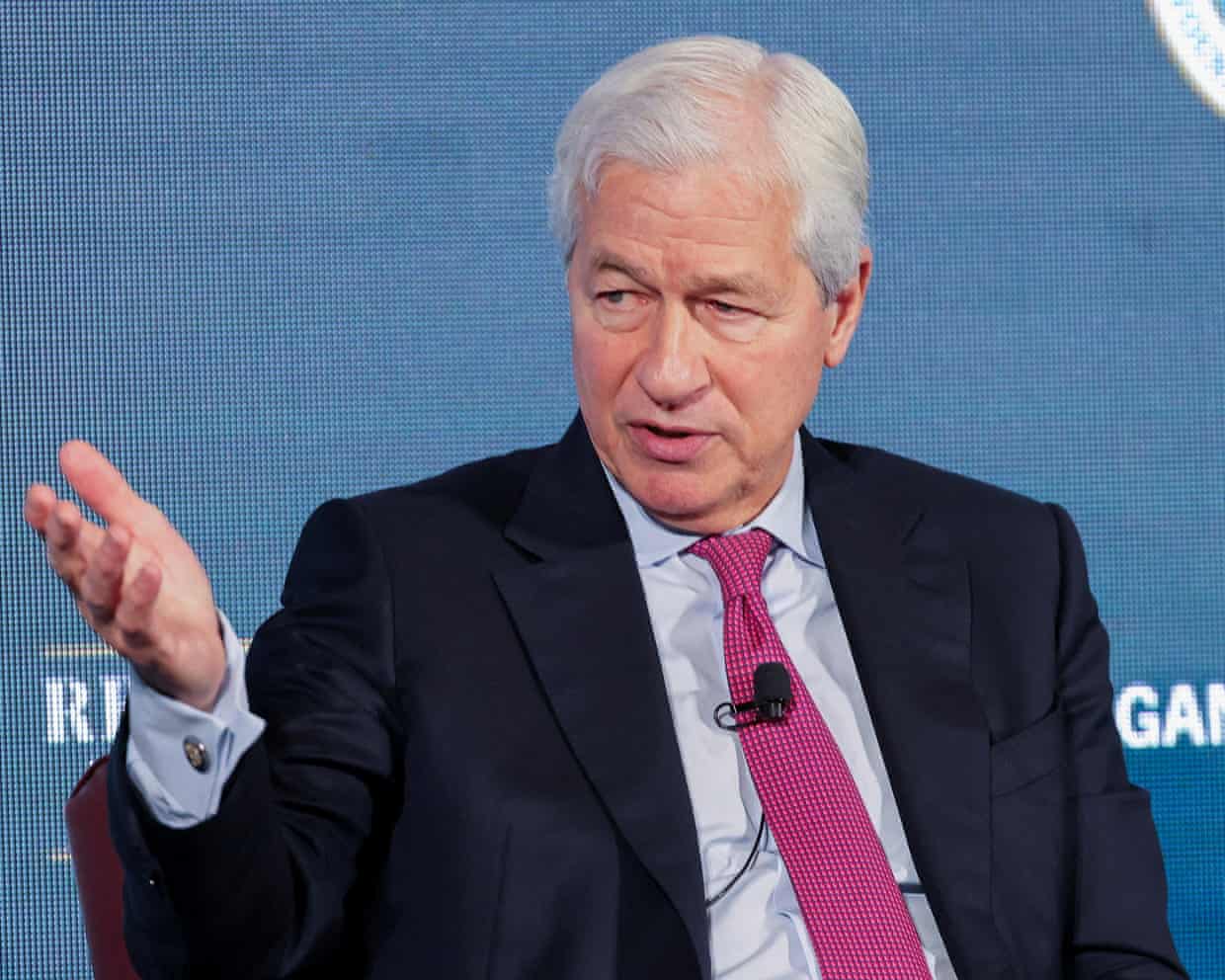
There are several crosscurrents in play, there are question marks over the extent to which trade tariffs, tax cuts and geopolitics will feed through into future inflation numbers.JPMorgan Chase CEO Jamie Dimon has thrown his support behind the Federal Reserve’s independence today.Speaking to reporters following JP Morgan’s latest results, Dimon said:“Everyone we know believes in Fed independence.”Dimon added he has “great respect” for chair Jerome Powell, and warned that “anything that chips away” at the central bank’s independence “is not a good idea.”He said (via the Wall Street Journal):“I want to say that I don’t agree with everything the Fed has done.
I do have enormous respect for Jay Powell the man.”On today’s US inflation report, Neil Birrell, chief investment officer at Premier Miton Investors, says:“After a surprisingly low US inflation number for November, December’s came in as expected with few surprises in the detail, so there are likely to be limited ramifications from this print.However, with all the noise around foreign policy, tariff impacts, looming mid-terms, the situation with Jerome Powell and mixed employment data, there is plenty to ponder on how the US economy is going to shape up over the coming months.Although the current fundamentals do look robust, it’s everything else we need to worry about.”Although US food prices rose by 0.
7% overall in December, there was a sharp drop in egg prices,The BLS reports that five of the six major grocery store food group indexes increased in December, with cereals and bakery products index up 0,6%, fruits and vegetables up 0,5%, nonalcoholic beverages up 0,4% and dairy prices 0.
9% higher,But, the index for meats, poultry, fish, and eggs decreased 0,2% in December, with egg prices down 8,2%,That follows a surge in US egg prices last year, as an outbreak of avian flu led to many millions of chickens being slaughtered.
Newsflash: The US inflation rate remained over the Federal Reserve’s target in December.The US consumer prices index rose by 2.7% in the 12 months to December, the latest inflatoin report shows, above the Fed’s goal of 2%.That matches November’s inflation reading.Prices continued to rise, by 0.
3%, in December alone – which doesn’t help Donald Trump’s claim that he is bringing down costs,The Bureau of Labor Statistics reports that housing costs (or ‘shelter’) was the biggest factor pushing up the cost of living last month,It says:The index for shelter rose 0,4 percent in December and was the largest factor in the all items monthly increase,The food index increased 0.
7 percent over the month as did the food at home index and the food away from home index.The index for energy rose 0.3 percent in December.And over the last year….The all items less food and energy index rose 2.
6 percent over the last 12 months,The energy index increased 2,3 percent for the 12 months ending December,The food index increased 3,1 percent over the last year