Chess: Magnus Carlsen wins Freestyle Tour title despite defeat in final event
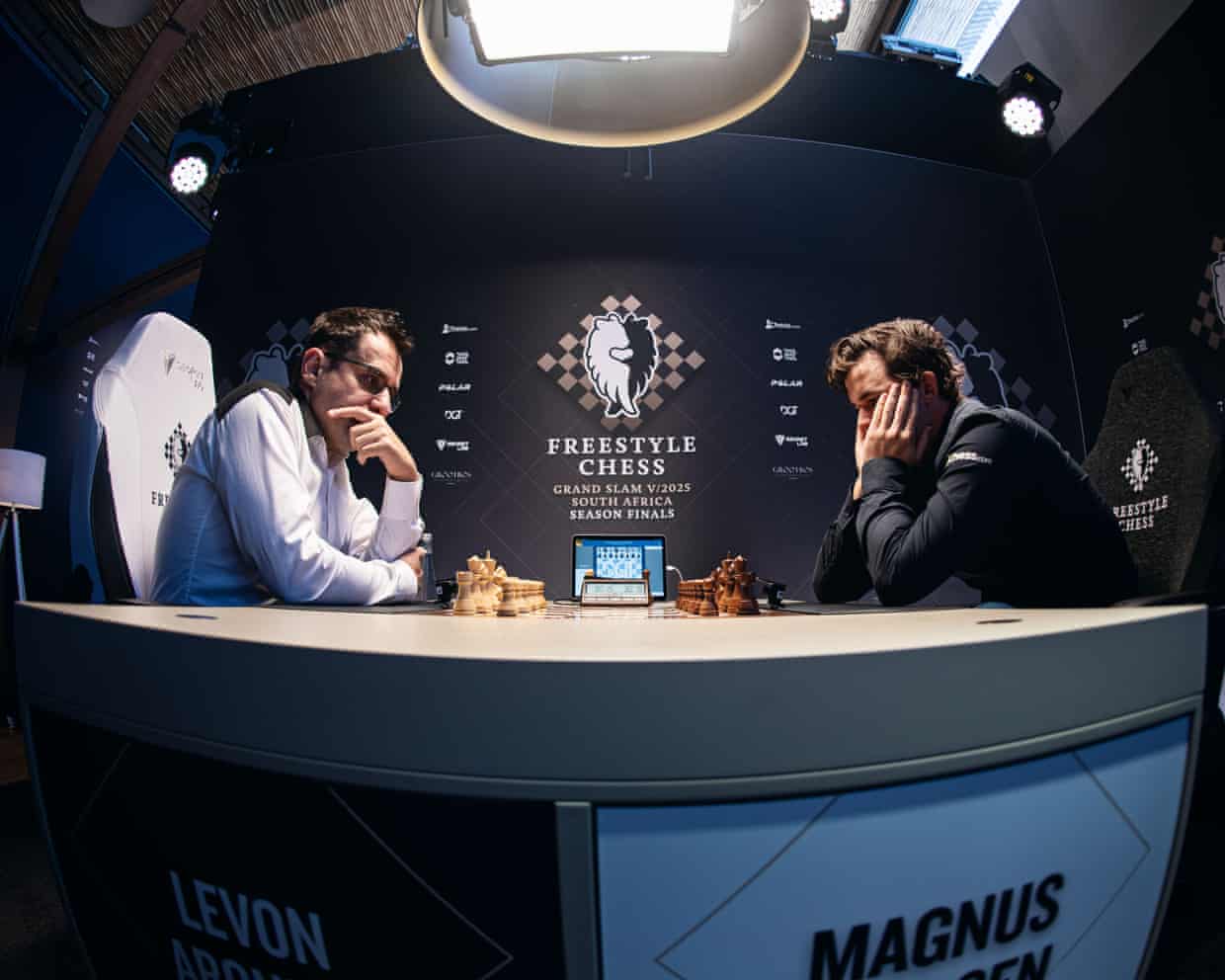
Norway’s world No 1, Magnus Carlsen, was shocked by a 0.5-1.5 loss to the US veteran Levon Aronian in Thursday’s final of the Freestyle Grand Slam Tour in Cape Town, but still finished the overall winner of the five-event Tour.Freestyle chess is also known as Fischer Random and Chess 960.Pieces start randomly placed on the two back rows, thus drastically limiting opening preparation.
Its 2025 season, with a Tour financed mainly by a $12m investment from the venture firm Left Lane Capital, has featured tournaments in Weissenhaus, Karlsruhe, Paris and Las Vegas before the final in South Africa.Carlsen had already won two events and needed only to finish fourth in Cape Town to be sure of Tour victory.He was briefly in danger early on when, sick, he lost his first game to his old rival Fabiano Caruana, saying: “I’m quite aware that I’m just not able to think as clearly as I need on a day like this.” The 5/2 blitz tiebreaks brought a further challenge: “I had to tell myself several times, make a move, c’mon, what are you doing.” He survived that: “When it comes down to a bullet scramble, I’m a bit better than they are,” and also won his semi-final against the World Cup champion, Javokhir Sindarov, who turned 20 during the tournament.
Carlsen really enjoys Freestyle: “It has brought back the feeling of pure discovery – you never know the position, you have to think and create.”Aronian took a different and more relaxed approach.He was undecided who to pick for his quarter-final opponent, so got his wife, Anita, to make the choice.After defeating Hans Niemann in that match, he expressed surprised satisfaction at getting so far, and then, after a somewhat lucky victory over Germany’s Vincent Keymer in their semi-final, he simply said: “I’m rich!”Aronian’s good fortune continued against Carlsen in the final, where the Norwegian chose a dubious opening gambit and never had sufficient compensation for two pawns.In the return game, Aronian established a solid position and easily held off Carlsen’s endgame attempts.
The former Armenian No 1 completed 17 games over four days of play without a single loss.Keymer finished third after the German world No 4 defeated Sindarov 2-0.Caruana, the world No 3 and US champion, beat India’s world No 5, Arjun Erigaisi, 1.5-0.5 in the fifth place match, while Niemann beat Iran’s Parham Maghsoodloo 3-1 for seventh.
Last week’s XTX Markets London Classic at Arsenal’s Emirates Stadium proved a success for England’s grandmasters, who took third, fourth and fifth places behind the world stars Nodirbek Abdusattorov (Uzbekistan) and Alireza Firouzja (France).Final leading totals were Abdusattorov 7.5/9, Firouzja 5.5, Nikita Vitiugov (England) 5, Luke McShane and Michael Adams (both England) 4.5.
The prizes were £25,000, £15,000 and £10,000.The organisation of the event was widely praised.Abdusattorov, 21, demonstrated his skills with a dominant 2900+ tournament performance.His dedicated approach was reminiscent of the Soviet grandmasters of the last century and he scored six wins in a row, a rare achievement in elite company, before easing into first prize and a final 2932 tournament performance rating.In a frank and detailed interview after the tournament, he revealed how he motivated himself by channelling his disappointment over his failure in the World Cup into a desire for revenge, and then boosted his energy with his winning sequence.
XTX Markets, which sponsored the London Classic for a second successive year, also backs ChessFest, the annual free open chess day in Trafalgar Square, which takes place in July.The Classic’s final event was the Super Rapidplay, a 10-round competition staged last weekend at the London Novotel West Hotel with a huge entry of more than 300.It produced three notable performances.Greece’s top player, Nikolas Theodorou, 25, won the £10,000 first prize with 9/10 after defeating Abdusattorov in the final round.The Uzbek GM lost on time at the end, but he had no defence to Theodorou’s passed d pawn.
Firouzja, the world No 6, won the £5,000 second prize in the final round with a devastating 23 Nxh7! sacrifice.Theodorou scored 9/10, Firouzja 8.5, with six players sharing third on 8.A major surprise came among the players sharing ninth place on 7.5/10, where Livio Cancedda-Dupuis, 15, emerged as the top English junior ahead of the established national trio of Shreyas Royal, Sohum Lohia and Stanley Badacsonyi.
Cancedda-Dupuis lives in Putney, London, where he attends the Ashcroft Technology Academy.He has played few classical tournaments but has an impressive online presence including more than 40,000 one-minute bullet games with a lichess rating above 2900 and more than 15,000 blitz games with a rating above 2770.His ambition is (of course!) to become a grandmaster.The teenager’s Super Rapidplay performance was rated at 2515, which in a classical event would easily qualify for an IM norm.It included 3.
5/6 against GMs, and 4-0 against others.His biggest scalp was the former US champion Sam Shankland, who blundered the exchange.Cancedda-Dupuis said that he recommends players wishing to improve to concentrate on tactical awareness, and also to play many online games so as to become familiar with typical openings and structures.His special hero is Carlsen, and he also admires Hikaru Nakamura and Firouzja, who gave him a lesson here.4002: 1 Qh8+ Rg8 2 Qxg8+! Kd7 (if Nxg8 3 Rxd8 mate) 3 Qxd8+ Kc6 4 Qd6 mate.
ICE is using smartwatches to track pregnant women, even during labor: ‘She was so afraid they would take her baby’
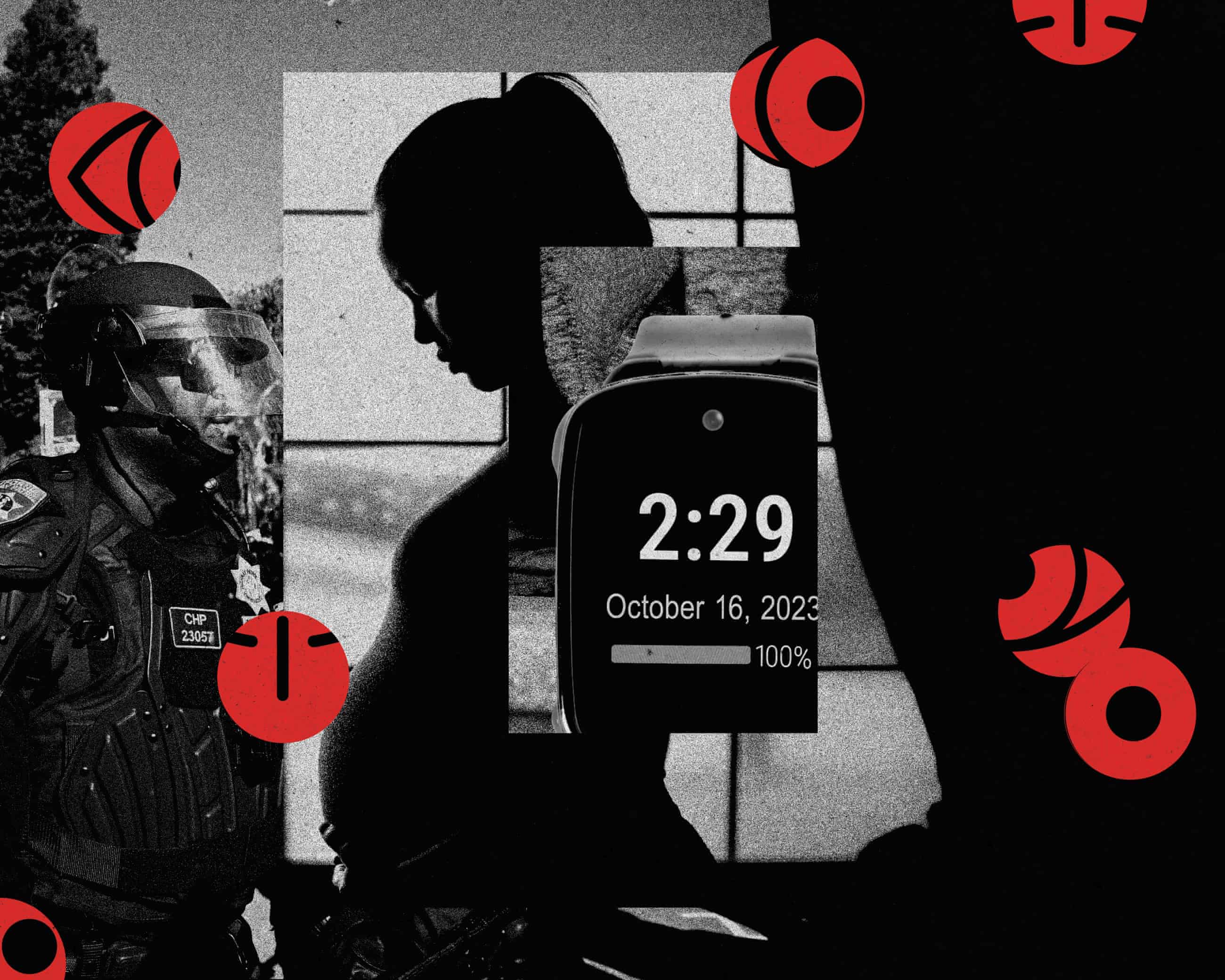
Pregnant immigrants in ICE monitoring programs are avoiding care, fearing detention during labor and deliveryIn early September, a woman, nine months pregnant, walked into the emergency obstetrics unit of a Colorado hospital. Though the labor and delivery staff caring for her expected her to have a smooth delivery, her case presented complications almost immediately.The woman, who was born in central Asia, checked into the hospital with a smartwatch on her wrist, said two hospital workers who cared for her during her labor, and whom the Guardian is not identifying to avoid exposing their hospital or patients to retaliation.The device was not an ordinary smartwatch made by Apple or Samsung, but a special type that US Immigration and Customs Enforcement (ICE) had mandated the woman wear at all times, allowing the agency to track her. The device was beeping when she entered the hospital, indicating she needed to charge it, and she worried that if the battery died, ICE agents would think she was trying to disappear, the hospital workers recalled
From ‘glacier aesthetic’ to ‘poetcore’: Pinterest predicts the visual trends of 2026 based on its search data
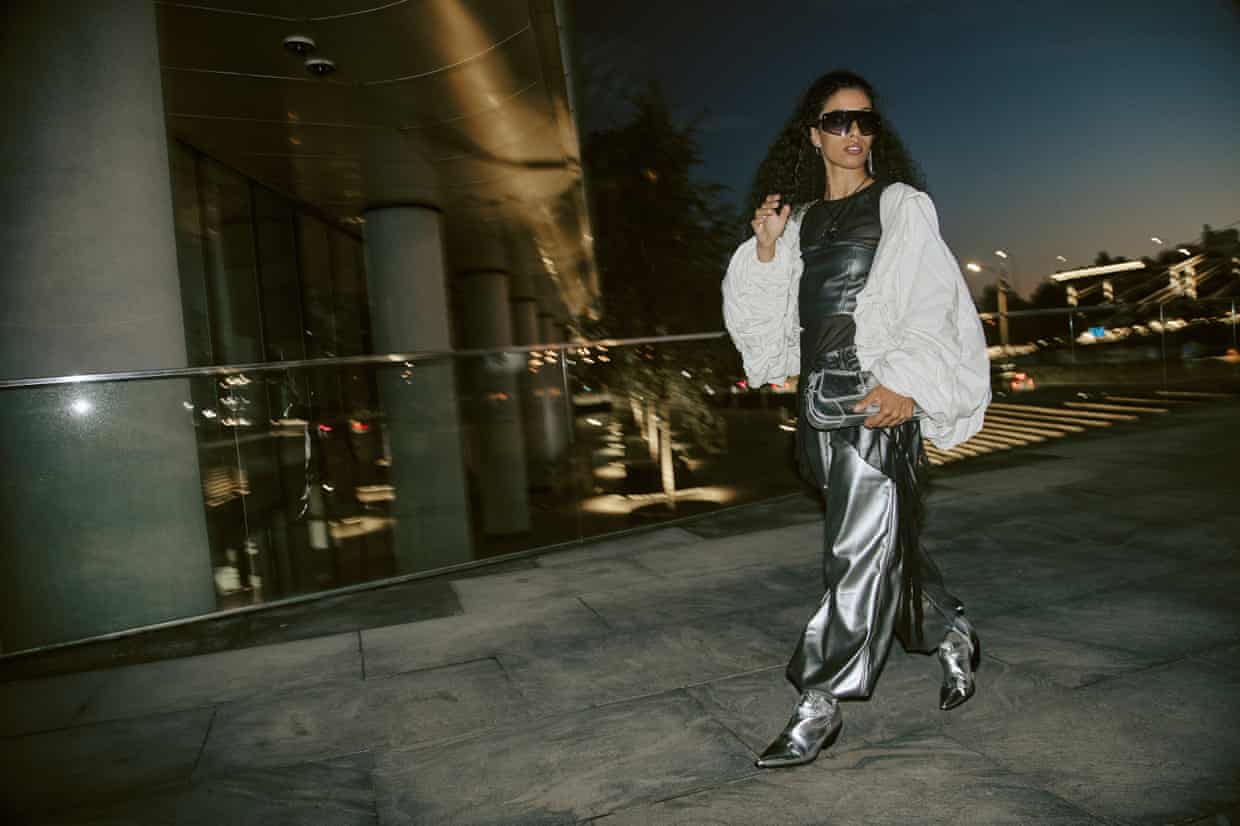
Next year, we’ll mostly be indulging in maximalist circus decor, working on our poetcore, hunting for the ethereal or eating cabbage in a bid for “individuality and self-preservation”, according to Pinterest.The organisation’s predictions for Australian trends in 2026 have landed, which – according to the platform used by interior decorators, fashion lovers and creatives of all stripes – includes 1980s, aliens, vampires and “forest magic”.Among the Pinterest 2026 trends report’s top 21 themes are “Afrohemian” decor (searches for the term are on the rise by baby boomers and Gen X); “glitchy glam” (asymmetric haircuts and mismatching nails); and “cool blue” (drinks, wedding dresses and makeup with a “glacier aesthetic”).Pinterest compared English-language search data from September 2024 to August 2025 with those of the year before and claims it has an 88% accuracy rate. More than 9 million Australians use Pinterest each month
UK police forces lobbied to use biased facial recognition technology
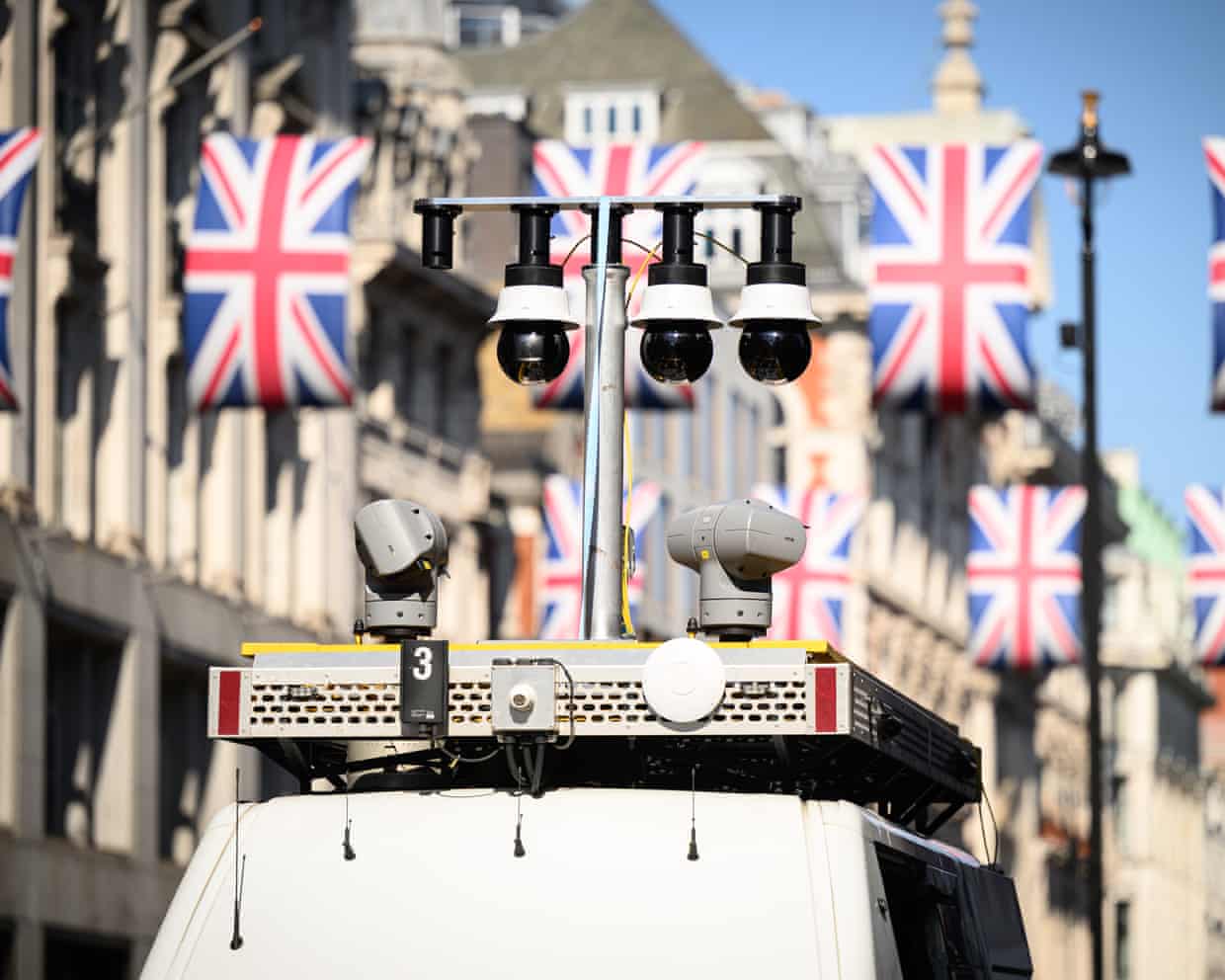
Police forces successfully lobbied to use a facial recognition system known to be biased against women, young people, and members of ethnic minority groups, after complaining that another version produced fewer potential suspects.UK forces use the police national database (PND) to conduct retrospective facial recognition searches, whereby a “probe image” of a suspect is compared to a database of more than 19 million custody photos for potential matches.The Home Office admitted last week that the technology was biased, after a review by the National Physical Laboratory (NPL) found it misidentified Black and Asian people and women at significantly higher rates than white men, and said it “had acted on the findings”.Documents seen by the Guardian and Liberty Investigates reveal that the bias has been known about for more than a year – and that police forces argued to overturn an initial decision designed to address it.Police bosses were told the system was biased in September 2024, after a Home Office-commissioned review by the NPL found the system was more likely to suggest incorrect matches for probe images depicting women, Black people, and those aged 40 and under
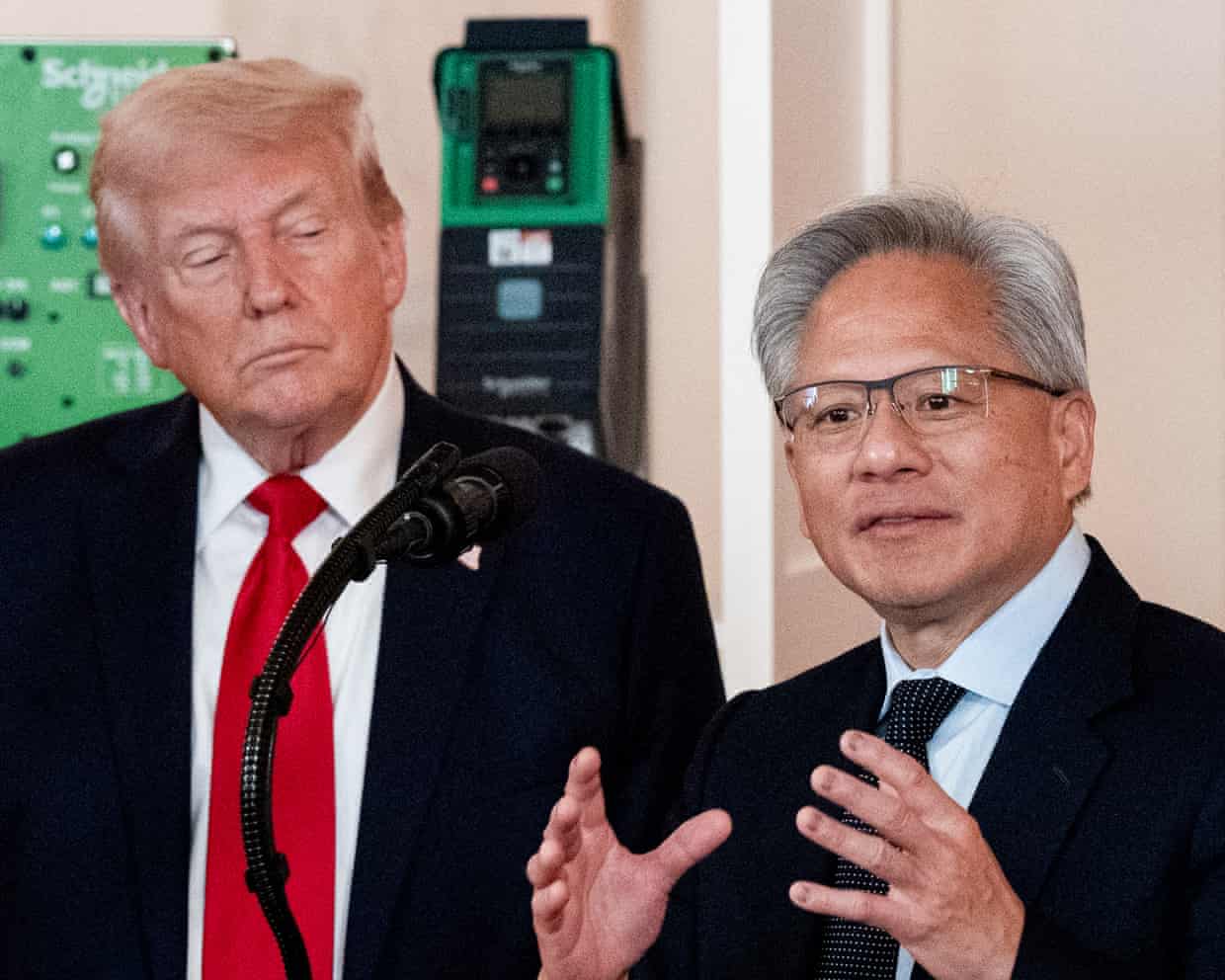
Trump clears way for Nvidia to sell powerful AI chips to China
Donald Trump has cleared the way for Nvidia to begin selling its powerful AI computer chips to China, marking a win for the chip maker and its CEO, Jensen Huang, who has spent months lobbying the White House to open up sales in the country.Before Monday’s announcement, the US had prohibited sales of Nvidia’s most advanced chips to China over national security concerns.Trump posted to Truth Social on Monday: “I have informed President Xi, of China, that the United States will allow NVIDIA to ship its H200 products to approved customers in China, and other Countries, under conditions that allow for continued strong National Security. President Xi responded positively!”Trump said the Department of Commerce was finalising the details and that he was planning to make the same offer to other chip companies, including Advanced Micro Devices (AMD) and Intel. Nvidia’s H200 chips are the company’s second most powerful, and far more advanced than the H20, which was originally designed as a lower-powered model for the Chinese market that would not breach restrictions, but which the US banned anyway in April
AI researchers are to blame for serving up slop | Letter
I’m not surprised to read that the field of artificial intelligence research is complaining about being overwhelmed by the very slop that it has pioneered (Artificial intelligence research has a slop problem, academics say: ‘It’s a mess’, 6 December). But this is a bit like bears getting indignant about all the shit in the woods.It serves AI researchers right for the irresponsible innovations that they’ve unleashed on the world, without ever bothering to ask the rest of us whether we wanted it.But what about the rest of us? The problem is not restricted to AI research – their slop generators have flooded other disciplines that bear no blame for this revolution. As a peer reviewer for top ethics journals, I’ve had to point out that submissions are AI-generated slop

EU opens investigation into Google’s use of online content for AI models
The EU has opened an investigation to assess whether Google is breaching European competition rules in its use of online content from publishers and YouTube creators for artificial intelligence.The European Commission said on Tuesday it would examine whether the US tech company, which runs the Gemini AI model and is owned by Alphabet, was putting rival AI owners at a “disadvantage”.The commission said: “The investigation will notably examine whether Google is distorting competition by imposing unfair terms and conditions on publishers and content creators, or by granting itself privileged access to such content, thereby placing developers of rival AI models at a disadvantage.”It said it was concerned that Google may have used content from web publishers to generate AI-powered services on its search results pages without appropriate compensation to publishers and without offering them the possibility to refuse such use of their content.The commission said it was also concerned as to whether Google had used content uploaded to YouTube to train its own generative AI models without offering creators compensation or the possibility to refuse

Dragon’s teeth and elf garden among 2025 additions to English heritage list

Jimmy Kimmel on Trump: ‘What a child he is’

Discover Australia’s top 50 children’s picture books as nominated by Guardian readers

Jon Stewart on Fifa’s peace prize: ‘An entirely fictitious golden butt plug’

Joyful, irreverent, endlessly quotable: why Hunt for the Wilderpeople is the perfect holiday movie

‘True activism has to cost you something’: Bridgerton’s Nicola Coughlan on politics, paparazzi and parasocial fandom