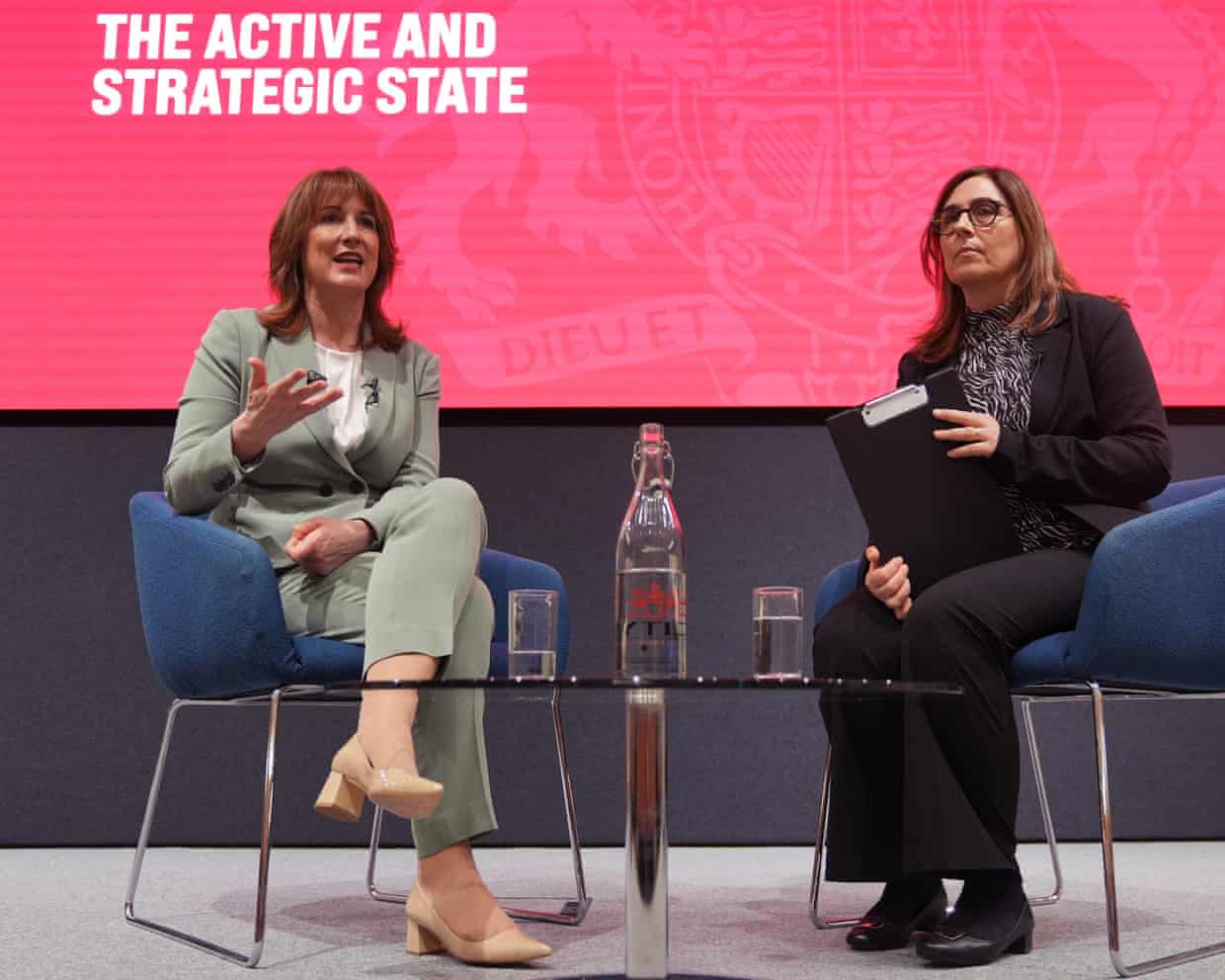
Rachel Reeves reveals push for fiscal devolution to English regions, says Brexit caused damage, and admits student loan system is ‘broken’ – as it happened
Time to wrap up…Rachel Reeves has announced that the Treasury will draw up proposals to hand England’s mayors a share of national tax revenues as part of a radical plan to rebalance the economy.The chancellor promised “a genuine break with the past” that would shift spending power away from Westminster, as she promised to create investment-led growth, across the UK.Reeves was delivering the Mais lecture – the second time she has given the high-profile annual address at Bayes Business School in London.It is no coincidence that the UK is “the most politically centralised of advanced democracies, and one of the most geographically unequal”, Reeves said.Treasury officials will bring forward a plan at the autumn budget to allow regional leaders to receive a share of national taxes, starting with income tax, she added.
Reeves also announced new city investment funds worth £2.3bn for England’s regional “metro” mayors to spend on long-term investment projects, adding that they would be able to retain future business rates revenue.More here:During a wide-ranging speech, the chancellor also argued that innovation and AI, closer ties with Europe, and regional growth provided the biggest opportunities for growth in the UK.Reeeves announced the creation of an AI Economic Institute to help identify opportunities, saying the government wanted the British people to benefit from them.And on closer alignment with Europe, she explained:double quotation markLet me say this directly to our friends and allies in Europe.
This government believes a deeper relationship is in the interest of the whole of Europe,She also cited research that Brexit could have knocked up to 8% off UK GDP, saying it had caused damage,The chancellor also agreed that the student loan system was broken, but argued she couldn’t fix it yet and that it was right to prioritise child poverty, the NHS and defence,Goodnight,GWTo deliver on Rachel Reeves’s artificial intelligence ambition, the UK needs a workforce that is not just aware of AI but equipped with the skills to use it effectively, argues David Shepherd, senior vice president of the EMEA region at UK software firm Ivanti,Shepherd explains:double quotation markBuilding these capabilities requires continuous public sector support and accessible resources, alongside a renewed focus on widespread upskilling and AI literacy programmes.
And by investing in comprehensive AI education now, we ensure that when employees encounter AI in their roles, they’re not just familiar, they’re empowered to leverage it confidently and productively.Not only does this enhance individual career opportunities, but it enables organisations to adopt and scale AI more effectively.In turn, that strengthens the wider UK business ecosystem, boosting productivity, competitiveness and long-term economic growth.While the government’s enthusiasm for AI is clear, the reality is lagging behind.A Guardian investigation earlier this month found that the multibillion-pound drive to “mainline AI into the veins” of the British economy is riddled with “phantom investments” and shaky accounting.
While many massive deals to build new datacentres and create thousands of jobs have been trumpeted in recent years, progress on the ground has been slow.More here:The TUC is urging the government to show “relentless ambition” in strengthening the UK’s relationship with the EU, as Rachel Reeves pledged to do today.TUC General Secretary Paul Nowak said:double quotation mark“The Conservatives’ botched Brexit deal left our economy poorer, put jobs at risk and set workers and businesses back.“A closer relationship with the EU could cut the cost of essentials, and be a boon for British jobs and manufacturing.The Chancellor is right to put this at the heart of her plan for growth.
“The Government should have relentless ambition,Alignment on key sectors is common sense – starting with chemicals, pharmaceuticals and automotive where there are the biggest gains to be made,“With such a volatile and unpredictable President in the While House, it’s never been a more important time to strengthen ties with our biggest trading partner,”Rachel Reeves’s pledge to support regional growth today is being welcomed,Anna Leach, chief economist at the Institute of Directors, said:double quotation mark“The Chancellor’s focus on driving up productivity and investment are the right ones.
Enhancing growth resilience is ever more vital as the UK continues to be buffeted by shocks.Reinforcing the UK’s trade connections, maximising opportunities across regions and gripping the AI opportunity are sensible priorities.And doing so hand-in-hand with business will help shape policies that will work in practice.It is good to see policy consistency coming through, for example through policies to deliver Oxford-Cambridge and Northern growth corridors.And there’s a welcome reference to the role regulation can play in inhibiting investment by businesses – this regularly appears in the top four factors negatively affecting investment amongst business leaders.
Rosalind Gill, director of policy, analysis and external affairs at the National Centre for Universities and Business (NCUB), welcomed the chancellor’s ‘more interventionist’ approach, saying:double quotation mark“The Chancellor is right to focus on stability, investment and reform as the foundations for long-term growth.Commitments to the Oxford Cambridge corridor, alongside plans to expand Luton Airport and invest in regional water infrastructure, reflect a more interventionist approach to unlocking growth.At the same time, measures to accelerate delivery, including potential use of compulsory purchase, underline the government’s intent to move quickly.”Reeves’s plans to devolve tax and spending powers to regional mayors, including through “looking at income tax” at the Autumn Budget, have been thrown around before many times in British politics.Yet few chancellors have made meaningful changes, my colleague Richard Partington writes.
From the Poplar Rates Rebellion of 1921, to the 1990 Poll Tax riots, Westminster has run into trouble when reforming local financial powers.Back in the 1970s, the government-backed Layfield report called for the introduction of local income tax that would give councils control of several pennies in the pound.But it was never implemented.Tackling regional divisions are complex.Given the unequal nature of wealth and income distribution across the country - turbocharged in recent decades by London pulling ahead from the rest of the UK - tweaking regional policy can create winners and losers.
Granting full autonomy to vary local income tax and retention would enhance incentives for mayors to boost their local economy.But a full-fat approach could hand vastly more cash to the areas with the most high-earners - typically in London and the South East.Official figures show London and the South East are the only UK regions with a net fiscal surplus.All other places spend more than they receive in tax income.As a result the design of any devolution package would be hugely important, to avoid entrenching inequalities.
There are however big reasons to push ahead.Britain is among the most regionally unequal countries in Europe, and could do with more high-performing cities and towns to drive up the country’s economy at large.Economists argue devolution could be part of the mix to boost incentives and local financial firepower.Analysis by the Centre for Cities shows only 5% of the UK’s tax revenues in 2019 were collected by local government - compared to 14% in France, 23% in Japan and 35% in Sweden.Meanwhile, the Mayor of New York City controls property taxes, a sales tax, and an income tax, which together bring in over $60bn.
According to the Centre for British Progress, mayors in England control little more than £5bn.Today’s announcement from Rachel Reeves about fiscal devolution feels like “a turning point”, says Councillor John Merry, Chair of Key Cities and Deputy Mayor of Salford,double quotation markThe Chancellor’s plan directly answers a long‑standing frustration from cities that they are expected to drive economic growth without the fiscal tools to make it happen.double quotation markFor years, the Key Cities network has argued that local leaders understand their economies better than central government and are best placed to decide how tax revenue should be invested, whether by improving transport, boosting skills, building homes or reviving our high streets.By committing to give regional leaders a share of national taxes, including income tax, the government is explicitly acknowledging that local growth depends on local control.double quotation markThe promise that this will be a permanent, fiscally neutral transfer of power marks a real break with that past and gives people confidence that money raised in their area will be used to improve their area.
Key Cities is ready to help shape this roadmap and to work alongside mayors and ministers to make sure it delivers the meaningful and practical solutions our cities need on the ground.”The three key priorities in the Chancellor’s Mais lecture will resonate with many businesses as they fight to get on the front foot, says Shevaun Haviland, Director General of the BCC.double quotation mark“Investing in our regional economies, promoting AI and improving our trading relationship with the EU are vital steps on the pathway to higher growth.“Firms want to see a bolder approach from Government on cutting trade barriers and improving defence cooperation with Europe.It remains our largest trade partner and a pragmatic approach to improving that relationship can offer some much-needed stability amid an ocean of geopolitical turbulence.
“The ambition to make the UK the fastest AI adopter in the G7 should also be applauded,We are in a global race to secure the benefits of this game changing technology which can give UK businesses a vital edge in an increasingly competitive global market,Increasing support for the Oxford-Cambridge and Northern Growth Corridors shows the chancellor understands the need to back winners, Haviland adds,Reaction to Rachel Reeves’s Mais lecture is starting to roll in,Mirte Boot, Principal Research Fellow and Interim Head of IPPR North says the chancellor’s plans for ‘fiscal devolution’ could help rebalance the economy.
double quotation mark“The UK is still one of the most regionally unequal places in Europe, with jobs and opportunity concentrated in places like London, Oxford and Cambridge.A young person growing up in the North shouldn’t have to look down South to imagine success.“So, the Chancellor’s announcement, promising £1.7bn to city-regions across the north, is a very welcome shift towards rebalancing the economy.“But this investment package must also work hand in hand with the visitor levy and further devolution, to hand local leaders the powers to make the North rival the South.
”Rachel Reeves and her team from the Treasury have now vacated the Bayes Business School lecture theatre (after an amusing vote of thanks from Professor Sir Anthony Finkelstein, President, City St George’s, University of London).So I’ve listened back to the part of the chancellor’s Q&A where she explained why she won’t, yet, fix the student loan system.Touching on the state of the UK public finance, she said:double quotation mark“Yes, the student loan system is broken.But if you try to fix everything straight away, everything will fall over.”“We have precarious public finances, and that has also been thrown into stark relief in the last few weeks since the conflict in the Middle East erupted.
”“We are reintroducing the maintenance grant for the poorest students going to university,”We are also investing heavily in further education and apprenticeship, because the majority of young people don’t go to university,[The chancellor then pointed out that the people who aren’t in education, employment or training don’t tend to be the graduates, they tend to be the kids who didn’t go to university],Pleading for patience, Reeves says:double quotation mark“So yes the student loan system is broken, but what is more broken is the fact that we have got one in six kids not in education, employment or training,”“So yes we want to fix it, yes we want to make improvements,But is it front of the queue? No, it’s not.
”“Because we’ve got to get those hospital waiting lists down.We’ve got to lift kids out of poverty so they get the chance in the first place,and we’ve got to uplift our defence spending.”“Politics is about priorities.I’m not denying there’s a problem.I’m not blind to that.
“But what I do say is there has to be some patience, you can’t fix everything straight away.Reeves concluded by insisting that she “strongly” disagreed with anyone who suggested she should have reformed the student loan system rather than tackling child poverty (through ending the two child benefit cap).Nearly 90 minutes after beginning her lecture, Rachel Reeves wraps up by answering another question about Europe – and repeating that closer alignment can bring benefits.She repeats her earlier warning that some economists estimate the hit to the UK economy from Brexit could be around 8% of GDP.[I’m not sure at all, but the chancellor could be referring to recent research from the CEPR, here].
Thus, making trade and investment easier between the UK and European Union countries can begin the process of bringing some of that loss back.Ultimately, that will be felt in people’s pockets and in their living standards, she concludes.Q: Following the oil price shock, do you stand by your view that the UK has done enough to avoid the need for any further tax increases, and can withstand further shocks without need for further fiscal action?Reeves says the UK’s public finances are improving, pointing to a drop in the budget deficit as a share of GDP, and forecasts that it will faster than other G7 countries.And she fires a warning shot across the bows of anyone who things “this is the moment to change course.”Standing by her fiscal rules (to bring down the national debt and only borrow to invest)The chancellor warns:double quotation markI just say to them, be very careful about what you are doing and what you are advocating.
We are in a stronger position now because of the fiscal rules.Q: On Europe, do the red lines that Labour has set out still fully apply?Reeves indicates they do.We will not be rejoining the single market, the customs union or rejoining the free movement of people, she insists.Onto questions, and Rachel Reeves is challenged about the crisis in the student loan system.Q: Yesterday, the chancellor of the University of Cambridge said the student loan system is broken.
What are you going to do to fix it?[this is the growing anger that many people’s student loan debts are rising faster than they are paying them off]Reeves acknowledges that the student loan system is “broken”.However, she’s not planning to fix it imminently, arguing this isn’t possible.The chancellor says the “precarious public finances” mean the government can’t fix everything straight away.She points out that the government is reintroducing maintenance grants for poorer students going to universities.And she argues that what is “more broken” is the large number of young people who are are not in education or training.
Reeves points out that the majority of kids she went to school with didn’t go to university.So while fixing student loans is important, it’s not at the front of the queue.Reeves says:double quotation markI’m not denying that there’s a problem.I’m not blind to that.But, she adds, there has to be “some patience”, as the government can’t fix everything immediately.