Bentley to cut hundreds of UK jobs amid ‘challenging global market environment’
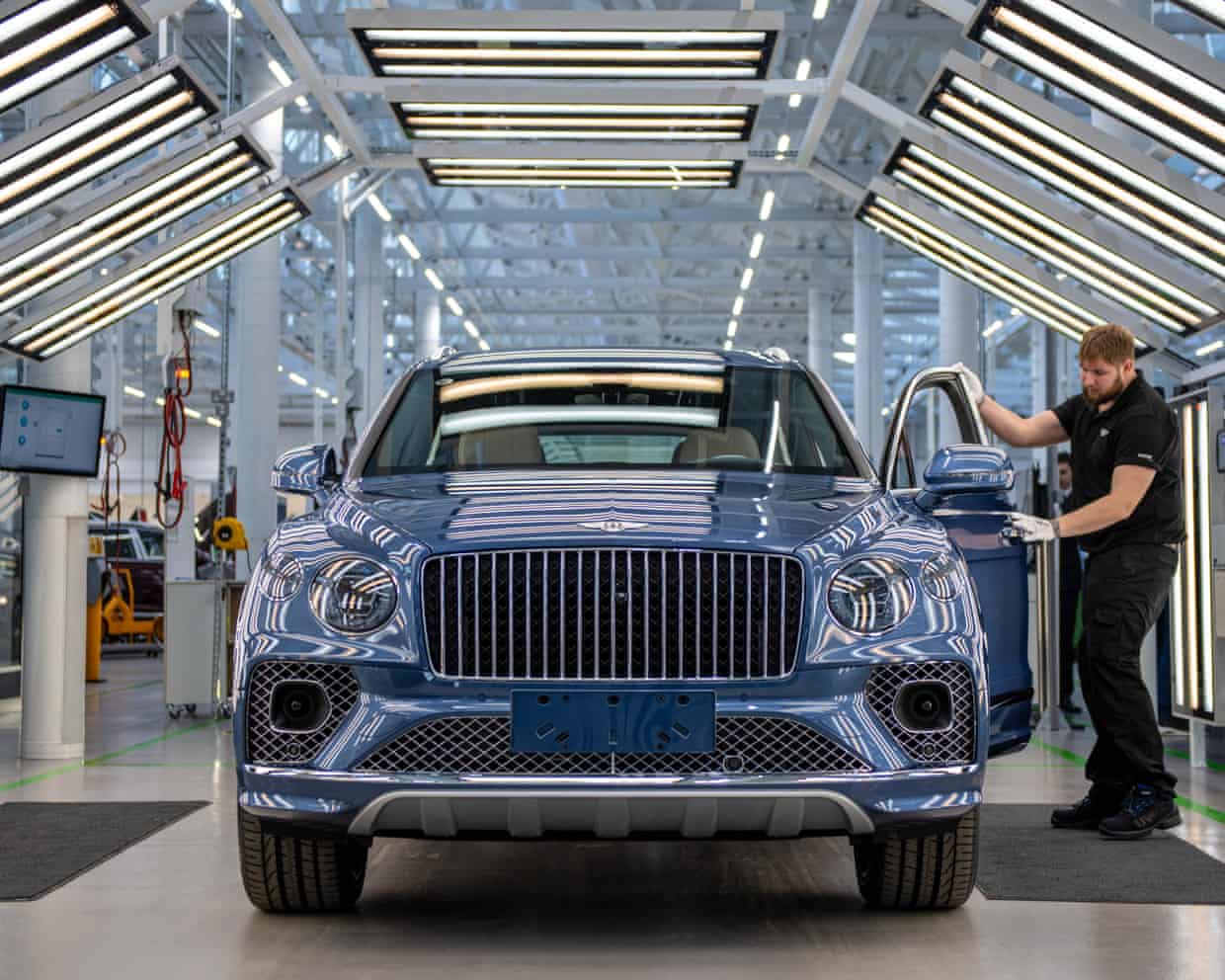
Bentley is to cut 275 jobs in the UK as the carmaker faces a “challenging global market environment”.The luxury brand, owned by Germany’s Volkswagen, is preparing to launch its first all-electric model but acknowledged it had some work to do to persuade consumers to switch away from internal combustion engine vehicles.The company said on Tuesday it was slashing about 6% of its 4,600-strong workforce by cutting about 150 office-based permanent staff and by not filling vacant positions or replacing employees.The announcement came as the company reported a 42% fall in annual operating profit to €216m (£187m) in 2025, compared with a year earlier.While this marked a seventh consecutive year of profitability at Bentley, which produces cars at its factory in Crewe in Cheshire, the company said its profits had taken a hit from the impact of US tariffs introduced by Donald Trump and foreign exchange changes and weaker sales in China, as well as decisions made by its parent company, VW.
Frank-Steffen Walliser, Bentley’s chief executive, said the company was making “some difficult decisions to ensure the long-term competitiveness of the business”,He added that the job cuts and investment in its sites would “ensure Bentley remains financially resilient, strategically focused and well positioned for the next generation of luxury vehicles”,US tariffs and weaker demand in China have also put pressure on other luxury carmakers,Aston Martin Lagonda announced plans in February to cut its workforce by 20% in an effort to save £40m and tackle widening losses,Bentley said it had delivered 5% fewer cars in 2025 compared with a year earlier, but this was partly offset by higher customer demand for bespoke personalisation of its vehicles.
The Bentayga luxury SUV remains its bestselling model,It has a starting price of £176,000 but can cost significantly more with higher specifications,The carmaker is due to unveil its electric “urban SUV” later this year,It pushed back its electrification plans in late 2024, when it said it would continue to sell fossil fuel cars until 2035, five years later than previously planned,It has also said it will continue to sell plug-in hybrids beyond 2035.
Walliser has previously said there was “not a lot of demand” for electric vehicles among its customer base, at a time when carmakers have seen a drop-off in demand for EVs among their wealthy clientele,Porsche, another VW-owned luxury brand, has walked back on its ambitious EV strategy and announced job cuts in recent days,The Italian supercar manufacturer Lamborghini has also abandoned plans to make all-electric vehicles, deciding instead to focus on plug-in hybrid cars,Battery cars are seen to offer some distinct advantages to luxury carmakers, particularly smooth and rapid acceleration,However, Lamborghini’s boss has said that sports car lovers reported missing the noise of a car with an internal combustion engine.

Samsung Galaxy S26 Ultra review: its huge screen blocks shoulder surfers from spying on you
Samsung’s latest Ultra superphone promises to keep shoulder surfers out of your business with a first-of-its-kind privacy display built into its huge 6.9in screen.The Guardian’s journalism is independent. We will earn a commission if you buy something through an affiliate link. Learn more

AI has exposed age-old problems with university coursework | Letter
The frustration many academics are expressing about artificial intelligence and critical thinking is understandable (‘I wish I could push ChatGPT off a cliff’: professors scramble to save critical thinking in an age of AI, 10 March). But from my experience working with students on academic writing, blaming AI risks masking a problem that universities have lived with for years.In my work with students, I have long seen the ways in which thinking can be outsourced when assessment allows it: essay mills, shared past papers, model essays passed between cohorts, or heavy reliance on tutors and friends to structure assignments. Artificial intelligence did not invent this behaviour. It has simply industrialised a shortcut that already existed

Trump administration reportedly set to be paid $10bn for brokering TikTok deal
Donald Trump’s administration is reportedly poised to be paid $10bn by investors as part of a deal to create a US-controlled version of TikTok.The $10bn, considered by the US government as a sort of transaction fee, will be paid by the administration-friendly investors who took control of TikTok’s US operations from its Chinese parent company, ByteDance, according to reporting that first appeared in the Wall Street Journal.The investors in the popular social media app include software company Oracle; MGX, an investment firm based in the United Arab Emirates; and private equity business Silver Lake. These entities, along with other backers, paid $2.5bn to the US treasury when the deal closed in January and are set to make further payments in the unusual arrangement until the total hits $10bn

Meta and Google trial: are infinite scroll and autoplay creating addicts?
It was as “easy as ABC”, claimed the lawyer prosecuting a landmark social media harm case against Meta and Google which heard closing arguments this week. The defendants were guilty, said Mark Lanier, of “addicting the brains of children”. Not true, replied the tech companies. Meta insisted providing young people with a “safer, healthier experience has always been core to our work”.Features such as autoplay videos, infinite scrolling and constantly chirruping alerts woven into the fabric of online platforms were central to the six-week trial in Los Angeles, which has been compared to the cases against tobacco companies in the 1990s

New study raises concerns about AI chatbots fueling delusional thinking
A new scientific review raises concerns about how chatbots powered by artificial intelligence may encourage delusional thinking, especially in vulnerable people.A summary of existing evidence on artificial intelligence-induced psychosis was published last week in the Lancet Psychiatry, highlighting how chatbots can encourage delusional thinking – though possibly only in people who are already vulnerable to psychotic symptoms. The authors advocate for clinical testing of AI chatbots in conjunction with trained mental health professionals.For his paper, Dr Hamilton Morrin, a psychiatrist and researcher at King’s College in London, analyzed 20 media reports on so-called “AI psychosis”, which describes current theories as to how chatbots might induce or exacerbate delusions.“Emerging evidence indicates that agential AI might validate or amplify delusional or grandiose content, particularly in users already vulnerable to psychosis, although it is not clear whether these interactions can result in the emergence of de novo psychosis in the absence of pre-existing vulnerability,” he wrote

Fake rooms, props and a script to lure victims: inside an abandoned Cambodia scam centre
It is as if you have walked into a branch of one of Vietnam’s banks. A row of customer service desks, divided by plastic screens, with landline phones, promotional leaflets and staff business cards. A seated waiting area and a private meeting room. All of it features the OCB bank’s logo, or its trademark green colour.This is not a genuine bank branch, however

Gatz review – the Great Gatsby performed in eight and a half hours of attentive, immersive joy

How to Make a Killing to Wu-Tang Clan: your complete entertainment guide to the week ahead

The Guide #234: Five big questions before the 2026 Oscars

Jimmy Kimmel on Trump being gifted an Olympic medal: ‘Yet another award he didn’t win’

Seth Meyers on Pete Hegseth: ‘The face of a man war-fighting with his colon’

Sydney Biennale 2026: politics is everywhere – but with nuance, beauty and heart