US inflation soars in March as war on Iran drives economy into uncertainty

US inflation soared in March amid the US-Israel war with Iran, with prices up 0.9% compared with last month and 3.3% over the year, according to new data released on Friday.The spike in the consumer price index (CPI), which measures the price of a basket of goods and services, is the largest in nearly two years and the first official measure of how the conflict has affected US consumer prices, particularly as Iran blocked the strait of Hormuz, through which a fifth of the world’s oil and gas would typically pass.The index for energy rose 10.
9% in March, led by a 21.2% increase in the index for gasoline which accounted for nearly three-quarters of the monthly all items increase.Airfares rose 2.7% in March and were 14.9% higher than a year earlier.
Core inflation – which strips out volatile food and energy prices – rose at a more modest 0.2% over the month and was 2.6% higher over the year.The annualized inflation rate has not pushed past 3% since summer 2024, when inflation was finally cooling after reaching a generational high of 9.1% in June 2022.
The war on Iran has driven the American economy into deeper uncertainty, adding to a precariousness that first came with Donald Trump’s tariffs last year,Inflation reached a four-year low last April, when price increases dropped to 2,3%,It rose to 3% by September, before coming back down to 2,4% in January and February.
Oil prices dropped after Trump announced a two-week ceasefire with Iran, which agreed to reopen the strait during the ceasefire period, but oil prices still remain high.Even after the agreement was announced, US crude oil was still priced 10% higher than before the conflict and nearly 30% higher since the start of the year.Recent data shows prices are also affecting producers.Gross domestic product (GDP), which measures all final goods produced in the US, for the last quarter of 2025 was revised down on Thursday from an initial 1.4% to 0.
5%.And the prices index in the Institute for Supply Management’s survey of managers saw its largest one-month increase in 13 years, rising from 63 in February to 70.7 in March.Consumer confidence is also falling.The University of Michigan’s closely-watched consumer confidence survey was also released on Friday and recorded a 10.
7% drop to its lowest level on record.Survey director Joanne Hsu said comments “show that many consumers blame the Iran conflict for unfavorable changes to the economy.”Though the conflict has hit prices and confidence, the labor market appeared resilient: Employers added 178,000 jobs in March while the unemployment rate fell to 4.3%.Strength in the labor market, combined with rising prices, puts officials at the US Federal Reserve in a tricky situation as they consider how to adjust interest rates amid the conflict.
Raising interest rates could help inflation at the risk of destabilizing the labor market and increasing unemployment.Minutes from the Fed board’s last meeting in February, released on Wednesday, mentioned “many participants” seem to be worried about the impact of prolonged inflation, “which could call for rate increases”.The Fed went on a long interest rate hike campaign after inflation soared in 2022, bringing rates from near zero to a 20-year high range of 5.25% to 5.5% in 2024.
Rates currently sit at a range of 3,5% to 3,75%,In a note to investors, Bernard Yaros, lead US economist at Oxford Economics, wrote: “The Federal Reserve will look past the energy supply shock as a onetime boost to inflation and will watch for any weakening in the job market, which is usually hurt by energy shocks with a lag,”But he warned that the next CPI report will “also be uncomfortably strong.
Pump prices have continued to rise this month and will deliver another boost to inflation.A statistical quirk associated with the government shutdown will unwind, adding another unusual source of upward pressure to the April CPI.Also, the energy price shock will increasingly bleed into food and other core prices.”
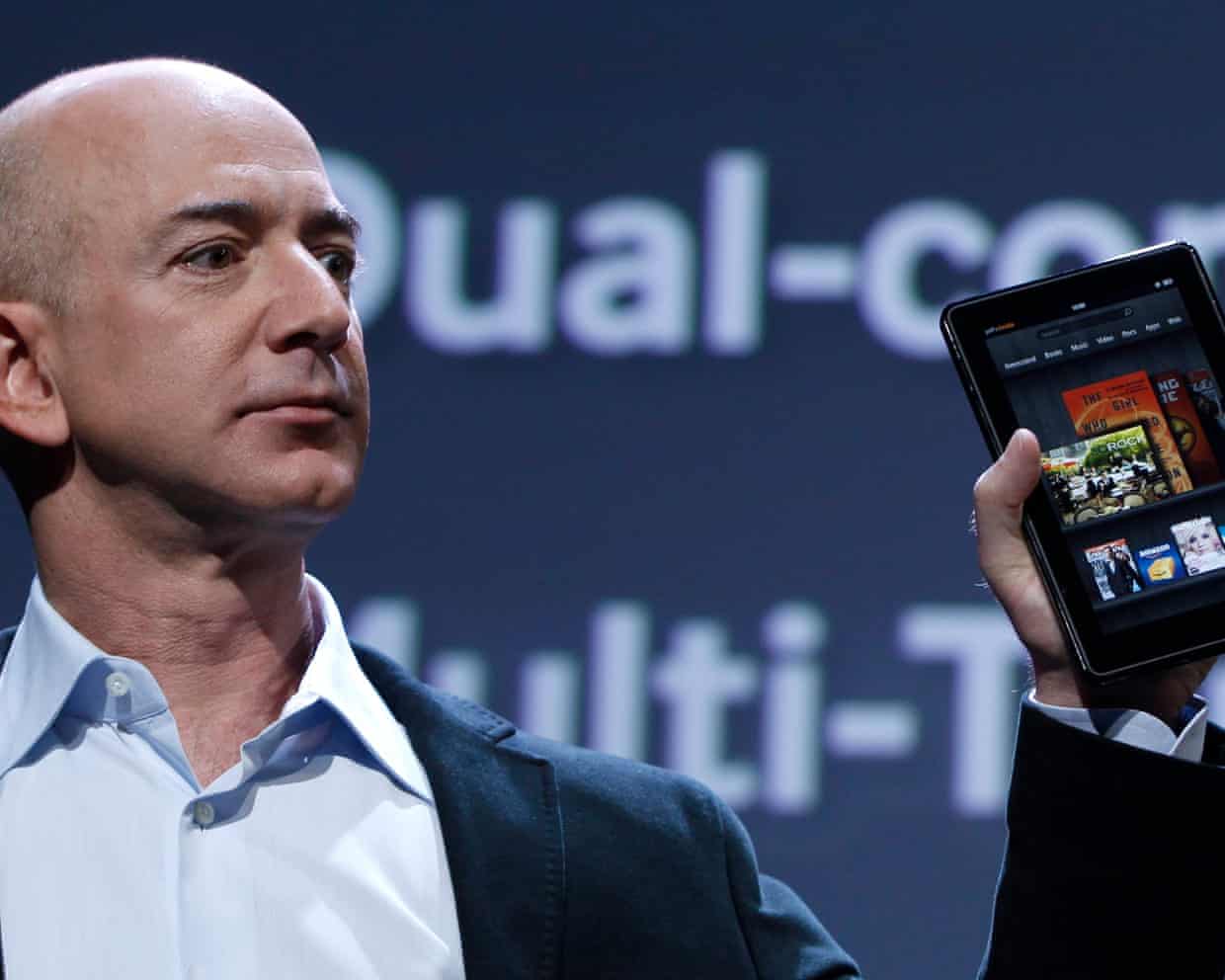
Amazon upsets ebook lovers by ending support for old Kindle devices
Amazon is to stop supporting older Kindle models leaving longtime ebook fans unable to access new content from the Kindle store.Devices released during or before 2012 will no longer receive updates from 20 May, affecting owners of older Kindles, including the earliest models such as the Touch and some Fire tablets. It is thought that 2m e-readers could be affected.Users will still be able to read ebooks they have downloaded, and their accounts and their Kindle library will remain accessible on mobile and desktop apps. Active users have been offered discounts to help “transition to newer devices”

OpenAI shelves Stargate UK in blow to Britain’s AI ambitions
OpenAI has put on hold plans for a landmark UK investment citing high energy costs and regulation, in a blow to the government which has put AI at the centre of its growth strategy.Stargate UK was a part of the UK-US AI deal announced last September, in which US companies appeared to commit £31bn to the UK’s tech sector, part of a larger series of investments intended to “mainline AI” into the British economy.It came as the Labour government seeks to make AI and datacentres the engine of its growth plans, alongside closer ties with Europe and regional growth.“This is a wake-up call for the government to manage energy costs in the UK and foundation infrastructure,” said Victoria Collins MP, the Liberal Democrat spokesperson for science, innovation and technology. “We cannot be dependent on US tech companies to build our own sovereign capabilities – whether that’s energy cost, supply or even data and phone signal

British computer scientist denies he is bitcoin developer Satoshi Nakamoto
A British computer scientist has insisted he is not the elusive developer of bitcoin, after a report claimed to unmask him as its creator.A story in the New York Times details a years-long effort to unmask Satoshi Nakamoto, the mysterious author of the bitcoin white paper which laid the theoretical foundations for modern digital currencies.It names Adam Back, a London-born computer scientist and entrepreneur. In a thread on X, Back promptly denied being the mysterious – and presumably ultra-wealthy – technologist.“I also don’t know who satoshi is, and i think it is good for bitcoin that this is the case, as it helps bitcoin be viewed [as] a new asset class, the mathematically scarce digital commodity,” he wrote

Britons warned about Russian hackers targeting internet routers for espionage
Russian hackers are exploiting commonly sold internet routers to harvest information for espionage purposes, the UK’s cybersecurity agency has said.The hack could allow attackers to obtain users’ credentials, redirect them to fake sites, and potentially access other devices on their home network such as phones and PCs, said Alan Woodward, a professor at the University of Surrey.The National Cyber Security Centre said on Tuesday the operations were “believed to be opportunistic in nature, with the actor targeting a wide pool of victims and then likely filtering down for users of potential intelligence value at each stage of the exploitation chain”.It follows a common pattern of cyber-actors targeting edge devices – hardware such as internet routers or internet-connected security cameras – that act as a bridge between users and the cloud.Woodward said: “It’s not the first time that warnings have come out about routers

The life-changing magic of wearing smartglasses | Letters
I read with sympathy the concerns of Elle Hunt in relation to privacy issues around Meta smartglasses (I wore Meta’s smartglasses for a month – and it left me feeling like a creep, 1 April). Clearly there needs to be ongoing development of technology and protocols that protect the public from ill-intentioned users. As the chief executive of a charity supporting people with a visual impairment, however, I would like to emphasise the point touched upon in your article: how transformative this technology is already proving for blind people.We are seeing significant numbers of our visually impaired staff and clients using Meta glasses in conjunction with their mobile phones to improve their ability to perform ordinary functions that most of us take for granted. A visual impairment can be disempowering and isolating

Tell us: do you use AI chatbots to make decisions for you?
AI chatbots like ChatGPT, Gemini and Claude are now a part of everyday life.More and more people are using them to help make decisions in their lives, like sending text messages, deciding what to cook, or navigating relationships.We want to hear about your experiences of using chatbots. Are you addicted to them? And what type of decisions are you using them for?You can tell us your experiences of using chatbots using this form.Please include as much detail as possible

Lachlan Kennedy breaks 10-second barrier for 100m but Jess Hull crashes out of 1500m final

Grand National 2026: horse-by-horse guide to all the runners

Women’s Six Nations: will anyone stop England’s conveyor belt of talent?

A lower-round AJ Brown to a 306lb missile: the 2026 NFL draft’s under-the-radar prospects

Chess: Sindarov extends Candidates lead and heads for world title challenge

The Masters 2026: Rory McIlroy shares lead with Sam Burns after first round – as it happened