‘Too powerful for the public’: Inside Anthropic’s bid to win the AI publicity war
This week, the AI company Anthropic said it had created an AI model so powerful that, out of a sense of overwhelming responsibility, it was not going to release it to the public.The US treasury secretary, Scott Bessent, summoned the heads of major banks for a chat about the model, Mythos.The Reform UK MP Danny Kruger wrote a letter to the government urging it to “engage with AI firm Anthropic whose new frontier model Claude Mythos could present catastrophic cybersecurity risks to the UK”.X went wild.Others were more sceptical, including the noted AI critic Gary Marcus, who said: “Dario [Amodei] has far more technical chops than Sam [Altman], but seems to have graduated from the same school of hype and exaggeration,” referring to the CEOs of Anthropic and its rival, OpenAI.
It is unclear if Anthropic has built the machine god.What is more apparent is that the San Francisco startup widely seen as the “responsible” AI company is brilliant at marketing.In the past months, Anthropic has enjoyed a 10,000-word profile in the New Yorker, two pieces in the Wall Street Journal, and the front cover of Time magazine, on which Amodei’s face was emblazoned, movie-poster style, above the Pentagon and the US defense secretary, Pete Hegseth.Amodei and Anthropic’s co-founder, Jack Clark, appeared on two separate New York Times podcasts in February, chewing over questions such as whether their machine was conscious, and if it might soon “rip through the economy”.The company’s “resident philosopher” has spoken to the WSJ about whether Claude – a commercial product being used to trade cryptocurrency and designate missile targets – has a “sense of self”.
This has all come amid a dustup between Anthropic and the US department of defence in which Anthropic, despite creating the AI tool used by the Pentagon to strike Iran, has managed to come out looking far better than OpenAI, which offered to help the US military do the same thing but with – maybe – fewer guardrails,Its media lead, Danielle Ghiglieri, has notched the wins on LinkedIn,“I’m endlessly proud to work at Anthropic,” she said of the company’s Time cover, tagging the journalists involved in a post about the “mad dash” to get the story over the line,Watching a CBS 60 Minutes segment featuring Amodei “was one of those pinch-me moments,” she said,“What made it meaningful wasn’t just the platform.
It was seeing the story we wanted to tell actually come through.”Of the New Yorker profile, by the journalist Gideon Lewis-Kraus, she wrote: “I would be lying if I said I wasn’t nervous for our first meeting in person … working with someone of Gideon’s calibre means being pushed to articulate ideas you’re still forming, and being OK with that discomfort.”(“I bet that’s what they all say about you,” said my editor.)Other tech PRs have taken notice.“They are clearly having a moment right now but companies building technology that will change the world deserve equal scrutiny,” said one.
“They accidentally leaked their own source code last week, then this week they claim stewardship over cyber threats with a new powerful model that only they control.Any other big tech firm would be ridiculed.”Anthropic did accidentally release part of Claude’s internal source code at the beginning of April.“No sensitive customer data or credentials were involved or exposed,” it said.What does this all mean about Anthropic’s undoubtedly powerful Mythos?The model’s capacities were not “substantiated,” said Dr Heidy Khlaaf, the chief AI scientist at the AI Now Institute.
“Releasing a marketing post with purposely vague language that obscures evidence … brings into question if they are trying to garner further investment without scrutiny.”“Mythos is a real development and Anthropic was right to treat it seriously,” said Jameison O’Reilly, an expert in offensive cybersecurity.But, he said, some of Anthropic’s claims, such as that it found thousands of “zero-day vulnerabilities” in major operating systems, were not that significant to real-world cybersecurity considerations.A zero-day vulnerability is a flaw in software or hardware unknown to its developers.“We have spent over 10 years gaining authorised access to hundreds of organisations – banks, governments, critical infrastructure, global enterprises,” said O’Reilly.
“In those 10 years, across hundreds of engagements, the number of times we needed a zero-day vulnerability to achieve our objective was vanishingly small.”Other reasons may have contributed to Anthropic’s decision not to release Mythos.The company has limited resources, and appears to be struggling to offer enough computing capacity to allow all its subscribers to use its models.It has introduced usage caps on the wildly popular Claude.Recently, it said users would have to purchase extra capacity on top of their subscriptions in order to run third-party tools, such as OpenClaw.
At this point, it may simply not have the infrastructure to support the release of a hyped-up new creation.Like OpenAI, Anthropic is in a race to raise billions of dollars and capture a market – still ill-defined – of people who might lean on its chatbots as friends, romantic partners or deeply personalised assistants, and of companies that might use them to replace human employees.But differences in these products are marginal and impressionistic, mostly down to hard-to-quantify attributes such as “sense of self” and “soul” – or rather, what passes for these in an AI agent.The battle is for hearts and minds.“Mythos is a strategic announcement to show that they’re open for business,” said Khlaaf, saying Anthropic’s release limitation prevented independent experts from evaluating the company’s claims.
She suggested we may be “seeing the very same bait and switch playbook that was used by OpenAI, where safety is a PR tool to gain public trust before profits are prioritised” and: “Anthropic publicity has managed to better obscure this switch than its rivals,”

UK will not join any Trump blockade of strait of Hormuz
The UK will not be involved in any blockade of the strait of Hormuz, the Guardian understands, after claims by Donald Trump on Sunday that the US would be blockading the waterway with the assistance of Nato allies.Speaking to Fox News, Trump said “it won’t take long to clean out the strait” and claimed “numerous countries are going to be helping us”, adding that the UK and other nations were sending minesweepers.The UK has previously suggested it could play a role in making the strait of Hormuz safe to pass, and it has mine-hunting systems and anti-drone capabilities already in the region.But there have been concerns in Whitehall that complying with Trump’s demand to send ships could escalate the crisis. The UK’s willingness to consider a role in mine-removal operations is seen as distinct from Trump’s blockade proposal

Britain could adopt single market rules without MPs’ vote as part of UK-EU reset
Ministers are planning to fundamentally reshape Britain’s relationship with the European Union, with new legislation that could result in the UK signing up to EU single market rules without a normal parliamentary vote.In a major development in the prime minister’s push for closer ties with the continent after the Iran war, the Guardian understands ministers are bracing to face down opposition to “dynamic alignment” with the EU from those who “scream treason” over the powers in a new EU-UK reset bill.After weeks of Donald Trump’s war with Iran that have exposed the fragility of the UK’s damaged special relationship with the US, ministers argue the move will add billions to the UK economy, help temper the cost of the conflict and boost sluggish productivity.A new bill, which will bring into force the food and drink trade deal with the EU, will contain powers enabling the government to dynamically align with Europe on areas where it has already made agreements. But it will also allow the UK to quickly implement evolving single market rules if it determines it is in the national interest, without having to face full parliamentary scrutiny each time
Reform UK’s ugly response to slavery reparations claims | Letters
It is not necessary to agree with the slavery reparations movement in order to see through the crude and threadbare logic of Zia Yusuf’s tirade against it (Reform UK would stop visas for people from countries seeking slavery reparations, 7 April). Britain’s prominent role in ending the slave trade and subsequently slavery neither absolves its involvement in those enterprises nor erases their effects. Endless reiteration of it does, however, encourage a sentimental attachment to a single, insular version of history.Similarly, to claim that advocates for reparations are using history “as a weapon to drain our treasury” is a wilful misrepresentation, designed to jolt the indignant reflexes of Reform UK supporters too lazy to engage with extensive argument.But the ugly coup de grace in Yusuf’s diatribe is his willingness to demonise whole populations whose governments have the audacity to question historical narrative or to possess opinions built on principle – a crime so heinous that it deserves the denial of visas for entry to Britain

Sorry, Keir Starmer, but pensioners don’t feel better off under this government | Letter
For the most part in his recent article (Workers, pensioners and children: all better off. Ignore the critics – we really are standing up for working people, 5 April), Keir Starmer rightly flags up the introduction of policies supporting the less well off in this society. However, I believe it was an ill-considered move to include the statement about increasing the state pension. As a pensioner I am not seeing a straightforward improvement and instead seeing a policy that is reducing the benefit of those increases.The triple lock, established by a Conservative–Liberal Democrat government in 2010, was designed to ensure that pensioners who had made tax and national insurance contributions throughout their working lives did not see their pension watered down

Votes for populist parties in May elections will put NHS at risk, Streeting says
Voters in May’s local and devolved elections risk putting the NHS in jeopardy if they vote for populist parties, Wes Streeting has said, as he sought to make the health service a key battleground.“The founding principles of the NHS are at greater threat than at any time since the NHS was founded in 1948,” the health secretary said.He warned that there was “a particular jeopardy” for the NHS in Wales, where Labour faces electoral wipeout at the hands of Reform UK and Plaid Cymru, with the latter pitching itself to voters as the best “stop Reform” option.Streeting called Labour’s progressive rivals “rookies” and said he “refuse[d] to believe that many people in Wales would vote for Reform if they knew where Nigel Farage stood on the NHS”.Streeting argued that the NHS in Scotland was weaker after almost two decades of SNP governance, while in England Labour-run councils would work more efficiently with Labour in government
Tories would reinstate two-child benefit cap to fund defence, says Badenoch
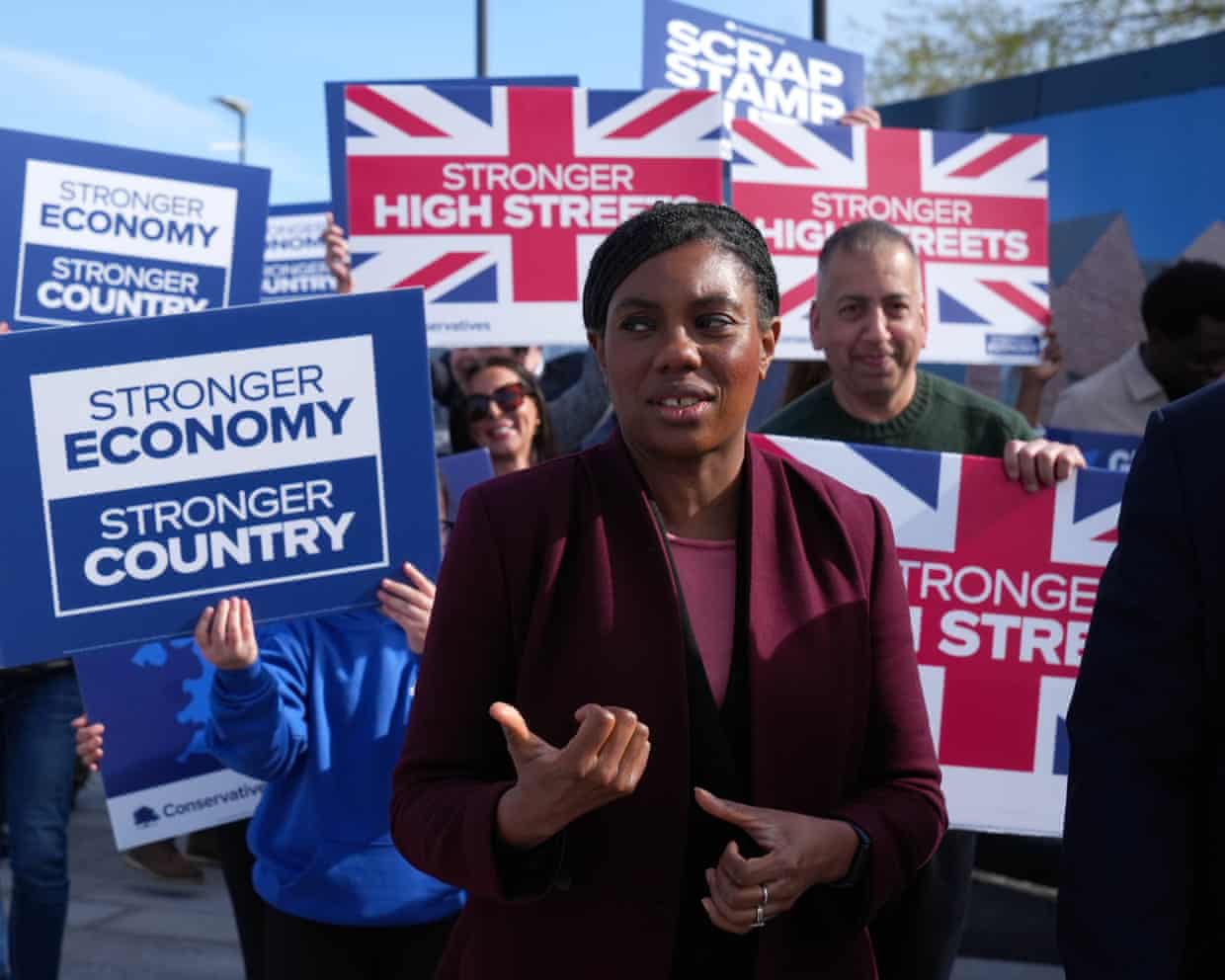
The Conservatives would reinstate the two-child benefit cap and use the savings for a wide-ranging spending splurge on defence in what Kemi Badenoch said would be “the biggest peacetime programme of rearmament in our country’s history”.Speaking at a defence conference in London, the Tory leader criticised the government for Britain’s “lack of readiness” for war, which has been exposed by recent world events.Badenoch said the UK needed to “reassert” itself as a global power and committed the Tories to “the largest net increase in British troops under any government since the second world war” if they returned to power at the next general election.The pledge would involve recruiting 6,000 full-time soldiers and 14,000 reservists. The Tories say they could raise £20bn towards the venture by reinstating the two-child benefit cap and reallocating money earmarked for net zero projects

History beckons for I Am Maximus as Red Rum’s record comes in to view | Greg Wood

Cardiff stages thriller while Women’s Six Nations favourites show strength

Is Gout Gout faster than Usain Bolt? Australian sprinter sets sights on Jamaican great’s 200m record

Rory McIlroy targets even loftier goals after winning back-to-back Masters titles
Rain puts dampener on Gather Round despite AFL’s hype and schmoozing | Jonathan Horn

The Masters 2026: McIlroy retains title after thrilling final round – as it happened