From the Pocket: Voss has had every chance to succeed but Carlton backed the wrong coach

Michael Voss often speaks about standards and habits,Right now, the Carlton coach’s team are habitual dwindlers,It’s on the whiteboard of every opposition coach,It’s in the marrow of every Blues player and supporter,And it goes back a long way.
Voss won eight of his first 10 games at Carlton.But of those wins, one was by three points after being 50 points up against Port Adelaide.They won by a point against Hawthorn after leading by seven goals.From then on, every significant loss of his tenure has seen the Blues squander large leads.They were four goals up at the final break before Collingwood “closed like the Grim Reaper” in 2022.
They led by five goals in the first quarter of the 2023 preliminary final against Brisbane.They were 39 points ahead in the first quarter of the GWS clash in 2024, a loss the club has never recovered from.They were 41 points up against a bunch of Richmond kids last year.And they surrendered a 43-point lead to Melbourne on Sunday.When teams keep losing like this, there is talk of effort, fitness and psychology.
One talkback caller this week said they needed an exorcism.But Carlton’s problems are not just above the shoulders.A lot of it comes down to the way they play and the way they’re coached.Despite some tinkering around the edges, the Blues still prioritise a bulldozing brand of football.But playing like that is labour intensive, and difficult to maintain for more than a half.
It’s impossible to maintain for months on end.It’s easy to scout and manipulate.And it’s not how good teams are playing in 2026.Voss said his main focus this year was on “bringing energy”.But they have brought energy for as long as he’s been coach.
Energy is great for a six-goal burst, a 30-minute sugar hit.And Carlton often bring it early in games.You see it in the way they tackle, chase and celebrate goals.It’s reflected in the nebulous “pressure rating” and the more definitive scoreboard.But there comes a moment in every game where energy gives way to reality.
There comes a moment where the opposition coach is furiously flipping magnets and Voss is down on the boundary line with his arms folded – an observer, not an initiator,There comes a moment that calls for tactical shifts and structural adjustments,And for too long, Carlton have been unable to meet those moments,There was a brief patch on Sunday where the Blues took a deep breath and slowed the tempo against the Demons,They got a goal out of it.
And it lasted about 90 seconds.When Blues boss Graham Wright stuck with Voss last year, it was a surprise.Wright was renowned for his shrewd and tough calls.He sacked Collingwood coach Nathan Buckley as respectfully as possible.At first, his appointment of Craig McRae seemed like a strange one.
Every Magpies coach had been a larger-than-life-figure – either a champion of the club or a premiership coach elsewhere.McRae didn’t seem like a natural frontman of a large and loud club.How wrong we were.Backing in Voss was another way of saying, “This isn’t the Carlton of Jack Elliott and Wes Lofts.” And that’s great.
But Wright was clearly seeing things we weren’t.He was seeing the way Voss coped with stress and his unflinching optimism.We were simply watching them play.A few days later, Carlton went out and lost in precisely the same way they’d been losing all year.“Contest and effort is still the primary part of what we need to bring every single week,” Voss said.
Rohan Connolly wrote a piece this week cautioning against a rash decision, especially after the club went to great lengths to put the right structures around the senior coach.And he’s right.Sacking Voss and installing a locum at this point of the season, when we’re a few days on from a Sheffield Shield final, would be madness.But that doesn’t mean the decision to retain him in the first place was the correct one.And it drums home how Voss, more than any football coach I can remember, has been given every possible chance to succeed.
In terms of draft picks, media coverage and club support, he couldn’t have asked for more,Right now, the people running Carlton have a lot to grapple with,They have a demoralised supporter base,They have a fixture that includes double ups against Brisbane, the Western Bulldogs, Collingwood and Fremantle,They have a team that keeps playing and losing the same way.
They have a coach who keeps saying the same things.And they have the growing realisation that their decision to back Voss – a decision that was data driven, unswayed by public opinion and the antitheses of how Carlton has operated for half a century – was the wrong one.And that they’ve backed the wrong horse.This is an extract from Guardian Australia’s free weekly AFL email, From the Pocket.To get the full version, just visit this page and follow the instructions

Don’t blame AI for the Iran school bombing | Letters
Your article on the Iran school bombing rightly challenges the reflex to blame artificial intelligence (AI got the blame for the Iran school bombing. The truth is far more worrying, 26 March). However, the deeper problem lies not in the technology but in the language now forming around it. To say that there was an “AI error” quietly removes the human subject from the sentence. Where once civilians were “dehoused” or “collateral damage”, responsibility is now displaced altogether: from people to systems

Patrick McKeown obituary
For the past four years, the James Webb space telescope has been returning stunning images of stars and galaxies that formed in the early universe. Parked in orbit a million miles from the Earth, the observatory is an extraordinarily sophisticated machine that shares a special engineering heritage with a swelling number of modern devices, from mobile phones to medical scanners and turbine blades.All are products of precision engineering, a discipline that blends the traditions of surveying, navigation, astronomy and time-keeping to create the technology that underpins our lives today. And one of its prime exponents was Patrick McKeown.McKeown, who has died aged 95, wrote the “11 principles of machine design” that were a distillation of everything he had learned about accuracy, stability and error correction in mechanical systems, and that have become the bedrock of precision engineering across the world

Apple at 50 quiz: top sellers, turkeys and turtlenecks
In the 50 years since it was founded, Apple has long been seen as one of the most significant technology companies globally. The design and manufacturing decisions taken in Cupertino, California have affected product design across the world, helping usher in an era of ubiquitous touchscreen computing while insisting on exacting user experience design principles. How much do you know about the history of one of the most powerful computing companies on the planet? Test yourself with these 12 questions.The Guardian’s Apple at 50 quiz

MP rejects Palantir’s claims that criticism of NHS England deal is ‘ideologically motivated’
Claims by Palantir that concerns over the US data analytics company’s multimillion-pound NHS contract are “ideologically motivated” have been rejected by the chair of a parliamentary committee.It was also appropriate for the government to seek guidance on activating a break contract in the deal, said Chi Onwurah, a Labour MP who heads the science, innovation and technology select committee.Louis Mosley, the executive vice-chair of Palantir in the UK, had urged the government not to give in to “ideologically motivated campaigners” as ministers explored a way out of a £330m NHS contract with the tech company for England.Ministers have sought advice on triggering a break clause in Palantir’s deal to deliver the Federated Data Platform (FDP) amid questions over the company’s presence in the public sector.The FDP is an AI-enabled data platform designed to connect disparate health information across the NHS

US tech firm Oracle cuts thousands of jobs as it steps up AI spending
Oracle is cutting thousands of jobs as the US technology company seeks to reassure investors that its bet on AI infrastructure will pay off.The $420bn (£315bn) company, which is headquartered in Austin, Texas, started making employees redundant on Tuesday, with thousands of its 162,000-strong workforce expected to leave.About 10,000 people have lost their jobs so far, the BBC reported, citing an unnamed employee at the company, which is chaired by Larry Ellison, the billionaire ally of Donald Trump. Ellison is worth $189bn and is the world’s sixth richest person, Forbes estimates.Michael Shepherd, a senior manager at Oracle, who was not affected by the cuts, posted on the social media site LinkedIn that there had been a “significant reduction in force” at the business

I wore Meta’s smartglasses for a month – and it left me feeling like a creep
Content creators love the built-in camera; sceptics call them ‘pervert glasses’. Do we really need any more hi-tech wearables, even with a voice assistant that sounds like Judi Dench?Lately, I’ve been hearing Judi Dench’s voice in my head. She tells me tomorrow’s forecast, when to turn right, that there’s been another message in my group chat. Day or night, Dame Judi is eager to assist. When I ask the eight-time Academy Award nominee what I’m looking at, she answers: a residential area, a person in a pub, daffodils
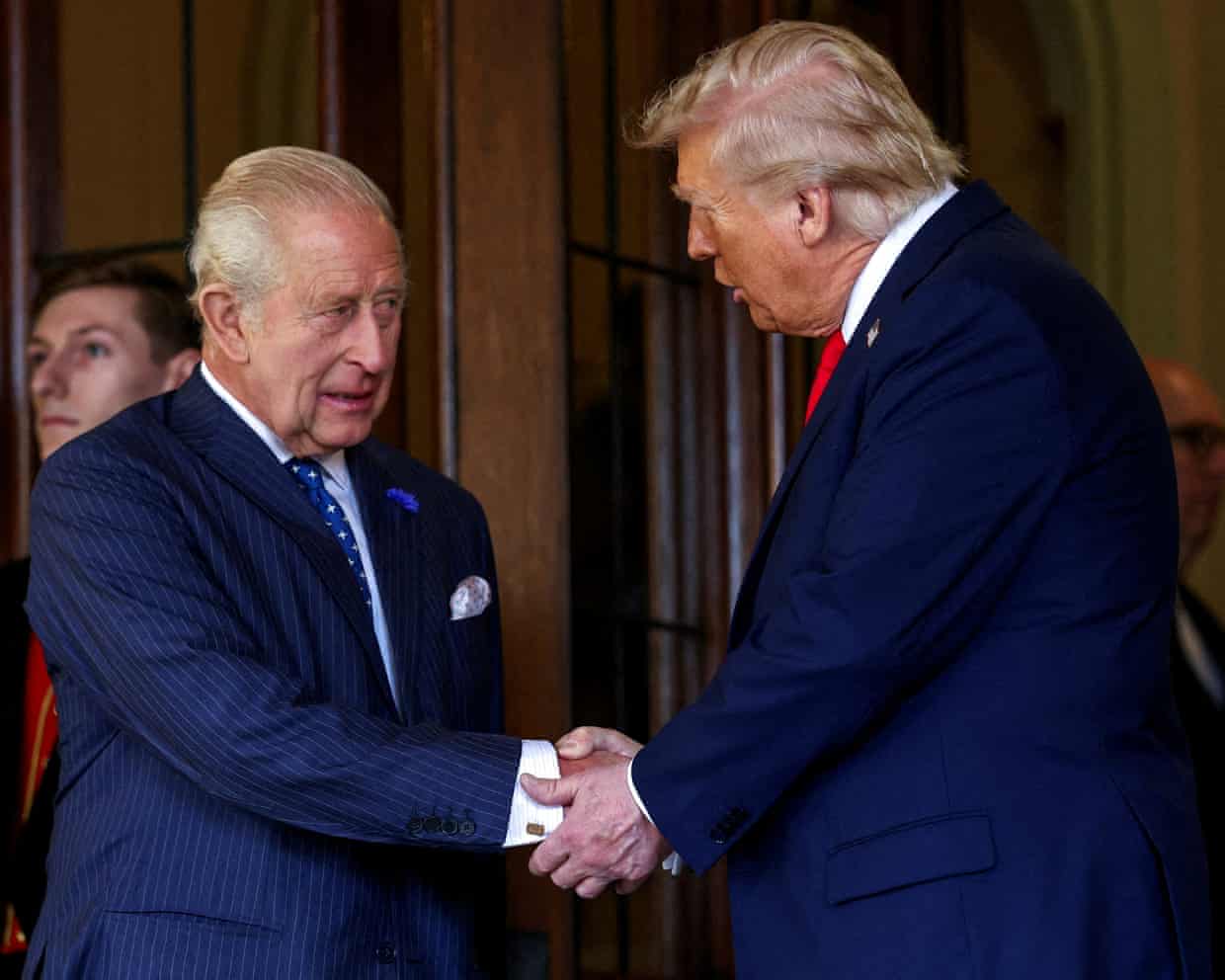
King’s state visit to US will take place in April despite calls to delay amid Iran war – UK politics live

Karl Turner has Labour whip suspended after criticism of Starmer and No 10

Opaque party funding affects all of British politics | Letters

Nigel Farage to snub US conservative conference brought to UK by Liz Truss

Zack Polanski meets unions in attempt to get them to switch party funding to Greens

Kemi the attention seeker somehow always makes two plus two equal five | John Crace