Sharp rise in young Britons saying ill health is reason they are jobless, study finds

There has been a sharp rise in the number of jobless young people in the UK citing health problems as the reason they are not working, according to analysis.The share of 16- to 24-year-olds not in education, employment or training – known as Neets – who reported a work-limiting condition has surged by 70% in a decade, a charity thinktank found.The trend is potentially putting the generation “at even greater risk of harm to their future opportunities”, the Health Foundation said.The findings are published as the government announces a youth employment drive and overhaul of apprenticeships.Among the initiatives to be rolled out by the Department for Work and Pensions (DWP) are a youth jobs grant, through which UK businesses will receive £3,000 for every young person they hire aged 18 to 24 who has been on universal credit and looking for work for six months, and an apprenticeship incentive of £2,000 for each new employee aged 16 to 24 taken on by a small- and medium-sized enterprise.
According to the Office for National Statistics, the number of Neets aged 16 to 24 was 957,000 in the three months from October to December – up from 946,000 in the previous quarter.Announcing the changes in a speech on Monday, the work and pensions secretary, Pat McFadden, will point to a statistic that shows a person under 25 on universal credit is less likely to get a job than someone aged over 55 on the same benefit.“Today the biggest issues facing the system are the challenges of youth unemployment and the growing number of people on long-term sickness and disability benefits,” he will say.“The number of young people not in education, employment or training is much too high at almost a million.Almost all of the recent rise took place before the last election.
“And within it the proportion of Neets who are sick or disabled has doubled in the past decade and is now 46% of the total.Acting on this should be a cause that motivates us all.The human cost is a tragedy.The waste of potential appalling.And the financial cost enormous.
”The Health Foundation said the “changing health landscape means yesterday’s solutions might not be enough for today’s young people”.Research by the thinktank found that between 2015 and 2025, the share of Neets who reported conditions that stopped them from working increased from 26% to 44%.This represents a rise of 70%, the Health Foundation said.Last year, more than two-thirds of Neets who cited health issues as a barrier to work did so because of mental health problems and autism.However, the Health Foundation said health problems were not exclusive to Neets.
It said that in the past 10 years, the share of all 16- to 24-year-olds reporting ill health as a barrier to work increased from 9% to 16%, a rise of 78%.Sam Atwell, a policy and research manager in the healthy lives team at the Health Foundation, said: “There’s been a lot of attention on the growing number of young people who are neither learning nor earning.But our analysis shows the problem runs deeper.More Neet young people are reporting health problems, potentially putting this generation at even greater risk of harm to their future opportunities.”Other changes to be announced by McFadden include the expansion of the jobs guarantee to a wider age range of 18 to 24, from 18 to 21, and further overhauls to the growth and skills levy to prioritise young apprentices.
The changes are backed by an additional £1bn, taking the total investment into the youth guarantee and the additional investment in the growth and skills levy to £2.5bn over the next three years, the DWP said.A government spokesperson said: “We are committed to ensuring every young person has the opportunity to earn or learn.“That’s why we are providing almost £1bn of additional investment to support young people, helping to create 200,000 jobs and taking the total to £2.5bn.
“For those young people being held back by health conditions, we are also investing £3.5bn by the end of the decade to help them back into the workplace.”

Meta and Google trial: are infinite scroll and autoplay creating addicts?
It was as “easy as ABC”, claimed the lawyer prosecuting a landmark social media harm case against Meta and Google which heard closing arguments this week. The defendants were guilty, said Mark Lanier, of “addicting the brains of children”. Not true, replied the tech companies. Meta insisted providing young people with a “safer, healthier experience has always been core to our work”.Features such as autoplay videos, infinite scrolling and constantly chirruping alerts woven into the fabric of online platforms were central to the six-week trial in Los Angeles, which has been compared to the cases against tobacco companies in the 1990s

New study raises concerns about AI chatbots fueling delusional thinking
A new scientific review raises concerns about how chatbots powered by artificial intelligence may encourage delusional thinking, especially in vulnerable people.A summary of existing evidence on artificial intelligence-induced psychosis was published last week in the Lancet Psychiatry, highlighting how chatbots can encourage delusional thinking – though possibly only in people who are already vulnerable to psychotic symptoms. The authors advocate for clinical testing of AI chatbots in conjunction with trained mental health professionals.For his paper, Dr Hamilton Morrin, a psychiatrist and researcher at King’s College in London, analyzed 20 media reports on so-called “AI psychosis”, which describes current theories as to how chatbots might induce or exacerbate delusions.“Emerging evidence indicates that agential AI might validate or amplify delusional or grandiose content, particularly in users already vulnerable to psychosis, although it is not clear whether these interactions can result in the emergence of de novo psychosis in the absence of pre-existing vulnerability,” he wrote

Fake rooms, props and a script to lure victims: inside an abandoned Cambodia scam centre
It is as if you have walked into a branch of one of Vietnam’s banks. A row of customer service desks, divided by plastic screens, with landline phones, promotional leaflets and staff business cards. A seated waiting area and a private meeting room. All of it features the OCB bank’s logo, or its trademark green colour.This is not a genuine bank branch, however

Apple cuts China App Store commission fees after government pressure
Apple announced late on Thursday it would lower the commission fees collected in its App Store in mainland China. The move follows pressure from regulators in the tech company’s second-largest market, as well as global scrutiny of its payment requirements.Fees for in-app purchases and paid transactions will be lowered to 25% from 30% starting on Sunday, Apple said in a statement on its blog for developers.“Apple is making changes to the App Store in China following discussions with the Chinese regulator,” the company’s announcement reads. “As of March 15, 2026, changes will be made to the commission rates that apply to the China mainland storefront of the App Store on iOS and iPadOS

Anthropic-Pentagon battle shows how big tech has reversed course on AI and war
The standoff between Anthropic and the Pentagon has forced the tech industry to once again grapple with the question of how its products are used for war – and what lines it will not cross. Amid Silicon Valley’s rightward shift under Donald Trump and the signing of lucrative defense contracts, big tech’s answer is looking very different than it did even less than a decade ago.Anthropic’s feud with the Trump administration escalated three days ago as the AI firm sued the Department of Defense, claiming that the government’s decision to blacklist it from government work violated its first amendment rights. The company and the Pentagon have been locked in a months-long standoff, with Anthropic attempting to prohibit its AI model from being used for domestic mass surveillance or fully autonomous lethal weapons.Anthropic has argued that giving in to the DoD’s demands to permit “any lawful use” of its technology would violate its founding safety principles and open up its technology for potential abuse, staking an ethical boundary that others in the industry must decide whether they want to cross
AI toys for young children must be more tightly regulated, say researchers
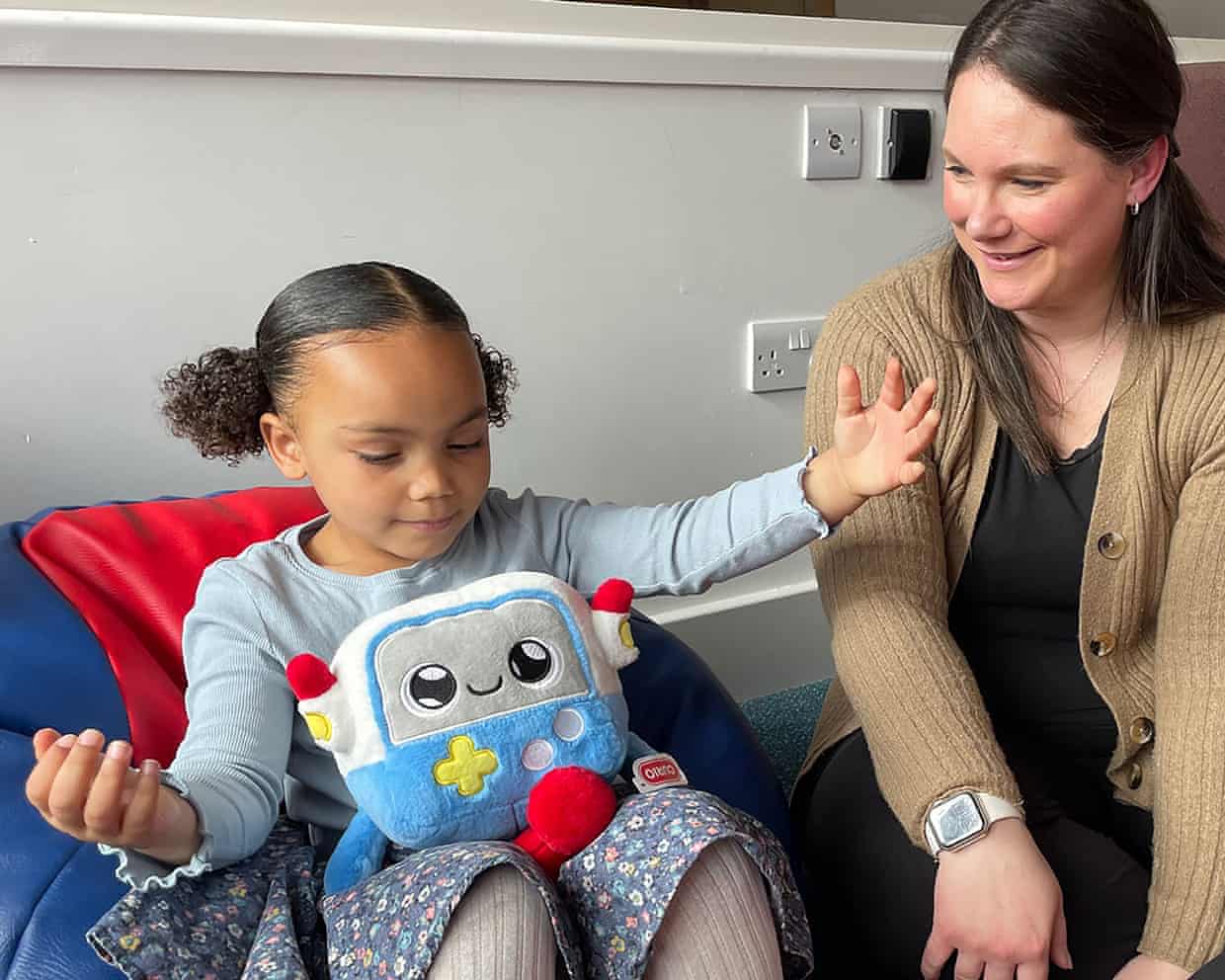
It was all going well. Charlotte, five, was chatting with an AI soft toy called Gabbo at a London play centre about her family, her drawing of a heart to represent them and what makes her happy. She even offered a couple of kisses to the £80 toy with a face like a computer screen.It was when she declared: “Gabbo, I love you”, that the fluent conversation came to an abrupt halt.“As a friendly reminder, please ensure interactions adhere to the guidelines provided,” said Gabbo, awkwardly crashing into its guardrails

Mother’s Day UK recipes: three delicious ideas to make for your mum from Ravinder Bhogal

Benjamina Ebuehi’s recipe for caramelised white chocolate and rhubarb cheesecake | The sweet spot

Noma chef resigns amid allegations of physical abuse of staff

Light red wines for spring drinking

Rachel Roddy’s recipe for risotto in bianco | A kitchen in Rome

‘Highly problematic behavior’: Noma residency in LA starts with PR crisis