John Knight obituary
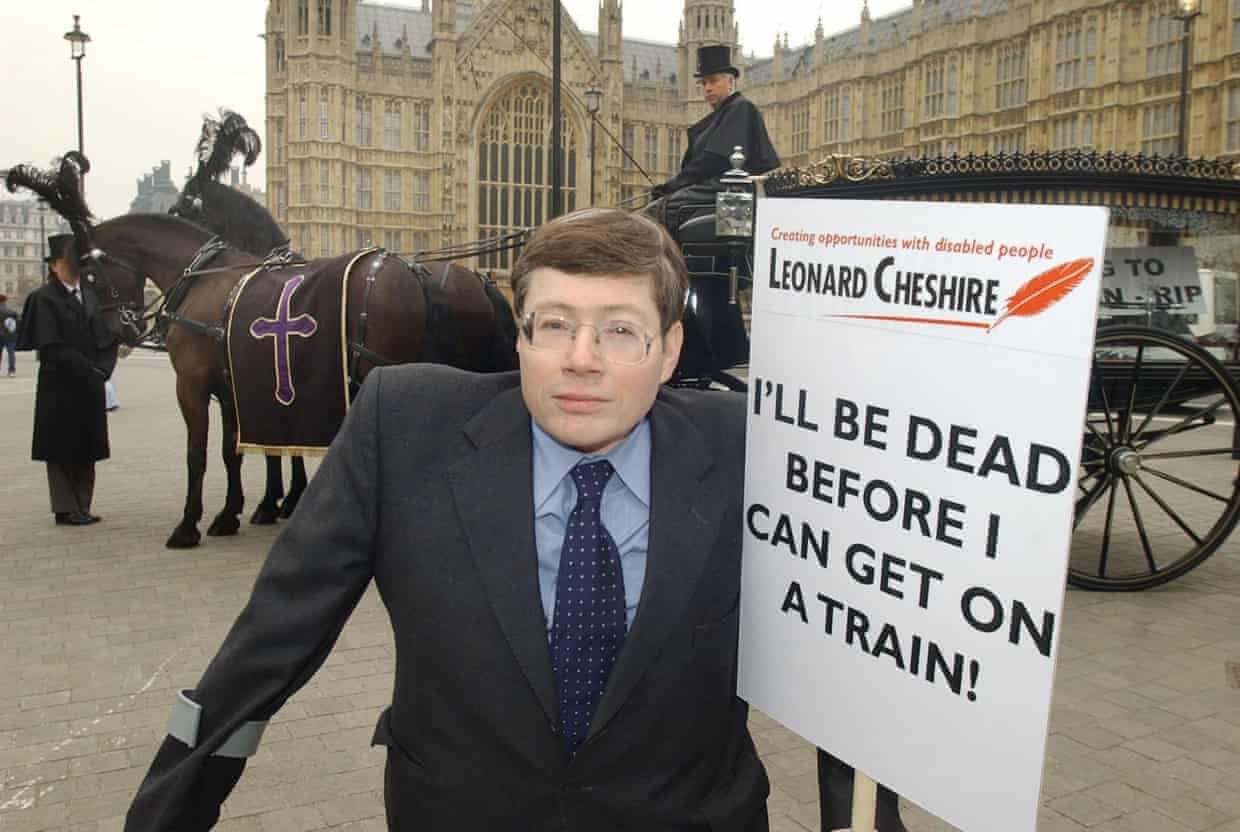
Disabled people might still be waiting for all UK trains to be accessible were it not for the success of a high-profile campaign led by John Knight, who has died of sepsis aged 67, after himself overcoming profound disabilities from birth and becoming a leading figure in the charity and public sectors.Knight was responsible for policy and campaigns at the disability charity Leonard Cheshire during passage of the Disability Discrimination Act 2005, which was to set a deadline for railway carriages to be accessible.Train companies were pressing for a date of 2035, to maximise the life of inaccessible rolling stock, but the campaign persuaded the House of Lords to back an amendment to the legislation with a time limit of 2020.The change was then accepted by the Labour government.At the climax of the All Aboard campaign, Knight arranged for a horse-drawn hearse to deliver to MPs and peers thousands of postcards on which disabled people had written what age they would need to live to in order to benefit from a 2035 deadline.
The slogan for the day was: “I’ll be dead before I can get on a train.”The tactic well reflected Knight’s mischievous personality and penchant for pranks.He had a particular love of fireworks and one of his party acts, according to friends, was to adapt his crutches as makeshift mortar tubes.At Leonard Cheshire he was seen by most, though not all, as a refreshing influence on an organisation that was at the time shaking off a traditional image and a somewhat patrician culture, and was struggling to introduce people with disabilities into its ranks.Knight, who was with the charity for 16 years and became a board-level director, robustly defended his decision to work within the establishment in the face of criticism by other disability activists.
His other achievements included disability equality training for London bus drivers and the securing of some safeguards for disabled people under Labour’s 2008 benefit changes that put emphasis on work capability,He later spoke of the early 2000s as “a heady time with great progress for disabled people”, but conceded that he had worked with Labour “sometimes too closely, on reflection”,In recent years, he again differed with many activists by openly supporting moves to legislate for assisted dying for people with terminal illness, becoming a board member and subsequently patron of the pressure group My Death, My Decision,He claimed to speak for a silent majority of disabled people,His childhood had been extremely challenging.
He was born in Bristol, the only child of a painter and decorator, also John, and his wife, Janet (nee Matthews), a comptometer operator, but his parents found it hard to cope with his disabilities.He remained in hospital for 10 weeks and was then transferred to the former John Capel Hanbury hospital home for disabled children in Woodford Bridge, Essex, where a decision was taken to amputate his very twisted legs and fit him with prosthetics.It was not until recent years that he used a wheelchair.At 18 months, he was placed in care of the Barnardo’s children’s charity.He was to describe his own experience of this as “transformational”, while acknowledging that it was not for many others, and after an initial placement at the former Ethel Davis special school in Ilford, Essex (now in east London), he flourished from age 10 at the Chailey Heritage special school in East Sussex, where he became head boy, and at Hereward College in Coventry, where he took O-levels.
At Chailey he developed a lifelong passion for opera through occasional free tickets for productions at nearby Glyndebourne.He later told friends that he had seen Benjamin Britten’s Peter Grimes 33 times.A particular influence at Barnardo’s was a member of staff, Judith Hocking, who was to become a mother figure.She frequently had him to stay at her parents’ house in Leominster, Herefordshire, something that today would not be permitted, and he grew to regard the Hockings as his family and Herefordshire as his home patch.He was to remain close to Judith until her death in 1999.
At 16, however, he went back to Bristol to take his A-levels at Filton College and to see if relations with his birth family could be built,They could not,He was living in a bedsit in the city when he collapsed and was diagnosed with type 1 diabetes, which he had unknowingly inherited from his mother,The condition, and resultant neuropathy, became an additional lifetime burden,Knight went on to Nottingham University, which was at the time making special efforts to welcome students with disabilities, and graduated in 1982 in zoology.
He later recalled that he had chosen to research urban seagulls as his thesis, because of his difficulties travelling, but had done so without ever actually spotting one in the city.He enjoyed an uproarious social life featuring many drunken escapades – and several hair-raising capers involving his blue Invacar – and he once appeared in a student revue having his “legs” sawn off by a supposedly bungling magician.He returned to studies in later years, taking an Open University degree in political and social sciences in 1992, and a diploma in voluntary sector management at City University Business School in 1997.He received an honorary doctorate from Nottingham in 2012.After a brief and ill-fated first career via a banking graduate trainee programme, Knight joined the civil service in 1985 and served for five years in the then Department of Health.
In 1990, he moved to become principal disabilities services officer at Hammersmith and Fulham council, west London, and in 1994 he moved again to Leonard Cheshire to build its policy and campaigns arm.Among a raft of subsequent public appointments, which became especially numerous after he left the charity in 2010, he was a commissioner of the former Commission for Social Care Inspection from 2004 to 2009 and a board member of the Charity Commission between 2009 and 2013.He was on the board of the National Council for Voluntary Organisations from 2003 to 2008, playing a key role in its policy development, and was a board member and tenant champion at Habinteg housing association, which was for many years his landlord, from 2019 until last November.He served as a magistrate in north-east London for 28 years until 2020.In 2011 he was made CBE.
He met Ruth Hall, a campaigner for social justice, through Guardian Soulmates in 1996.They were together for the rest of his life, and married in 2021.Ruth had a son, Alex, and in the early 2000s the couple also took in Shuxin Dai, a young adult whom they regarded as a daughter.Knight had a warm grandparental relationship with Shuxin’s son, Jonathan.Ruth and Alex survive him.
John Knight, disability campaigner, born 20 October 1958; died 2 December 2025

Your Guardian sport weekend: Premier League, Australian Open and NFL title games
Day seven at Melbourne sees some big names in action as Jannick Sinner and Novak Djokovic go in the men’s draw, where one of the game’s veterans is enjoying a last hurrah. The former champion Stan Wawrinka, who will retire at the end of the season, is the first player to reach the third round at a grand slam past his 40th birthday since Ken Rosewall at the same tournament back in 1978. The Swiss next faces the ninth seed, Taylor Fritz of the US. In the women’s draw, Iga Swiatek and fashionista Naomi Osaka are the standouts. Luke McLaughlin hosts our liveblog, while Tumaini Carayol and Jack Snape report

Alex de Minaur sets up enticing last-16 clash with nemesis Bublik at Australian Open
Alex de Minaur has a date with his own nemesis. The Australian defeated Frances Tiafoe in a spectacular three sets on Friday night, 6-3, 6-4, 7-5, to again reach the last 16 at his home grand slam.There he will meet Alexander Bublik, the dangerous 10th seed who came back to beat the Australian twice in high-profile matches last year. They were two of a series of agonising, frontrunning defeats that tainted De Minaur’s 2025 season, including one at the ATP Finals against Lorenzo Musetti that prompted him to admit he had become “quite dark”.Against Tiafoe though, there was no late turnaround, even if the American was unfortunate in a tight third set

Patrick Reed unfazed by fines as he hits the front in Dubai Desert Classic
Patrick Reed finds himself in a curious situation. The former Masters champion could prevail this weekend in the Dubai Desert Classic and see a decent chunk of the $1.5m (£1.1m) first prize duly handed back to the DP World Tour in fines. Reed has joked that it will not be particularly easy for him to make a profit on this tour during 2026

The cricket simulator that bowls ‘a million variations’ – and won’t judge batters for fresh-airing a few
Cricket has always held a strange tension between the individual and the team. By design, it demands periods of isolation and mental stamina rarely found in team sports, and so focus tilts towards the solo performance. Yet without the needs of the team, that performance is devoid of meaning.It’s a tenuous relationship that carries through to training. Bowling practice is more finely tuned with a batter down the other end; batting practice necessitates a bowler or thrower
Australian Open 2026: Norrie out, De Minaur and Andreeva advance – as it happened
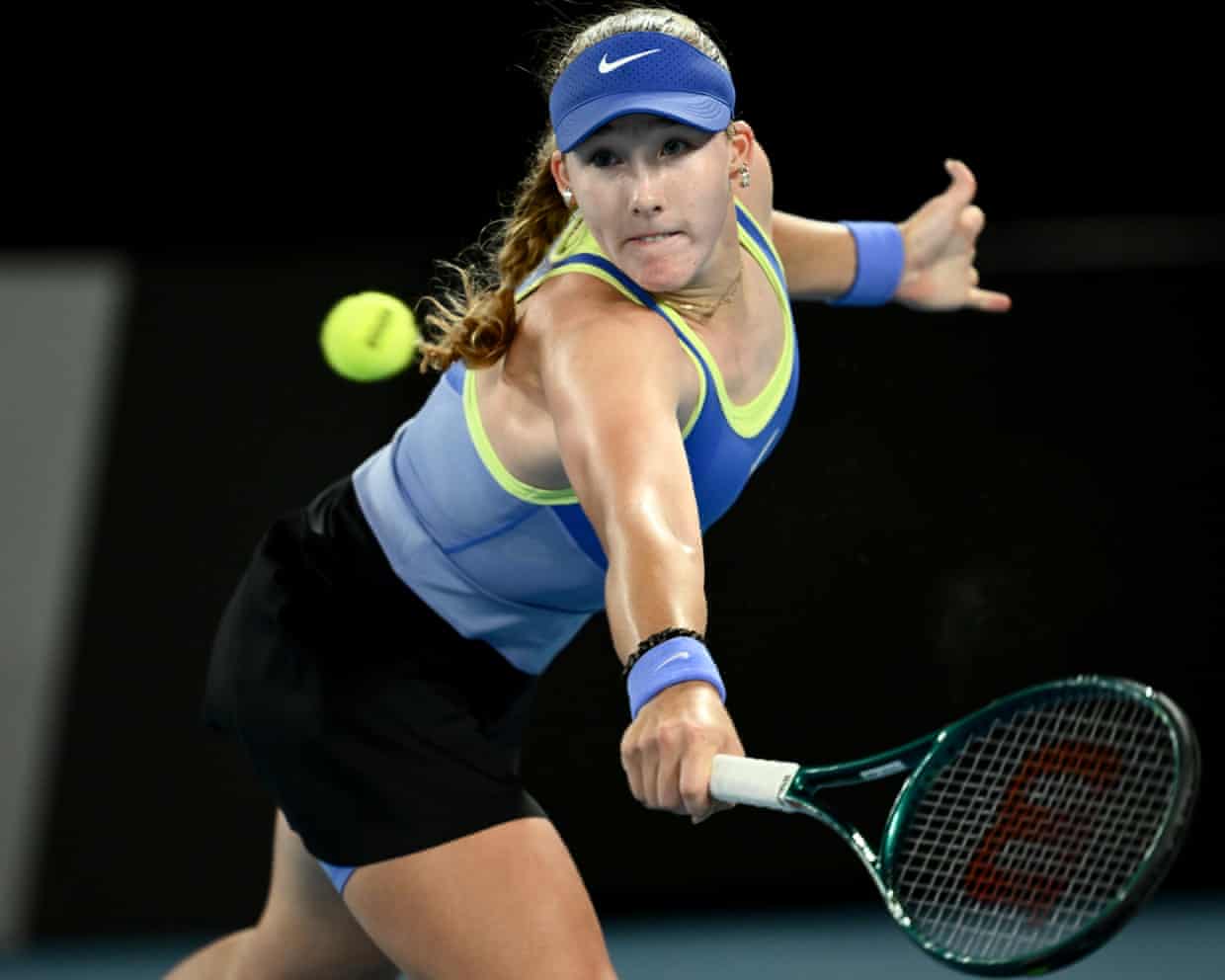
Cameron Norrie did what he could. Rather than easing into a long best-of-five-sets match, he played at full throttle from the beginning by launching into forehands and forcing himself inside the baseline at all cost. He worked through every shot in his arsenal, frequently sweeping forward to the net. He punctuated each small victory with booming cries of “allez”.In tennis, however, match-ups are king and the past meetings between Norrie and Alexander Zverev have already illustrated how the German’s game is built to outlast and overpower the Briton

The thrill of covering sports lies in a constant hunt for details | Ella Brockway
When I was a kid, I was drawn to stories that involved a good treasure hunt.Favorite movie: National Treasure, the 2004 Nicolas Cage classic. Favorite book series: The 39 Clues. Favorite puzzle: a word search. Dream book project: a hunt for a treasure hidden across Olympic host cities – and naturally, a companion series involving World Cup stadiums

‘At the table or on the menu’: a turbulent Davos week with Trump’s circus in town

Strong UK pay growth could limit interest rate cuts, Bank policymaker warns

Young will suffer most when AI ‘tsunami’ hits jobs, says head of IMF

TikTok announces it has finalized deal to establish US entity, sidestepping ban

Bullish Borthwick tells England to target Six Nations triumph in Paris
Borthwick’s task is to strike the right balance with thriving England ready for takeoff | Robert Kitson