‘Everything is going up’: Americans struggle with affordability despite Trump’s claims

US workers are still struggling with the cost of living despite Donald Trump’s campaign promises to fix the US affordability crisis.The Guardian spoke to workers as an exclusive poll showed cross-party concerns about the Trump administration’s handling of the US economy.Dawn Levie, 61, a postal service worker in Paulden, Arizona, said she’s lost thousands in earnings over the past year due to cuts to her hours, making it more difficult for her to afford basic necessities like paying for groceries and utility bills.“It’s hard to describe how you feel when you can’t sustain your livelihood because your money is impacted,” Levie said.“You can’t pay bills, [and] creditors get mad.
How do you tell them: ‘I just don’t have it?’”The White House insists that the affordability problem Americans like Levie report doesn’t exist,At a rally in Kentucky earlier this week, Donald Trump told the crowd: “Inflation is plummeting, income is rising, the economy is roaring back!”Though the positive sentiment will be a tough sell for voters in the upcoming midterm elections,After helping Congress pass huge cuts to healthcare and food assistance programs, Trump is now pushing to remove minimum wage and overtime protections for some workers,And though seven out of 10 Americans said that tariffs have led to higher prices, Trump has only doubled down on more levies,Far from feeling like the US is in a golden age, workers said rising inflation means their paychecks can’t keep up with prices.
“I know things are worse, because I’m living it and I feel it every day,” said Bryan Williams, 63, a home-care worker in Madison, Wisconsin, who is living paycheck to paycheck on $17.65 an hour.“It’s very hard trying to pay rent, pay your bills, buy food, gas and juggle which ones you can pay [and] which ones you can let go.“[I] ask myself which one should I get, when I know I need both, or worrying will I have enough money to get back and forth to work until another payday? Or will I have enough money to pay my light bill?”Vernice Thompson, 63, a retail worker in Williamsburg, Virginia, said that even though she receives social security benefits, housing still takes up half her income.“Groceries have gone up.
[The prices of] a lot of the foods that I like have gone up,” said Thompson.“I know the price of clothing too because I work in retail, and I haven’t seen any declines in the price of clothing.”“Everything is going up,” she added.Food prices were 2.9% higher in January compared to the year before and are predicted to increase by 3.
1% over the next year.Data shows that the food insecurity rate spiked to 16% in November, up from 12.7% in January 2025.Utility prices in the US also increased by more than 6% in January 2026 compared to a year prior.More Americans are taking on debt because of the rising cost of necessities.
Total household debt in the fourth quarter of 2025 reached $18,8tn, up by 4% since the beginning of the year,Delinquency for all types of debt rose 3,26% in the fourth quarter of 2025 compared to 1,7% in the same period of 2024.
Credit card debt in the US by the end of 2025 hit a record $1.28tn.Meanwhile, wages have stagnated for many workers.The 10% lowest wage earners, receiving on average $14.56 an hour, saw their wages decline by 0.
3% when adjusted for inflation in 2025.The federal minimum wage of $7.25 an hour has remained unchanged since 2009 – the longest period without an increase since the federal minimum wage was enacted.In comparison, higher-income Americans have been earning more than ever.Since 1979, high-end wages have grown twice as fast as low and middle wages.
“If people aren’t being paid a cost-of-living increase, or just the bare minimum of a cost of living increase, it’s hard to keep up,” said Crystal Franklin, 54, a US passport specialist and mother of three who lives in Dumfries, Virginia.Franklin said she started taking the bus to work because of rising gas prices and is being more frugal at the grocery store.Yet she still has less room in her budget for entertainment and leisure expenses for her grandchildren.“We’re not able to do what we used to be able to do because cost of living has gone up extremely high,” Franklin said.US families have paid more than $1,700 in estimated costs due to the Trump administration’s tariffs from February 2025 to January 2026, with Trump announcing new tariffs to replace those struck down by the US supreme court last month.
At the same time, Republicans have been cutting down the country’s social safety net,Trump’s One Big Beautiful Bill Act that was passed last summer included massive cuts for the next decade, including over $1tn from Medicaid, $536bn from Medicare and $186bn from the Supplemental Nutrition Assistance Program (Snap),In addition to these cuts, the White House is allowing Affordable Care Act subsidies to expire, which will raise health insurance premiums for 22 million Americans by an estimated 114%, from $888 a year to $1,904 in 2026,Trump has also sought to cut pay for millions of low-wage workers,Last year, the president rescinded an executive order that raised the minimum wage for federal contractors to $15 an hour and gave annual raises to keep in pace with inflation, impacting more than 300,000 workers.
The White House is also trying to remove overtime protections for nearly 4 million home-care workers who received median wages of $16.78 an hour in 2024.“Things have been pretty tough in the last year,” said Williams.“I don’t believe anything Trump says because everything he promised us he was going to do did not happen.”A spokesperson for the White House, Kush Desai, disputed the economic trajectory under the Trump administration.
“America’s economic trajectory under President Trump has been solid,” Desai said.“This week’s CPI report showed inflation continues to cool while the Administration’s tax cut, tariff, and deregulatory agenda continues to drive robust real wage and investment growth.Once we are past short term disruptions from Operation Epic Fury, America is poised to see even greater economic progress as the Administration’s trade deals, drug pricing deals, deregulatory efforts, and tax cuts continue taking effect.”

Fake rooms, props and a script to lure victims: inside an abandoned Cambodia scam centre
It is as if you have walked into a branch of one of Vietnam’s banks. A row of customer service desks, divided by plastic screens, with landline phones, promotional leaflets and staff business cards. A seated waiting area and a private meeting room. All of it features the OCB bank’s logo, or its trademark green colour.This is not a genuine bank branch, however

Apple cuts China App Store commission fees after government pressure
Apple announced late on Thursday it would lower the commission fees collected in its App Store in mainland China. The move follows pressure from regulators in the tech company’s second-largest market, as well as global scrutiny of its payment requirements.Fees for in-app purchases and paid transactions will be lowered to 25% from 30% starting on Sunday, Apple said in a statement on its blog for developers.“Apple is making changes to the App Store in China following discussions with the Chinese regulator,” the company’s announcement reads. “As of March 15, 2026, changes will be made to the commission rates that apply to the China mainland storefront of the App Store on iOS and iPadOS

Anthropic-Pentagon battle shows how big tech has reversed course on AI and war
The standoff between Anthropic and the Pentagon has forced the tech industry to once again grapple with the question of how its products are used for war – and what lines it will not cross. Amid Silicon Valley’s rightward shift under Donald Trump and the signing of lucrative defense contracts, big tech’s answer is looking very different than it did even less than a decade ago.Anthropic’s feud with the Trump administration escalated three days ago as the AI firm sued the Department of Defense, claiming that the government’s decision to blacklist it from government work violated its first amendment rights. The company and the Pentagon have been locked in a months-long standoff, with Anthropic attempting to prohibit its AI model from being used for domestic mass surveillance or fully autonomous lethal weapons.Anthropic has argued that giving in to the DoD’s demands to permit “any lawful use” of its technology would violate its founding safety principles and open up its technology for potential abuse, staking an ethical boundary that others in the industry must decide whether they want to cross

AI toys for young children must be more tightly regulated, say researchers
It was all going well. Charlotte, five, was chatting with an AI soft toy called Gabbo at a London play centre about her family, her drawing of a heart to represent them and what makes her happy. She even offered a couple of kisses to the £80 toy with a face like a computer screen.It was when she declared: “Gabbo, I love you”, that the fluent conversation came to an abrupt halt.“As a friendly reminder, please ensure interactions adhere to the guidelines provided,” said Gabbo, awkwardly crashing into its guardrails
‘IG is a drug’: jury to deliberate as US trial over social media addiction wraps up
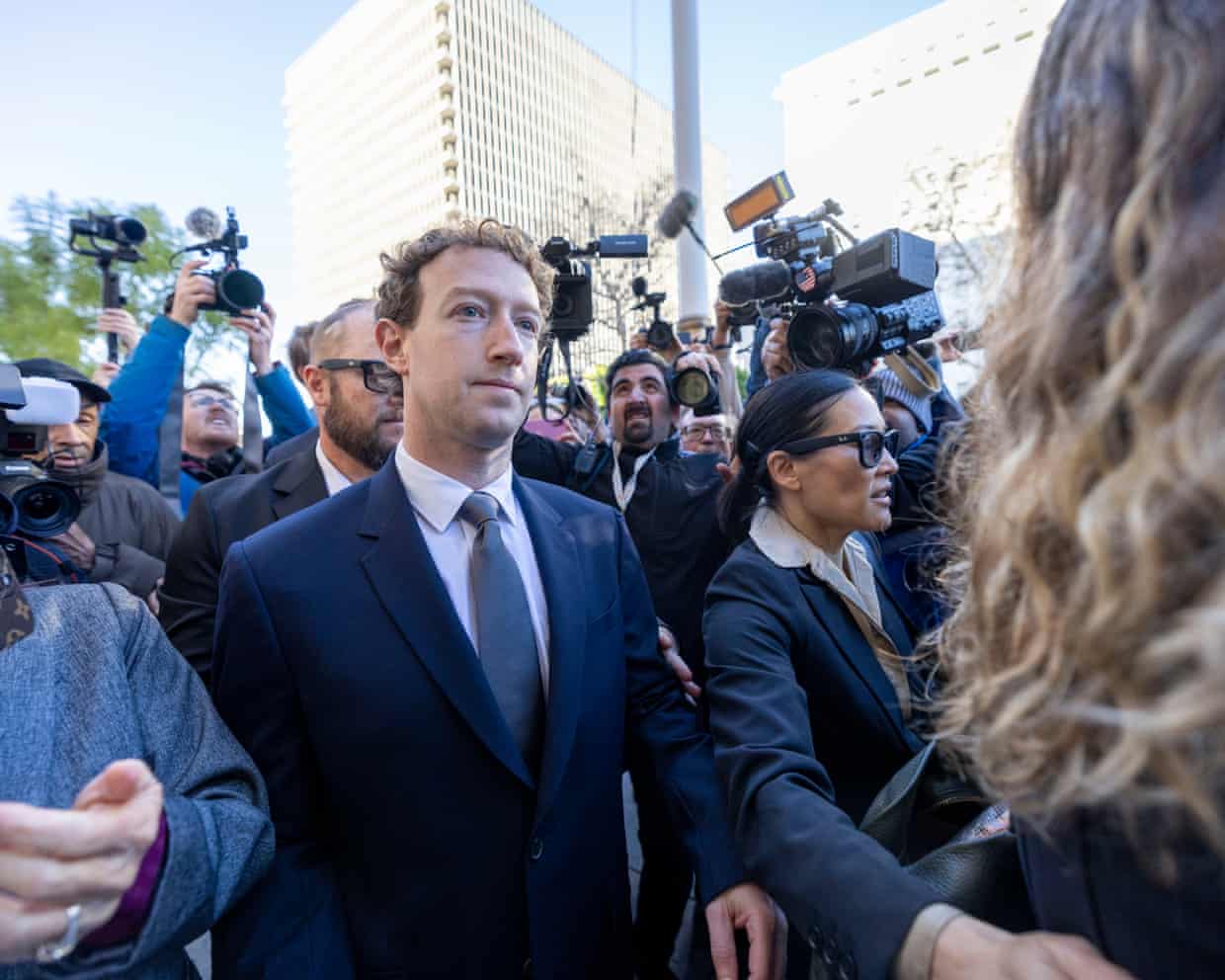
The first-ever jury trial over the potential harms of social media wrapped up on Thursday. Lawyers for Meta and YouTube have argued their platforms are safe for the vast majority of young people, while lawyers for a young woman at the center of the case say the tech companies have designed their products to be addictive, leading to mental health issues in children and teens.“How did they become such behemoths?” Mark Lanier, a lawyer for the plaintiffs, said during closing arguments in Los Angeles superior court on Thursday, according to NBC. “It’s the attention economy. They’re making money off capturing your attention

Google’s former Europe boss close to becoming next head of BBC, sources say
Google’s former Europe boss is closing in on becoming the BBC’s next director general, the Guardian has been told.Sources said that Matt Brittin, 57, was very advanced in the appointment process. Some insiders believe that, barring a last-minute development, he will succeed Tim Davie as the broadcaster’s next director general.Brittin, a member of the British Olympic rowing team in 1988, led Google in Europe, the Middle East and Africa for a decade until stepping down last year to take what he described as a “mini gap year”. He is also a non-executive director of Guardian Media Group

Fetuses likely have more ‘forever chemicals’ in blood than thought – report
Casey’s review of adult social care offers hope | Letters

Give mayors more powers to tackle youth unemployment crisis, says Alan Milburn
Sons were suspects in nearly one in five cases of women killed by men in UK in past year

Patients face long journeys for medicines as pharmacies cut weekend hours

Hundreds of thousands of NHS staff in England attacked and harassed, survey shows