Higher energy costs from Iran war could threaten fragile economics of AI boom | Heather Stewart

Donald Trump’s most immediate concern in demanding Iran reopen the strait of Hormuz may be rocketing US gasoline prices, but if the conflict drags on, higher energy costs will be felt far beyond the pumps.Systemically higher power prices and fractured supply chains will squeeze industries and consumers worldwide.For the US, one consequence may be to threaten the fragile economics of the AI boom.Many oil-importing economies, especially in the global south, are having to contemplate outright shortages of oil and its products.Shops in Egypt face curfews, Indonesia has imposed work from home Fridays and the Philippines has declared a national energy emergency.
As a wealthy oil exporter, the US can largely dodge these concerns.However, as the rising cost of filling up US cars illustrates, it cannot completely avoid the global rise in energy costs – which many analysts now believe will persist for months even if the strait reopens within days.As a result, many companies will be looking anxiously at their cashflow projections.But for a uniquely energy-hungry industry, whose business model is not yet firmly established and whose investments are financed by huge debts, the challenges may be particularly acute.OpenAI’s Sam Altman made a less than reassuring comparison in February as he sought to play down fears about AI’s environmental impact in the run-up to what is expected to be a mega launch on to the stock market later this year.
“People talk about how much energy it takes to train an AI model – but it also takes a lot of energy to train a human,” he said.“It takes about 20 years of life – and all the food you consume during that time – before you become smart.”The Bank of England highlighted the potential link between energy costs and the share prices of AI companies in its regular survey of the risks facing the UK financial system last week.The Bank’s financial policy committee began by pointing out that investors had already been raising questions about the sector before Trump went to war.“Prior to the conflict, increasing debt-financing needs and concerns about whether expected returns on very significant AI-related investments would materialise led to selling pressure,” it said.
“The conflict could increase these concerns, particularly given the energy-intensive nature of the supply chain for key components and the operation of datacentres.”It was one aspect of a wider warning that the Iran war could exacerbate pre-existing fragilities in markets, given the likelihood that it will “weigh on growth, increase inflation and tighten financial conditions”.The chief economist of the World Trade Organization, Robert Staiger, has also made the connection between AI and the impact of the conflict, telling me last month that a prolonged period of high energy prices could “crimp” investment in the sector.“The boom is very energy intensive,” he said.To underline the real-world consequences of a possible retrenchment, in its latest global trade outlook, the WTO calculated that 70% of investment growth in the US in the first three-quarters of last year was in AI-related goods of one kind or another.
The sheer complexity of the financial engineering underpinning the AI investment mega-boom was laid bare in a forensic note by a US law firm, Quinn Emanuel, published last month, which kicked off by noting that the sector’s revenues last year were about $60bn (£45.3bn) and its capital expenditure $400bn.For those of us old enough to remember the 2008 global financial crisis, it makes sobering reading – off-balance sheet special purpose vehicles feature heavily, as do asset-backed securities.Essentially, the “hyperscalers” leading the AI charge, and infrastructure providers such as CoreWeave, are borrowing unimaginably large sums as they dash to build out datacentres (although recent analysis by the AI sceptic Ed Zitron suggests real-world projects lag far behind the promises).The lenders are often private companies such as asset managers, which makes each company’s total liabilities harder for regulators – or even their investors – to track.
There are separate but interconnected concerns about the activities of this burgeoning private credit sector, which regulators, including the Bank of England, have consistently warned about, highlighting their opacity.In some cases, tech companies have straightforwardly issued bonds.But there are much more byzantine arrangements at play, familiar from the run-up to the Great Crash.Datacentre operators have been creating off-balance sheet special purpose vehicles, which “own” the vast datacentres and their future rental income – and borrow against them.In some cases these debts are then pooled together, sliced up and resold to pension funds and investment managers.
As older readers may recall, structures such as these can create false comfort that risks are being spread rather than cumulated, and make it vanishingly difficult to work out exactly who owes what to whom.Quinn Emanuel’s analysts believe that about $120bn in datacentre debt has been moved off-balance sheets in the past two years.And, as they put it: “The deeply interconnected AI ecosystem means that distress at any single node … can propagate across multiple counterparties and financing layers.”Higher energy costs for an extended period might conceivably be one trigger for such “distress”, while expectations of volatile interest rates and weaker consumer demand – also likely consequences of the Middle East war – are unlikely to help either.The fundamental question is familiar: can the AI sector ever generate the revenues to justify sky-high valuations?But surely even modestly higher energy costs could prompt a rethink – which, given the financial wizardry at work, could cascade out across US markets and beyond.
Could this be yet another way in which Trump’s thoughtless onslaught on Iran has unleashed forces he is powerless to control?

‘Young people want to come together’: experts respond to mass teen meet-ups in Clapham
It started with a flyer sent around on Snapchat. Teenagers were invited to gather at a south London basketball court to celebrate the start of the Easter holidays. They were told to bring their own weed and laughing gas because it was going to be a late one.What followed in the hours after was chaos. Hundreds of young people came to the “link-up” last Saturday, and then gathered on Clapham High Street

Dorothy Logie obituary
My sister, Dorothy Logie, who has died aged 83 of Alzheimer’s, was a Scottish GP whose commitment to global health extended to HIV/Aids care and advocacy in Africa.Dorothy was born in Aberdeen, the daughter of Adeline (nee Donald), a housewife, and William Caie, group secretary of Aberdeen General Hospitals who helped establish the NHS in Aberdeen, inspiring Dorothy to study medicine. She left St Margaret’s school aged 17, qualified as MBChB from Aberdeen University in 1966, and married Sandy Logie, a fellow doctor, two weeks later.She and Sandy travelled the following year to the Gambia to join the Medical Research Council; Sandy was a medical officer and Dorothy researched maternal malaria. When she became pregnant with their first child, she returned to Aberdeen, but the visit sparked a lifelong love of Africa

How we won a refund from a cash-grabbing care home firm | Letters
As witness to the cash-grabbing nature of these businesses (The great care home cash grab: how private equity turned vulnerable elderly people into human ATMs, 28 March), I would like to draw your attention to a specific practice: that of trying to deny grieving families the balance of fees owed to them when a resident dies in the home with full weeks already paid for.I had already heard of this from someone else, so I was on the alert when the same thing happened to us. We were told that it was not their “policy to refund” when, policy or not, a careful reading of the contract showed that the money was owed. We appealed, and were successful.I imagine that many families in the grip of bereavement simply accept this “policy”, shrug their shoulders and say goodbye to the money owed to them

Calling us Auntie or Uncle is no insult | Letters
Re Lola Okolosie’s article (Is calling a woman ‘auntie’ ageist harassment – or a mark of respect? It’s a trickier question than you think, 31 March), I was interested to read uncle/auntie described as honorifics. Growing up (I’m 60-plus years old, Scottish), I think it operated as a familiar term. I was taught to call close friends of my parents Aunt Jane or Uncle John. Otherwise Mister/Miss.Clearly, there is an honorific element – if I am (as a child) calling you Aunt, you are close to my parents, but it was not related to age – I would never have dreamed of calling anyone Aunt/Uncle on an age basis

Young people ‘more likely to leave for health reasons when in low-paid, insecure jobs’
Young people in the UK are more likely to leave their job for health reasons and become economically inactive when they work in insecure, low-paid sectors, a study has found.Research carried out for the Trades Union Congress by the consultancy Timewise charts a connection between the jobs young people are most likely to do – in hospitality, retail and care, for example – and the proportion of people leaving because of ill health.“The occupations that young people are concentrated in are associated with high numbers of people moving into long-term sickness and worklessness,” the analysis said.The authors said that these sectors were also among those most likely to offer precarious or low-paid jobs.More than 40% of staff in accommodation and food services are in insecure working arrangements, for example
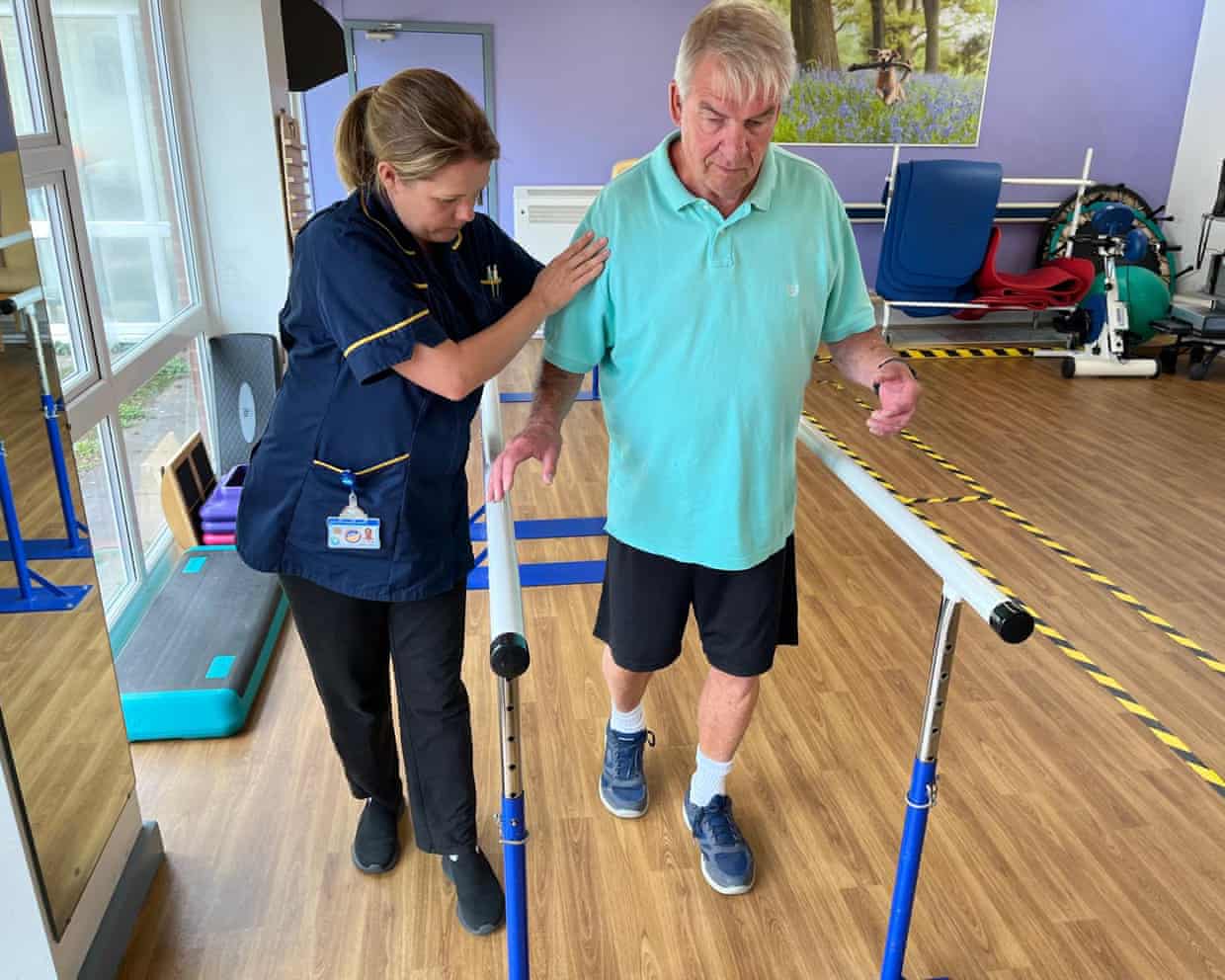
NHS rehabilitation care staff shortage fails stroke patients, say health leaders
The NHS is failing stroke patients and limiting their chances of recovery because of a shortage of rehabilitation care staff, health leaders have said.More people are surviving strokes than ever before in the UK. But their hopes of getting better are being dashed because of a lack of physiotherapists and other specialist staff, according to the Chartered Society of Physiotherapy and the Association of Chartered Physiotherapists in Neurology.National guidelines say people who have had a stroke should receive therapy-based rehabilitation for three hours a day, five days a week. But data suggests that, on average, people only receive rehab three to four days a week in hospital, and one to two days once they are discharged, the CSP and Acpin said

Waitrose employee sacked after stopping shoplifter from taking Easter eggs

How Trump’s Iran war could make the world more reliant on coal
UK’s leading AI research institute told to make ‘significant’ changes

Google to tap into gas plant for AI datacenter in sharp turn from climate goals

Saudi-backed LIV Tour looks at staging national opens after plug on talent drain

Super League’s rousing Rivals Round offers timely boost for takeover talks