More than 1,000 Amazon workers warn rapid AI rollout threatens jobs and climate

More than 1,000 Amazon employees have signed an open letter expressing “serious concerns” about AI development, saying that the company’s “all-costs justified, warp speed” approach to the powerful technology will cause damage to “democracy, to our jobs, and to the earth.”The letter, published on Wednesday, was signed by the Amazon workers anonymously, and comes a month after Amazon announced mass layoff plans as it increases adoption of AI in its operations.Among the signatories are staffers in a range of positions, including engineers, product managers and warehouse associates.Reflecting broader AI concerns across the industry, the letter was also supported by more than 2,400 workers from companies including Meta, Google, Apple and Microsoft.The letter contains a range of demands for Amazon, concerning its impact on the workplace and the environment.
Staffers are calling on the company to power all its data centers with clean energy, make sure its AI-powered products and services do not enable “violence, surveillance and mass deportation”, and form a working group comprised of non-managers “that will have significant ownership over org-level goals and how or if AI should be used in their orgs, how or if AI-related layoffs or headcount freezes are implemented, and how to mitigate or minimize the collateral effects of AI use, such as environmental impact”,The letter was organized by employees affiliated with the advocacy group Amazon Employees for Climate Justice,One worker who was involved in drafting the letter explained that workers were compelled to speak out because of negative experiences with using AI tools in the workplace, as well as broader environmental concerns about the AI boom,The staffers, the employee said, wanted to advocate for a better way to develop, deploy and use the technology,“I signed the letter because of leadership’s increasing emphasis on arbitrary productivity metrics and quotas, using AI as justification to push myself and my colleagues to work longer hours and push out more projects on tighter deadlines,” said a senior software engineer, who has been with the company for over a decade, and requested anonymity due to fear of reprisal.
The letter accuses Amazon of “casting aside its climate goals to build AI”.Like other companies in the generative AI race, Amazon has invested heavily in building new data centers to power new tools – which are more resource intensive and demand high amounts of electricity to operate.The company plans to spend $150bn on data centers in the next 15 years, and just recently said it will invest $15bn to build data centers in northern Indiana and at least $3bn for data centers in Mississippi.The letter claims that Amazon’s annual emissions have “grown roughly 35% since 2019”, despite the company’s promise in 2019 to achieve net zero carbon emissions by 2040.It warns many of Amazon’s investments in AI infrastructure will be in “locations where their energy demands will force utility companies to keep coal plans online or build new gas plants”.
“‘AI’ is being used as a magic word that is code for less worker power, hoarding of more resources, and making an uninformed gamble on high energy demand computer chips magically saving us from climate change,” said an Amazon customer researcher, who requested anonymity out of fear of retaliation for speaking out.“If we can build a climate saving AI – that’s awesome! But that’s not what Amazon is spending billions of dollars to develop.They are investing fossil fuel energy draining data centers for AI that is intended to surveil, exploit, and squeeze every extra cent out of customers, communities, and government agencies.”In a statement to the Guardian, Amazon spokesperson Brad Glasser pushed back on employees’ claims and pointed toward the company’s climate goals.“Not only are we the leading data center operator in efficiency, we’re the world’s largest corporate purchaser of renewable energy for five consecutive years with over 600 projects globally,” said Glasser.
“We’ve also invested significantly in nuclear energy through existing plants and new SMR technology–these aren’t distractions, they’re concrete actions demonstrating real progress toward our Climate Pledge commitment to reach net-zero carbon across our global operations by 2040.”The letter also includes strict demands around the role of AI in the Amazon workplace, demands that, staffers say, arose out of challenges employees are experiencing.Three Amazon employees who spoke to the Guardian claimed that the company is pressuring them to use AI tools for productivity, in an effort to increase output.“I’m getting messaging from my direct manager and [from] of all the way up the chain, about how I should be using AI for coding, for writing, for basically all of my day-to-day tasks, and that those will make me more efficient, and also that if I don’t get on board and use them, that I’m going to fall behind, that it’s sort of sink or swim,” said a software engineer who has been with Amazon for over two years, requesting anonymity due to fear of reprisal.The worker added that just weeks ago she was told by her manager that they were “expected to do twice as much work because of AI tools”, and expressed concern that the output expected demanded with fewer people is unsustainable, and “the tools are just not making up that gap.
”The customer researcher echoed similar concerns.“I have both personally felt the pressure to use AI in my role, and hear from so many of my colleagues they are under the same pressure …”.“All the while, there’s no discussion about the immediate effects on us as workers – from unprecedented layoffs to unrealistic expectations for output.”The senior software engineer said that the adoption of AI has had imperfect outcomes.He said that most commonly, workers are pressured to adopt agentic code generation tools: “Recently I worked on a project that was just cleaning up after a high-level engineer tried to use AI to generate code to complete a complex project,” said this worker.
“But none of it worked and he didn’t understand why – starting from scratch would have actually been easier.”Amazon did not respond to questions about the staffers’ workplace critiques about AI use.Workers emphasized they are not against AI outright, rather they want it to be developed sustainably and with input from the people building and using it.“I see Amazon using AI to justify a power grab over community resources like water and energy, but also over its own workers, who are increasingly subject to surveillance, work speedups, and implicit threats of layoffs,” said the senior software engineer.“There is a culture of fear around openly discussing the drawbacks of AI at work, and one thing the letter is setting out to accomplish is to show our colleagues that many of us feel this way and that another path is possible.
”

Almost 4 million children in UK affected by economic abuse, charity finds
Almost 4 million children in the UK are suffering the impact of economic abuse in their families, with some having pocket or birthday money stolen by the perpetrators, a charity has found.Data from charity Surviving Economic Abuse (SEA) showed that over the past year 27% of mothers with children under 18 had experienced behaviour considered to be economic abuse, where a current or former partner has controlled the family’s money.The research found perpetrators used various means, including stopping mothers accessing bank accounts and child benefits, and refusing to pay child maintenance.As a result, some children are missing out on essentials including clothes and food.A third of the women who experienced economic abuse by a former partner reported that their ex refused to pay child support, or paid it unreliably, despite being able to afford it
Resident doctors in England to go on strike in run-up to Christmas
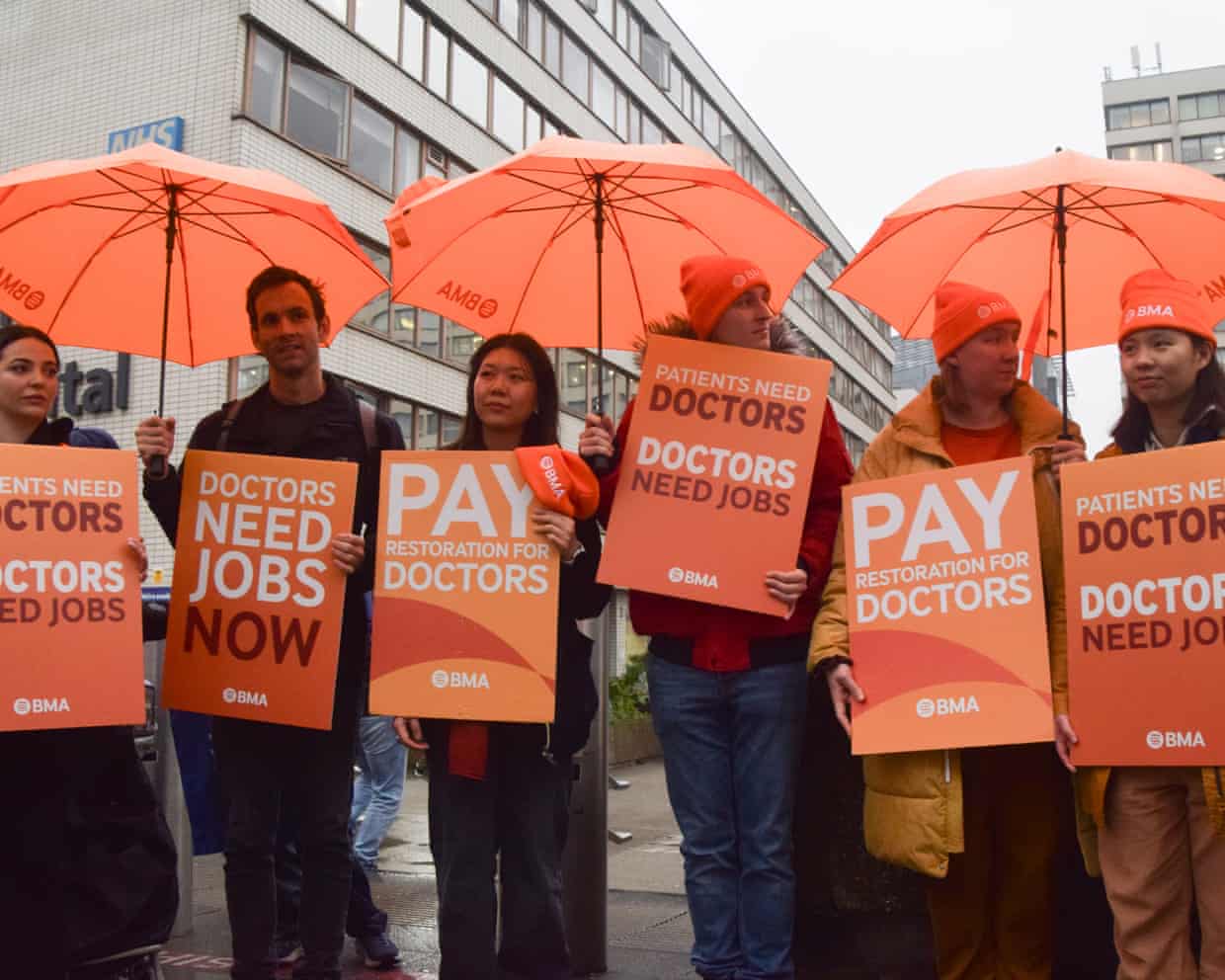
Thousands of doctors in England are to go on strike again this month, in a dispute over pay and job security.The British Medical Association has announced that resident doctors – formerly known as junior doctors – will begin a five-day strike action that will run from 7am on 17 December until 7am on 22 December.It is the 14th strike by doctors since March 2023 and follows a similar five-day action last month, which led to warnings that the NHS may have to cut frontline staff and offer fewer appointments and operations if the strikes continue.The BMA said resident doctors were being driven “away from jobs and to the picket line” because the government was failing to make a “credible offer on jobs or pay”.Dr Jack Fletcher, chair of the BMA’s resident doctors committee, said: “With the government failing to put forward a credible plan to fix the jobs crisis for resident doctors at the same time as pushing a real-terms pay cut for them, we have no choice but to announce more strike dates
Assisted dying bill is safer than any other in the world | Letters
Dr Lucy Thomas raises some interesting points in her defence of the House of Lords’ behaviour on assisted dying (Letters, 26 November). But it is a stretch to suggest that the 1,000 amendments that peers have tabled to the bill represent effective independent scrutiny.What possible justification can there be for requiring every dying person – including a 90-year-old in their final weeks with advanced metastasised cancer – to provide a negative pregnancy test before their request is approved (amendment 458)? I am sure there are many peers who want to scrutinise the bill in a sensible way, but they are being thwarted by a handful who seem intent on stopping law change at any cost.The bill as currently drafted – which MPs have amended and approved – is safer than any other in the world, including in its protections for doctors. Clause 31 ensures that if Dr Thomas doesn’t wish to support her patients with this option, she would be under absolutely no obligation to do so

Beware flammable skincare, too many sprouts and overindulging in cheese this Christmas, say health experts
Christmas might be a season of comfort and joy but health experts have warned of lurking dangers, ranging from the fire risk posed by skin creams to the possibility of festive foods interacting with certain medications.People using medical moisturisers known as emollient creams, often used for eczema and other dry skin conditions, should stay away from heat sources including candles and open flames because such creams can soak into fabrics and make them more flammable, according to the Medicines and Healthcare products Regulatory Agency (MHRA).The agency also warns that traditional Christmas vegetables, including brussels sprouts and broccoli, can be problematic for people who take the anticoagulant warfarin, as the high levels of vitamin K they contain can reduce the medication’s effectiveness.“These foods should not be avoided altogether – instead, try to eat consistent amounts so your vitamin K levels remain steady,” the MHRA said.However, some people may need to avoid festive treats

Shortage of ‘breakthrough’ weight loss drugs will slow fight against obesity, WHO warns
Weight loss drugs such as Mounjaro offer huge potential to tackle soaring obesity globally but are currently only available to one in 10 of those who need them, the World Health Organization has said.Their proven effectiveness in helping people lose weight means the medications represent “a new chapter” in how health services can treat obesity and the killer diseases it causes, the WHO added.Its statement urged countries to do what they could to ensure that people who would benefit from glucagon-like peptide-1 (GLP-1) therapies could access them. But while eligible adults generally should get them, pregnant women should not use them, the WHO stated.Limits on global production capacity mean that now only at most about 100 million people could receive the drugs – only 10% of the 1 billion who could benefit

‘It was extremely pornographic’: Cara Hunter on the deepfake video that nearly ended her political career
When Cara Hunter, the Irish politician, looks back on the moment she found out she had been deepfaked, she says it is “like watching a horror movie”. The setting is her grandmother’s rural home in the west of Tyrone on her 90th birthday, April 2022. “Everyone was there,” she says. “I was sitting with all my closest family members and family friends when I got a notification through Facebook Messenger.” It was from a stranger

Skye Gyngell obituary

‘Premium but not ostentatious’: the best extra virgin olive oils to gift instead of wine

Benjamina Ebuehi’s coffee caramel and rum choux tower Christmas showstopper – recipe

Facing burnout, she chased her dream of making pie - and built an empire: ‘Pie brings us together’

Yes, there are reasons to be cynical about Thanksgiving. But there’s also turkey …

Wine magnums aren’t just for Christmas – or even champagne